Nova Scotia, New Brunswick, and Prince Edward Island
NOVA SCOTIA, which at first included what is now known as Nova Scotia, New Brunswick, and Prince Edward Island, was first discovered by Sebastian Cabot, in 1497, under Henry VII. Cabot touched Labrador, and sailed along the Atlantic coast to Delaware. This voyage became, subsequently, the basis of England's claim to North America.
The first settlement was made by the French (who also claimed Nova Scotia), under Des Monts, at Port Royal (now Annapolis), in 1604. This is the oldest settlement in North America north of the Gulf of Mexico. Des Monts named the country Acadia. This was changed to Nova Scotia in 1621, when James I, of England, granted the territory to Sir Wm. Alexander.
There was almost continual war between France and England over eastern Canada until, in 1763, the Treaty of Paris ceded all French claims east of the Mississippi River to England.
It was during this conflict in the summer of 1755 that the New England colonies, under General Winslow, took seven thousand Acadians (French) from their peaceful homes on the shores of the15Bay of Fundy, and scattered them along the Atlantic coast from New Hampshire to Georgia. Families were separated, never to be united. Colonial papers for years were filled with mournful advertisements of husbands and wives searching for lost companions, and parents for their missing children, and vice versa, but of all these inquiries, few were successful. From this cruel scheme, Longfellow composed his beautiful poem, “Evangeline,” a fair and solemn account of the “Tale of Acadie.”
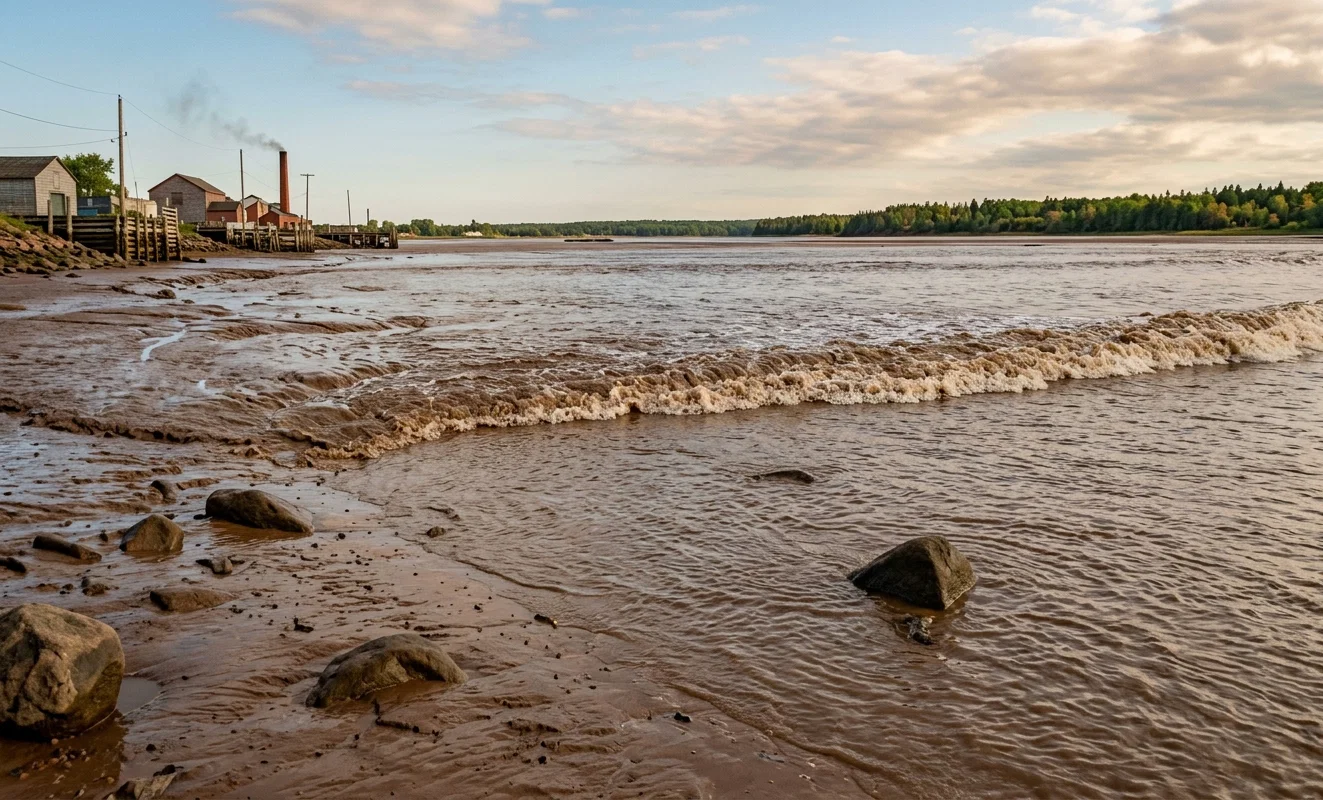
THE TIDAL BORE AT MONCTON, N. B.
“There disorder prevailed, and tumult
and stir of embarking.
Busily plied the freighted boats; and high,
in the confusion
Wives were torn from their husbands,
and mothers, too late, saw their
children
Left on the land, extending their arms, and
with wildest entreaties.”
In 1770 Prince Edward Island became a separate province, and in 1784 New Brunswick separated from Nova Scotia. The term “Canada” was applied only to the provinces of Quebec and Ontario, until 1867, when the dominion was formed, incorporating Nova Scotia and New Brunswick. Prince Edward Island joined in 1873. The colony of Newfoundland, which embraces Labrador, is the only colony now outside of the dominion.
These provinces remained loyal to the crown during the American Revolution, and as a result thousands of the royalist refugees from the United States settled here during and after the war. With these, the inhabitants are English, Scotch, some Irish, and a few French. The population now numbers about one million, with fifty-one square miles of territory.
Ample facilities are provided for travel by well-equipped steamships by water and vestibule trains by land. The country is principally settled along the extensive seacoast, and in the rich river valleys. The soil is deep and fertile, well adapted to grazing, and produces luxuriant grains, fruits, and vegetables.
The land is for the most part undulating, the hills are covered with beach, birch, and maple, thickly interspersed with towering evergreens—fir, spruce, and pine.
Thousands of tourists from all parts of the world annually visit this country to view the wonders of nature, prominent among which are the tides of the Bay of Fundy, the highest in the world, often rising seventy feet, compelling rivers to change their course and flow upstream for forty miles, twice each day; the “reversing falls” in the river St. John, when at the turn of the tide, which is so rapid that the water actually falls over the reef upstream for several hours; the Petitcodiac Bore, or tidal wave, which rolls up the stream a foaming wall of water from two to eight feet high, twenty-five miles from the sea.
The climate is remarkably healthful. There are several people over one hundred years old. Mr. Ross, of St. Martins, New Brunswick, is one hundred and thirteen years old. He went into his field and mowed with the scythe last summer. The rigor of winter is modified by the insular character of the country and the influence of the Gulf Stream. Ninety-five degrees above zero is the warmest, and fifteen degrees below, the coldest, with the exception of New Brunswick, where, in the northern portion, it runs lower.
The Indian summers are very delightful. Winter begins about the middle of December, and lasts until about the middle of March. Some winters the snow has reached a depth of three feet.
The principal industries are fishing, lumbering, grazing, agriculture, manufacturing, and mining coal, gypsum, copper, and gold.
The people are very hospitable, reflective, and love truth. All denominations are found here, the Baptists predominating numerically. GEO. E. LANGDON.