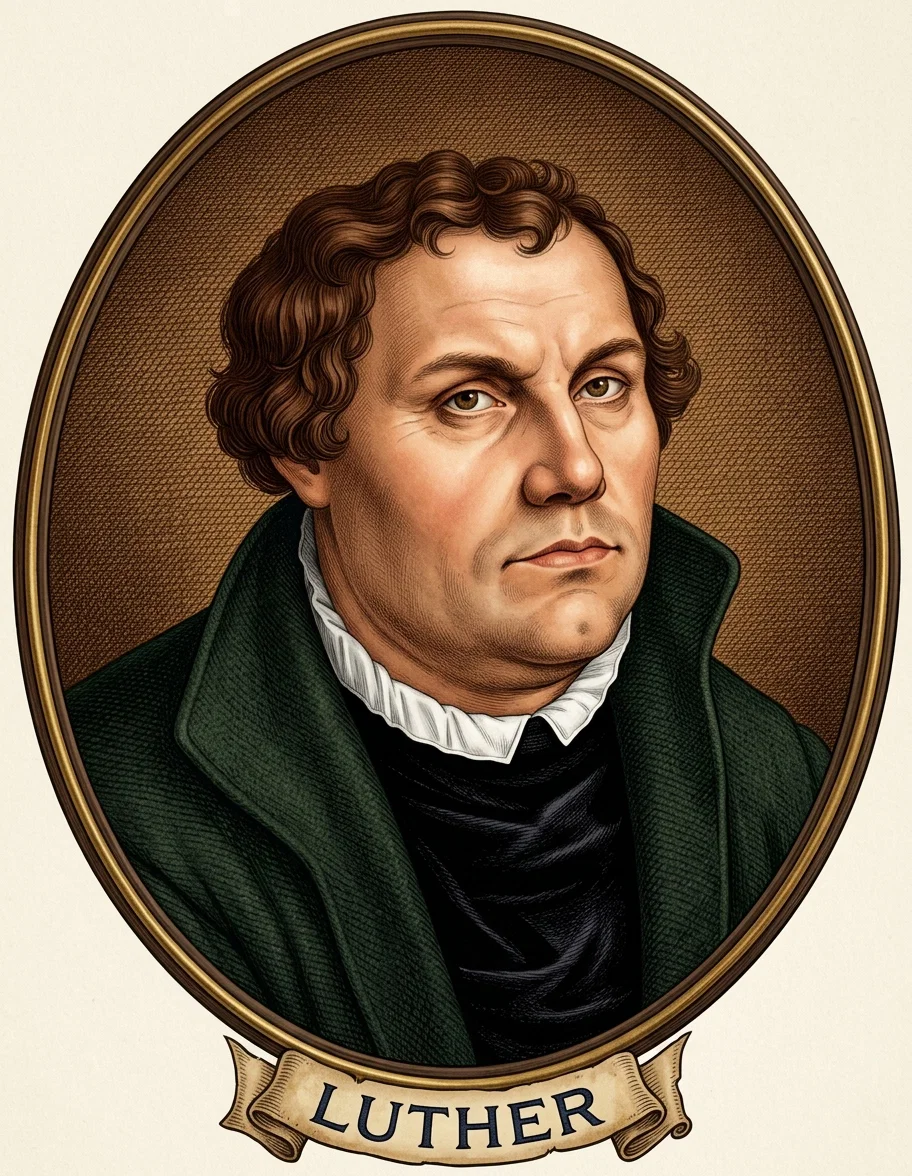
Martin Luther’s Hymn

10%

Seventh-day Adventist Publishing Association · Battle Creek, Michigan · Apr 15, 1902

FromReview and Herald, Vol. 79, No. 15.

Read the full edition

Martin Luther’s Hymn

ONE of the most historic and inspiring hymns of all time is Martin Luther’s famous song beginning, “Ein’ feste Burg ist unser Gott,”—“A mighty fortress is our God.” It is the battle hymn of the Protestant Reformation, and the national hymn of Germany. It is based on the forty-sixth psalm: “God is our refuge and strength, a very present help in trouble. Therefore will not we fear, though the earth be removed.” There are no less than sixty-five different translations of this hymn into English. The most faithful and forcible of all these translations is that by Thomas Carlyle.
The translation which is most popular in America is that of Rev. F. H. Hedge (1805–1890), a Unitarian minister and professor in Cambridge Divinity School. It was made in 1852, and is in part as follows:—
“A mighty fortress is our God, A bulwark never failing; Our helper he, amid the flood Of mortal ills prevailing, For still our ancient foe Doth seek to work us woe; His craft and power are great, And, armed with cruel hate, On earth is not his equal.
“Did we in our own strength confide, Our striving would be losing, Were not the right man on our side, The man of God’s own choosing. Dost ask who that may be? Christ Jesus, it is he; Lord Sabaoth is his name, From age to age the same, And he must win the battle.
“And though this world, with devils filled, Should threaten to undo us, We will not fear, for God hath willed His truth to triumph through us. The prince of darkness grim— We tremble not for him; His rage we can endure, For, lo, his doom is sure, One little word shall fell him.”
It is easy to see that the man who wrote this hymn had the faith and courage to lead the great Reformation to a glorious victory. Luther is really the father of modern Christian hymnology. In the early days of Christianity, the singing of psalms and hymns was a most popular and impressive part of public worship, but in the latter part of the fourth century (at the Council of Laodicea, 363 A. D.) the church prohibited laymen from taking any part in the singing; and from that time on, the priest did practically all the singing, and this was done mostly in an unknown tongue. It was Martin Luther who brought popular Christian song back again to worshiping congregations as their own divine right and precious privilege. His translation of the New Testament into the language of the people, and placing it in their hands, was a work which they appreciated and enjoyed only a little more than they did the privilege of singing bright and joyful Christian songs in their own language. It was Luther who made the singing of Christian hymns popular with the masses and with the common people. They heard him gladly as he preached, but still more gladly as he sang the blessed gospel, and taught them how to sing its songs of faith and hope and love. . . .
The inscription on Luther’s monument in Wittenberg is the first line of this hymn. This hymn was Luther’s solace in his times of greatest peril. When dangers gathered thickest about him, he would say to Melancthon: “Come, Philip, let us sing the forty-sixth psalm,” by which he meant his own “characteristic version.”
“Luther, full of faith,” says D’Aubigné in his “History of the Reformation,” “revived the courage of his friends by composing, and singing with his fine voice, that beautiful hymn, since become so famous: ‘Ein’ feste Burg ist unser Gott.’ Never did soul that knew its own weakness, but which, looking to God, despised every fear, find such noble accents.”—W. F. Tillett, in Sunday School Magazine.