Is GOD Particular?

3%

Pacific Press Publishing Association · Mountain View, California · Dec 11, 1928

FromSigns of the Times, Vol. 55, No. 49.

Read the full edition

Is GOD Particular?

Some say that God is not so particular after all which day we keep as the Sabbath, just so long as we keep one day. But is that so?
CARLYLE B. HAYNES
IN LEVITICUS 16:12 God instructed the priests that when they offered incense they should fill their censers “full of burning coals of fire from off the altar before the Lord.”
This instruction did not seem to be of great importance to two priests, Nadab and Abihu, the sons of Aaron. They “took either of them his censer, and put fire therein, . . . and offered strange fire before the Lord, which He commanded them not.” Leviticus 10:1.
Presumably Nadab and Abihu reasoned as some people reason to-day. They could see no difference between fires. Fire was fire. All fire would burn incense. There was no difference between this fire and that fire. Why should they use the fire that God had commanded when other fire would do just as well?
So people reason with regard to the Sabbath. A day is a day. All days are alike. One is as good as another. It is true that God has said the seventh day is the Sabbath; but the first will do just as well. What is the difference? It is so inconvenient to keep the seventh, and everybody is keeping the first; and so, since it does not make any difference, we will just do the easiest way. So people reason, and so, trifling with the plain words of God, they lose their souls.

GOD’S COMMAND MAKES THE DIFFERENCE

Was there any difference between the two fires? Probably not so far as the fire itself was concerned. The thing that made the difference was the command of God. God had said this fire, not that. That God meant what He said, and held all men accountable for obeying it, the two priests who held God’s command so lightly soon discovered, for we read: “There went out fire from the Lord, and devoured them, and they died before the Lord.” Leviticus 10:2.
It is always safe to do just what the Lord says. God had said they should use a particular fire; and, while there may not have been much difference between fires, yet there was a difference, and that difference was made by the command of God. God had commanded a certain fire. That command made it different from all other fire; and no other fire would answer, as these disobedient priests discovered.

FIFTY THOUSAND SLAIN FOR DISOBEDIENCE

There is the record, on another occasion, that the ark was captured by the Philistines, and caused so much trouble in their land that they decided to send it back to its own land.
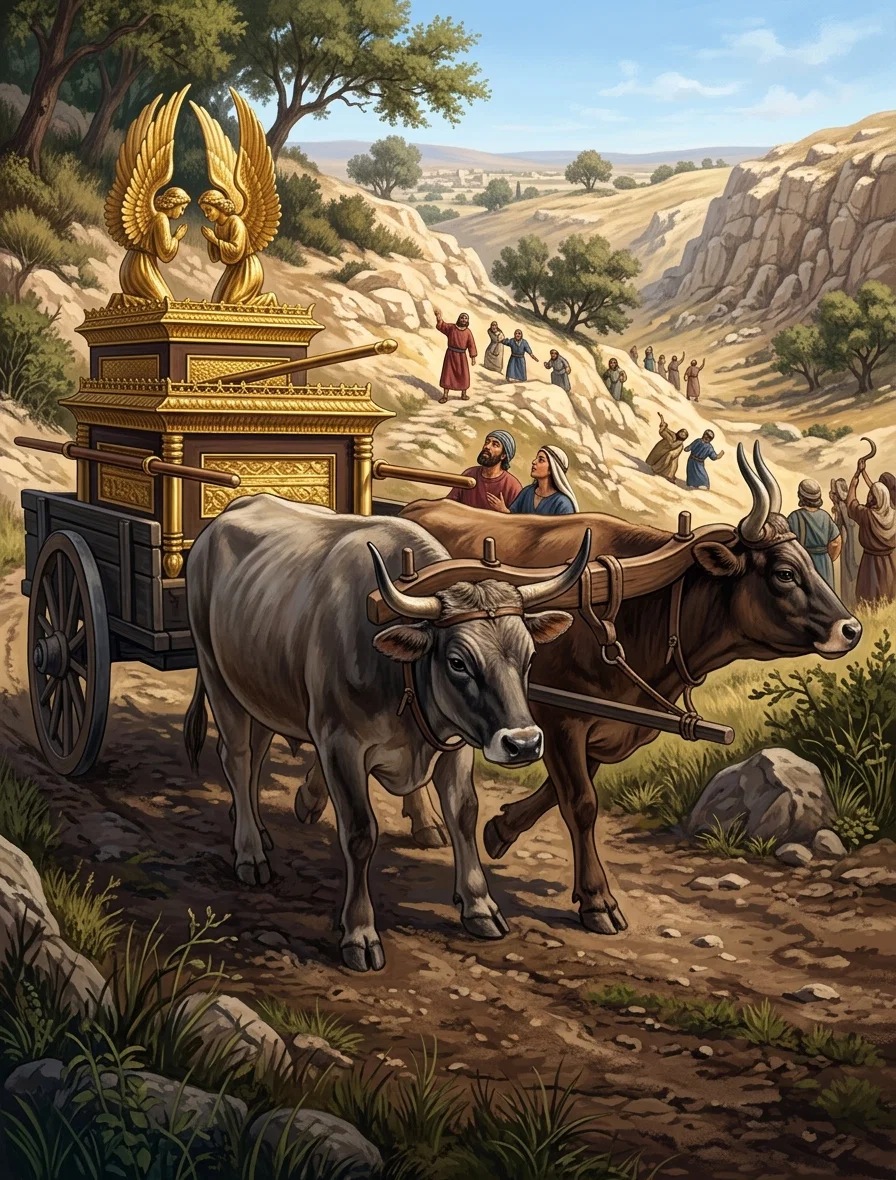
The Philistines built a new cart, harnessed two milch cows to it, and sent it away. “The kine took the straight way to the way of Beth-shemesh, and went along the highway, lowing as they went. . . . And they of Beth-shemesh were reaping their wheat harvest in the valley: and they lifted up their eyes, and saw the ark, and rejoiced to see it.” 1 Samuel 6:12, 13.
They were so rejoiced to see it that they forgot the command of God not to touch it, so they lifted the mercy seat and looked into the ark. “And He smote the men of Beth-shemesh, because they had looked into the ark of the Lord, even He smote of the people fifty thousand and threescore and ten men: and the people lamented, because the Lord had smitten many of the people with a great slaughter.” Verse 19.
Thus 50,070 more of the professed servants of God lost their lives by failing to remember and by neglecting just what God said.
There are those to-day who reason that if they offer one day to the Lord, though it may not be that day which He has commanded them to observe, it will make no difference. It makes just the difference between what God has commanded and what He has not commanded. If He declares one day to be the Sabbath, as He does in the fourth commandment, then that day is the only day it is safe to offer Him.

THE PLEA OF MOSES

When the ark came back to Beth-shemesh unguided and drawn only by two cows, the people ran out and laid hold on it despite the word of God. Fifty thousand and more were slain.
There is reason, then, in the admonition of Moses to the children of Israel just before they entered into the Promised Land and just as Moses was about to be removed from them by death. He pleaded with them to remember the exact words of God’s commandments, and heed them. “Now therefore hearken, O Israel, unto the statutes and unto the judgments, which I teach you, for to do them, that ye may live, and go in and possess the land which the Lord God of your fathers giveth you. Ye shall not add unto the word which I command you, neither shall ye diminish ought from it, that ye may keep the commandments of the Lord your God which I command you. . . . Keep therefore and do them; for this is your wisdom and your understanding in the sight of the nations, which shall hear all these statutes, and say, Surely this great nation is a wise and understanding people. . . . Only take heed to thyself, and keep thy soul diligently, lest thou forget the things which thine eyes have seen, and lest they depart from thy heart all the days of thy life: but teach them thy sons, and thy sons’ sons.” Deuteronomy 4:1-9.

THESE THINGS FOR OUR LEARNING

This admonition comes to Christian people with striking force to-day in the words of Paul when he urges us to consider the dealings of God with His ancient people as warnings, especially to those who live in the days of the end. “Now all these things happened unto them for ensamples: and they are written for our admonition, upon whom the ends of the world are come.” 1 Corinthians 10:11.
God declares the seventh day to be the Sabbath. There is no command in the Bible for the observance of Sunday. The Bible does not give the slightest hint of a Sunday institution. Christ never observed Sunday. The apostles never once kept Sunday. The Bible contains no prophecy that Sunday would ever take the place of the Sabbath, and no record that it ever has. Neither God, Christ, angels, nor inspired men ever uttered one word in favor of Sunday as a holy day.
On the other hand, God has placed His blessing on the seventh day, and sanctified it. He commanded it to be kept holy in the only commandment in the Bible for a weekly day of rest. He has placed in the Bible great and precious promises for those who will observe the seventh day. Everything can be produced in favor of the seventh day, nothing in favor of the first—no sanctity, no commandment, no penalty, no blessing.
Shall we obey God in this matter of Sabbathkeeping, and observe the day He has commanded us to observe; or shall we disobey Him, and observe a day that He has never once commanded us to keep? Which will you choose to do?
Remember, in this connection, that, according to James 2:8-12, it is this very law that contains the Sabbath commandment which will be the standard of the judgment when our cases come up in review before God. Our lives are to be measured by the law of Ten Commandments.
When we finally stand before the judgment bar of God and the law is applied to our lives, what shall we say if we have deliberately rejected His Sabbath? Shall we look up into the face of God and tell Him that we had been under the impression that it did not make any difference whether we did as He told us to do or not? Shall we tell Him that, while the Sabbath question had
been made very plain to us, yet we thought He would be just as well pleased if we kept Sunday, the day He never commanded, as He would if we kept the true Sabbath which He had commanded? Shall we add that it was much more convenient to keep Sunday, as all our neighbors were doing, and it meant a greater cross than we could think of bearing to observe the true Sabbath? Shall we say this to God? If we do, what do you think will be the result? Will God consider that we have obeyed Him or disobeyed Him?
As God pronounces upon the disobedient the just sentence of death for their violation of His righteous law, there will come to their minds His loving plea in a time long ago: ‘O that thou hadst hearkened to My commandments! then had thy peace been as a river, and thy righteousness as the waves of the sea.’ Isaiah 48:18.
Heed this plea now, before it is too late.