Would Peter be as lax and cold as the majority of the church-going laity, or would he stand out from the crowd and with fiery zeal condemn the world for the glaring inconsistencies that are so indicative of the times in which we are living?
VARNER J. JOHNS
He came unto His own, and His own received Him not.' For long, weary centuries Israel had waited for the fruition of her hopes in the coming of the Redeemer. Now He had come. Light divine shone upon the darkened plains of old Judea. The wonderful life that He lived, the marvelous miracles that He performed, the saving truths that He proclaimed, gave unmistakable evidence of His Messiahship. But the people loved darkness rather than light. They expected a conqueror; He came as a servant. They longed for a deliverer from the hated Roman yoke; He came to deliver them from the heavy yoke of sin. They would have welcomed a Jewish Cæsar, but they rejected the lowly Jesus, the world's Saviour.
“Whom do men say that I . . . am?” Jesus was talking now to the twelve disciples. His name was on everybody's lips. Some called Him the prophet Elias; others, the prophet Jeremiah. Some said He was John the Baptist restored to life. They gloried in His miracles and marveled at His teachings, but they bitterly resented His direct appeal for the renunciation of hidden sin. “But whom say ye that I am?” Jesus was now searching the hearts of the disciples themselves. Quick as a flash, from the lips of impetuous, great-hearted Peter, came the declaration: “Thou art the Christ, the Son of the living God,” to which Jesus replied: “I say also unto thee, That thou art Peter, and upon this rock I will build My church; and the gates of hell shall not prevail against it. And I will give unto thee the keys of the kingdom of heaven: and whatsoever thou shalt bind on earth shall be bound in heaven: and whatsoever thou shalt loose on earth shall be loosed in heaven.” Matthew 16:13-19.
CENTER OF THEOLOGICAL BATTLE
Around these words has centered many a theological battle. Twenty millions of people in our land believe that Peter was the first pope. As many more believe that Peter, if here to-day, would be a Methodist or a Baptist or an Episcopalian. What church would Peter join if he should come to your town to-day?
I wish to state briefly six propositions as evidence that Peter was never considered a pope, that he never had the preeminence among the disciples.
1. Before leaving the disciples Jesus told them that it was expedient for Him to go away in order that His representative might come. And the representative of Christ, the One who was commissioned to guide people into all truth, is clearly stated to be the Holy Spirit. (John 16:7-13.)
2. The church of the living God is built upon the foundation of all the prophets and apostles. Not Peter alone, but all were lively stones in that magnificent structure, the church. (Ephesians 2:19, 20.)
3. The chief corner stone of the church is the Lord Jesus. The testimony of this verse is so clear that it cannot be misunderstood. Peter himself called Jesus “the head of the corner.” 1 Peter 2:7, 8.
CHRIST IS THE ROCK
4. In all the Bible—and there are thirty-five instances in the Old Testament alone—Christ is called the rock. Not Peter, but Jesus the Son of God, is the rock, the tried stone, the corner stone of the church.
Using the words of the original Greek, the verse in Matthew would read, “Thou art Petros, and upon this petra I will build My church.” The words petros and petra have different meanings. Liddell and Scott’s Greek-English Lexicon says: “Petros, a piece of rock, a stone, and thus distinguished from petra . . . a ledge, or shelf, of rock. . . . Petrai [a variation of petra] are not loose stones, but masses of living rock.” Jesus is the living rock upon which His church is founded. Peter was but a fragment of stone and, like us, had life only in Christ.
5. The other apostles were given the same authority and power as was given to Peter. (Matthew 18:18; John 20:21-23.) The keys of gold that unlock the gates of heaven to the sin-bound soul are the Old and New Testaments of God's wondrous Book. The acts of the church in opening the word of God to men, thus opening to them the way to life eternal, are ratified in heaven. If Peter was a pope, then we are all popes, for we are all disciples of Christ.
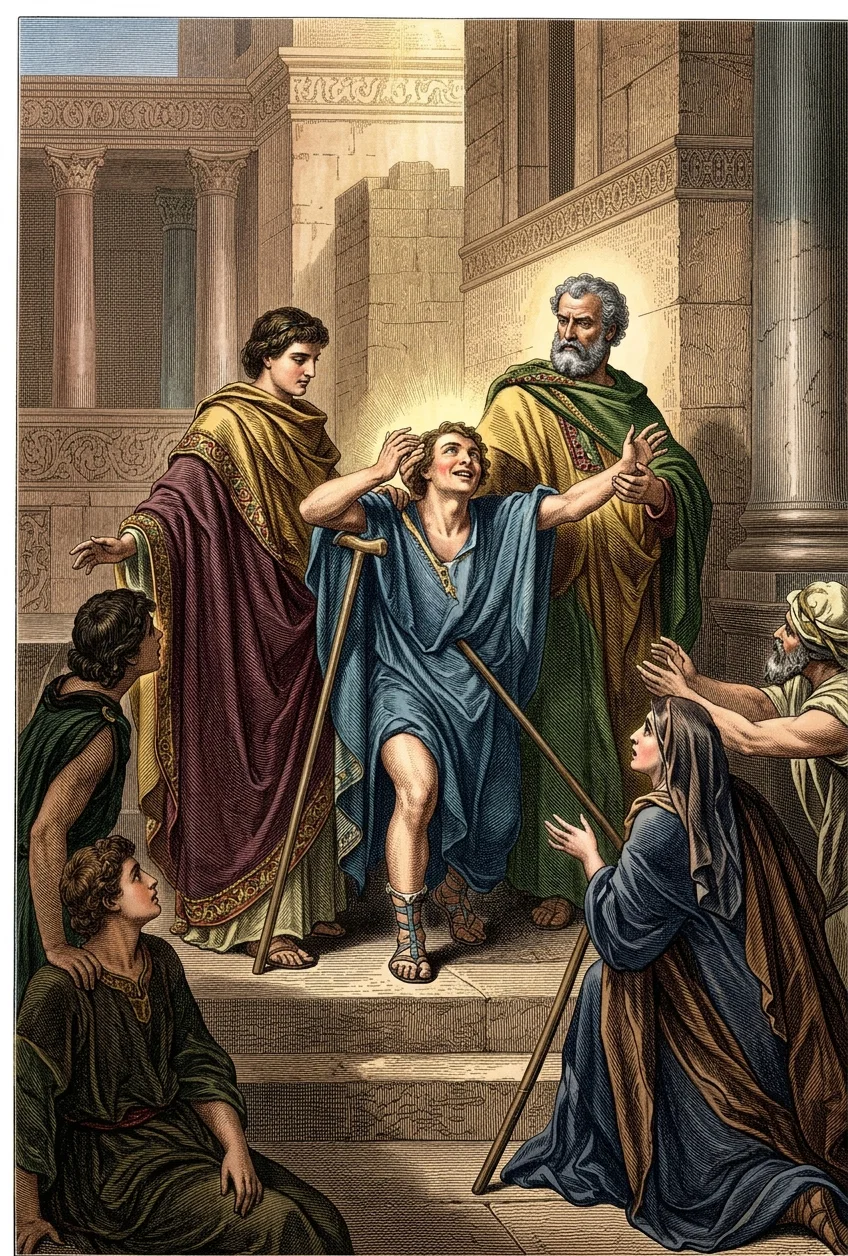
Peter and John heal the lame man at the entrance to the temple.
6. Peter himself acknowledged that he was on a par with his fellow disciples. (Acts 10:25, 26.) In the great council at Jerusalem it was not Peter but James who presided. If there were a preeminence, it belonged to the apostle James.
If Peter were in your town to-day, he would be a Protestant—but I scarcely utter the word before I seek to qualify it. O Protestantism, what absurdities and inconsistencies are taught in your sacred name! The Protestantism of Reformation days exalted the Bible as the voice of God speaking to man. “The Bible and the Bible only” as a rule of faith was the platform upon which Protestantism was built. Upon this platform the apostle Peter could stand. But the Protestantism of to-day is no longer a protest against traditional error and a proclamation of eternal truth. These shorter bibles and lesser christs, these travesties on truth that would pervert the meaning of Christ’s redemptive program, scrap the Ten Commandments, and substitute a message of social service for the gospel of salvation—these are no part of Protestantism. These wild fanaticisms, with their jazz hymns, their senseless jargon of “unknown” tongues, their “hip-hip-hoorah” preaching and praying—these religious tragedies that cover a multitude of sins with loud hallelujahs—are no part of Protestantism. These stately creeds, cold, formal, and lifeless, mimicking Rome and mocking apostolic Christianity, multiplying holydays and ritualistic services while dividing the truth of the Bible—these are no part of Protestantism.
SCRIPTURES DIVINELY INSPIRED
The Scriptures were read by the apostle Peter as the sacred oracles of God. “Holy men of God spake as they were moved by the Holy Ghost,” was his testimony as to the worth of Old Testament prophecy. The inspired and inspiring messages from the books of the Old Testament were living truths in the estimate of Peter. And why should they not have been since they testified of Jesus, the One who had lifted Peter from the miry clay and placed his feet upon the solid rock? Peter could never fellowship with a church that repudiates the writings of Old Testament scripture; with a church that denies the divinity of Jesus, His Sonship, His miraculous birth, His glorious resurrection, His saving power; or with a church that rejects any one of the Ten Words that were spoken by Jesus upon Mt. Sinai.
A church that exalts the Bible and the Christ of the Bible; a church that repudiates the God-dishonoring doctrine of evolution; a church that preaches salvation through the blood of Christ, a new birth, regeneration, growth in grace, and a triumphant experience in Christ; a church that upholds the majesty of the Ten Commandments; a church that carries into all the world the gospel of the kingdom; a church that is Spirit-filled and Spirit-led in its program of world evangelization,—for such a church would Peter seek if in your town to-day. Could he find it?