As told by our correspondent in the West Indies, who arrived in the destroyed city shortly after the holocaust.
ALFRED R. OGDEN
Havana, Cuba
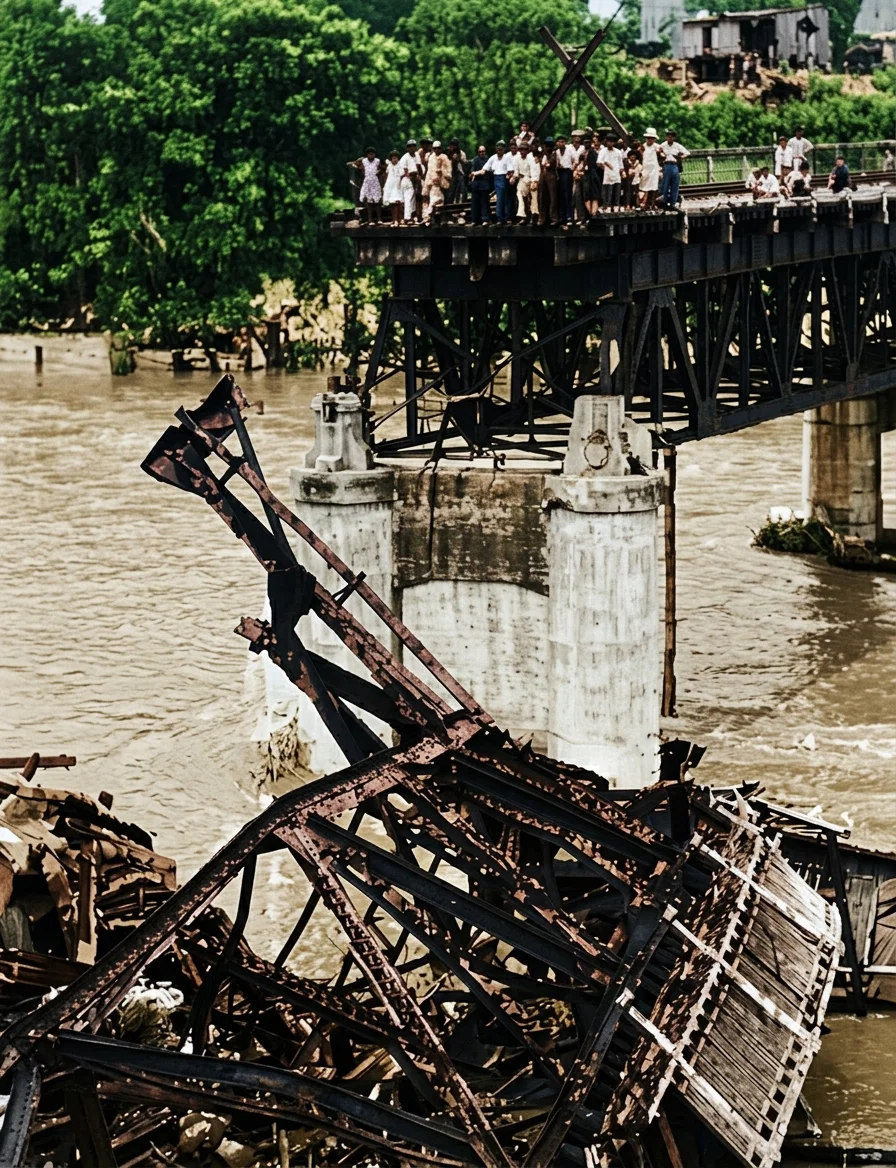
One can best appreciate the tremendous power of these tropical hurricanes when he considers the force necessary to wrest in two a great, strong bridge like this constructed of steel and concrete.
ANOTHER catastrophe of unusual severity was witnessed in the recent Caribbean hurricane that struck with such terrific force the capital city of the Republica Dominicana, better known as Santo Domingo. Santo Domingo is the east portion of the island more familiarly known as Haiti. The island of Haiti is divided into two republics, the French-speaking Republic of Haiti, comprising about one third of the west end of the island, and Spanish-speaking Santo Domingo, comprising the larger portion of the east end of the island. Though Santo Domingo has about two thirds of the territory of the island, yet the population is only about one million people, as compared with nearly three millions in Haiti.
WHERE COLUMBUS LANDED
This island was discovered by Christopher Columbus on the occasion of his first trip and discovery of the New World. He first landed on San Salvador, one of the islands of the Bahama group, October 12, 1492. From there he steered his course to the south, discovering Cuba, “the Pearl of the Antilles,” as it is familiarly known. After spending some days along the northern shores of Cuba, thinking that he had discovered the mainland of the East Indies, the continent that he had set out to reach by a shorter and more direct route than had hitherto been known, he turned his course eastward, soon discovering the island of Haiti, known in early history as “Hispaniola.” His first landing was on the northwestern portion of this island. Later he went around to the south of the island, finally landing at the point where the capital of the present Santo Domingo Republic is located. Here was established the headquarters of the newly discovered world, hence Santo Domingo City became the first permanent settlement in the New World by the white man, and is the oldest city in the Western Hemisphere.
It is a city full of historic interest. The body of the discoverer is kept in a metal casket in one of the Catholic cathedrals. But it is not of the historical settings that surround this interesting spot of this great Western Hemisphere of ours that I began to write, but rather to bring to the readers of this magazine a brief report of the terrible hurricane that struck this city on September 3, 1930.
A CIRCLE OF DESTRUCTION
These storms, known as “Caribbean hurricanes,” have been of more or less frequent occurrence since the early days of the discovery of this territory. Much as the cyclones of the Central States in America begin away out on the prairies by the changing currents of air that begin to move in a circular order, gathering momentum and force in their onward course, so these hurricanes of the Caribbean begin out in the waters of the Caribbean Sea, though operating in a much larger circle than the cyclones of the States. The cyclones of our Central States of America are usually of a very narrow circle, often covering not more than a few hundred feet in width, though they may travel long distances, usually in a northeasterly direction. The Caribbean hurricanes differ from the ordinary cyclone in this respect that they travel in large circles, often covering a breadth of a hundred miles or more; and while traveling in the circle at a tremendous speed the forward movement of the storm in a direct, straight-ahead course is rather slow. The force and destruction come from the excessive speed in the circle. This causes much damage, destroying life and property in the path of its onward course. The regularity of the time of year during which these storms occur is also interesting, as they nearly always come during the months of September or October, September, however, being the usual time of their appearance.
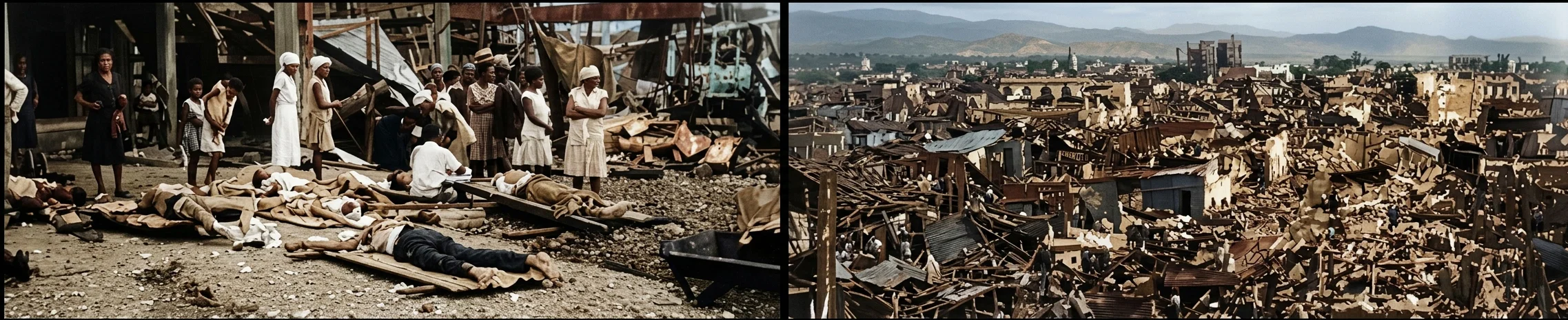
The path of the recent hurricane, known as the Santo Domingo hurricane, however, was not so wide as most, or many at least, of the storms of the past. The force of the storm seemed to center on the capital, Santo Domingo City, which before the storm had a population of approximately fifty thousand inhabitants. The storm was of such severity that scarcely a structure in the entire city was left standing unharmed, and most of the buildings were left in complete ruin.
ONLY A MASS OF DEBRIS
Two weeks after the terrible visitation I arrived at Santo Domingo City, which I had frequently visited during the past three years, and I could scarcely believe my eyes as I walked about over the city after landing and saw the heaps of wreckage and ruin everywhere. What less than two weeks before were the residences and business shops and public buildings of the city were one mass of indescribable wreckage. There was hardly a building but that was a heap of stone and mortar, or the scattered kindling wood of what before was a frame structure. Words altogether fail to begin to describe the awful destruction, not in one section only but throughout the entire city and reaching for a distance of fifty miles into the interior. Santo Domingo City is located on the southern shore of the island. This hurricane, true to the usual custom of the Caribbean hurricanes, came from the southeast, traveling in a northwestern course.
The Santo Domingo Hurricane
(Continued from page 16)
HOW DID ANYONE ESCAPE?
To view the wreckage, the marvel is that any person could have escaped instant death or at least very serious injury of body, as many indeed did. It is estimated from the most reliable figures and reports gathered that at least from three to four thousand persons were killed during the storm and from fifteen to twenty thousand were injured. Thus out of a population of fifty thousand nearly one half were either killed or injured. Many of the injured have since died from the severity of the injuries sustained or from gangrene and other causes incident to the storm. The death toll was so large that no attempt could be made to gather and bury the bodies. Many of them were gathered in heaps and burned in the streets. In one spot in one of the main streets witnesses testify that one hundred twenty bodies were burned at one time. Whole families were found dead in the ruins of their homes. But space forbids an attempt at detail. The suffering and death were indescribable. Three weeks after the storm it is estimated that the daily deaths from the injuries received numbered around forty.
In this calamity we have another evidence of the uncertainty of all things earthly. It is one more evidence that no person knows what a day may bring forth. The people of Santo Domingo City were busily engaged in their daily work, business, and pleasure during the early portion of the day, Wednesday, September 3. Suddenly in the afternoon the storm approached, increasing rapidly in its fury, leaving wreckage and ruin, suffering and death in its track, as evidenced by the facts and figures cited, and as seen with my own eyes in the almost complete annihilation of what a few days before was a thriving and prosperous city of the West Indies.
WHAT THESE THINGS MEAN
In every such calamity the student of God’s word and prophecy can find increasing evidence of the hastening of that great, grand, and glorious consummating event of all earth’s history, the second advent of our Lord and Saviour Jesus Christ. In speaking of the last generation before His second coming Christ prophesied: “There shall be signs in the sun, and in the moon, and in the stars; and upon the earth distress of nations, with perplexity; the sea and the waves roaring; men’s hearts failing them for fear, and for looking after those things which are coming on the earth: for the powers of heaven shall be shaken. And then shall they see the Son of man coming in a cloud with power and great glory.” Luke 21:25-27.
Glad day, yes, happy day, for with this event comes the end of the reign of sin and death, and the ushering in of that happy time described by the prophet John. “God shall wipe away all tears from their eyes; and there shall be no more death, neither sorrow, nor crying, neither shall there be any more pain: for the former things are passed away.” Revelation 21:4.
After viewing such ruin and witnessing such suffering and death as were seen in the Santo Domingo hurricane, our hearts cry out anew and long as never before for the hastening of that glad time when indeed “the former things are passed away,” for that blessed age when “there shall be no more curse.” Revelation 22:4. We unite as never before in praying, “Thy kingdom come. Thy will be done in earth, as it is in heaven.” Come, Lord Jesus, and come quickly. May the uncertainties of things earthly inspire all earnestly to prepare for that great event which, according to the prophecies of God’s word, is drawing near. The prophet Amos admonishes, “Prepare to meet thy God.”