A VERY remarkable document on the movies has recently been issued by the Christian Century. This material first appeared as a series of five articles in that journal from the pen of Fred Eastman. They are now reprinted in a separate brochure. We wish that every home in the land had a copy of this document. Surely every Christian worker should have one, and many parents too. It is entitled “The Menace of the Movies,” and can be obtained from the Christian Century, 440 South Dearborn Street, Chicago, at ten cents a copy or $7.50 a hundred.
Dr. Eastman, who is Professor of Religious Literature and Drama in the Chicago Theological Seminary, and a trained sociologist, has made an exhaustive study of the effect of the movies on conduct and character, especially among the children and youth. Although a liberal religionist, and writing in the chief organ of liberal religion in the United States, yet his indictment of the movies is a more drastic one by far than has ever appeared on these pages. He makes the movies out a menace of major importance not only to the mental and moral life of America, but also to America’s influence throughout the wide world where the films from Hollywood and elsewhere are exhibited.
In the first place, Mr. Eastman has polled a wide variety of opinion in the United States as to whether or not the movies have improved in their moral tone during the last ten years, since Will Hays became “the czar of the movies.” The unanimous opinion is that they have been gradually getting worse.
“The testimony, therefore, seems overwhelming to the effect that the movies have not been cleaned up. Their character is shady. Their morals are a mess. Their pull is downward. . . . But, worst of all, they are educating millions of young people daily in false standards of taste and conduct, false conceptions of human relationships.”
His indictment of the movies is:
“The movies are so occupied with crime and sex stuff and are so saturating the minds of children the world over with social sewage that they have become a menace to the mental and moral life of the coming generation.”
An analysis of what our modern motion pictures are made up of is most enlightening:
“The Child Welfare Committee of the League of Nations analyzed 250 films in 1926 and found in them ‘97 murders, 51 cases of adultery, 19 seductions, 22 abductions, and 45 suicides. Among the principal characters in these 250 pictures were 176 thieves, 25 prostitutes, 35 drunkards, etc.’”
“The Chicago Censorship Board in 1924 is said to have made the following eliminations from 788 pictures:
1,811 scenes of assault with guns, with
intent to kill
175 scenes of assault with knives, with
intent to kill
129 scenes of assault with other weap-
ons
231 scenes of hanging
173 scenes of horror (as clawing out
eyes, biting off ears, etc.)
757 scenes of attacks on women for im-
moral purposes
929 scenes of nudity and seminudity
31 scenes of jail breaking”
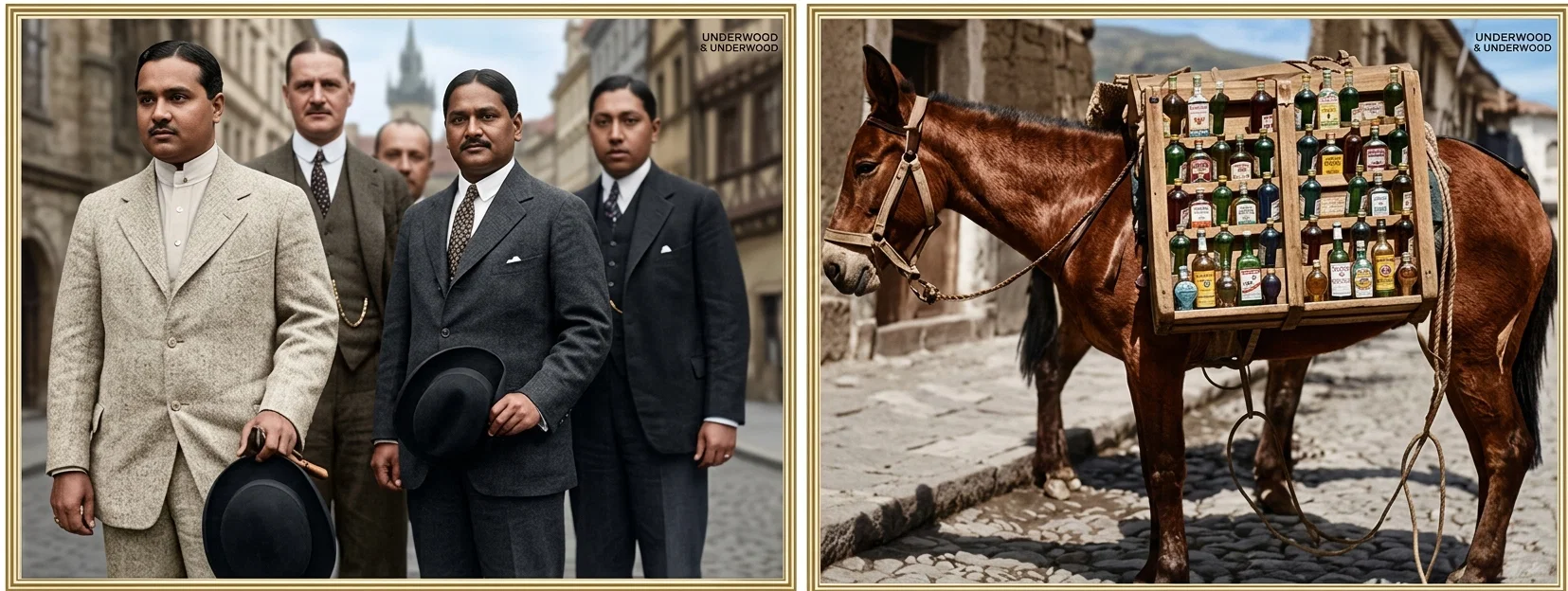
The Maharajah Manikya Behadur of Tripur, who is reputed to have a fortune in excess of $900,000,000, with members of his suite as they arrived in Prague, Czecho-Slovakia, on their tour of Europe. The maharajah is the man at the left, in the light suit. Unsettled conditions in Bolivia do not interfere with the delivery of alcoholic drinks. This picture shows how Bolivian merchants use pack mules and burros to make their deliveries in towns whose streets are so hilly that all other methods are unsuccessful.
When one takes into consideration the fact that thousands of communities, outside the few large cities that have boards of censors, see all these movies with nothing eliminated, one can easily appreciate the incitement toward crime and immorality the movies constitute. They are the chief debaucher of our present-day civilization.
Dr. Eastman interrogated scores of young boys and girls as to their impression of the movies. Here are two characteristic replies:
“A sixteen-year-old-girl: ‘Those pictures with hot love-making in them, they make girls and boys sitting together to get up and walk out, go off somewhere, you know.’”
“A young delinquent: ‘Movies make most anything seem all right. Things that look bad on the outside don’t seem to be bad at all in the movies.’”
That is perhaps the greatest single allegation that could be made against the movies,—they make bad seem good. In other words, they dull the moral perceptions. They blur the distinction between right and wrong. They obscure the line of demarcation between righteousness and iniquity. They so educate the young that they do not differentiate between honesty and dishonesty, purity and impurity, uprightness and degradation, integrity and moral obliqueness. They make sin and sinning attractive, and point the finger of scorn at the high standards of morality and religion.
We are thankful for Dr. Eastman’s exposure of the movies. We hope it will make some impression upon the several scores of millions who are constant attendants, and most of all, upon the parents who take or allow their children to go to the movies.