ROY F. COTTRELL

3%

Pacific Press Publishing Association · Mountain View, California, U.S.A. · Nov 25, 1930

FromSigns of the Times, Vol. 57, No. 46.

Read the full edition
Nothing has more clearly demonstrated the fallacy of the worn-out phrase, “a nation goes to war,” than the few years since the great World War. Neither men nor nations will be able to shake off this devastating habit until all things are made new.

ROY F. COTTRELL

Four young ex-soldiers started a small riot in a little town one Sunday morning, several persons being severely injured. When the combatants were at length torn apart, one of the boys revealed his martial spirit by the remark: “Who cares for a little blood like this?” We’ve been to war, and seen the real stuff.”
The Chinese are rated as a quiet, peace-loving people. Nineteen years ago they overthrew their Manchu masters, and hailed the advent of their new freedom. But once the war dogs are loosed, it is hard to call them off; and for well-nigh two decades there has been in China an almost continuous series of revolutions and counter-revolutions. It is tragic to think of the millions of human beings actually starving to death in that land, while the war lords are supporting huge armies and consuming the nation’s resources in futile age-long strife. When a temporary peace is declared, thousands of the disbanded troops turn bandit or Bolshevik, to bring further terrorism and destruction.
Evidently “a war to end war,” or “a war to make the world safe for democracy,” or something else, seldom works out according to schedule. On the contrary, it usually engenders hatreds and sows the seeds of bitterness for a new harvest of blood.

WARS ENGENDER HATREDS

Before the World War, Europe had its danger spots. To-day the situation fairly bristles with new complications and perils. Then European nations possessed two forms of government—monarchical and republican; now, three or more forms, depending on the classification, are struggling for the supremacy. The actual democracies are England, France, Germany, Switzerland, Czecho-Slovakia, Irish Free State, and Austria. These, as a class, give the least cause for apprehension; though how long the present status will continue with some of them is uncertain. In the recent German elections, the increase of both Fascist and Communist members in the Reichstag was astonishing.
This “specter of Fascism,” we read, has produced “alarm in France, gloom in London, uneasiness at Geneva, confusion in Germany, nervousness in the stock exchanges,” and an attack of war hysteria in several other European countries. Many believe Germany to be menaced by some kind of dictatorship,—Fascist, Communist, or monarchical. Adolf Hitler, a would-be German Mussolini, heads the Fascist party that is calling for the abolition of war guilt and the peace treaties, the restoration of the Saar Basin, the Polish Corridor, and the German colonies, the expulsion of foreigners located in Germany, the suppression of the Young Plan, and the annexation of Austria.
At the head of the Fascist dictator group stands Italy, its industries running with ruthless efficiency, strikes and lockouts being illegal, its one-party candidates always sure winners at elections, its foreign minorities subjected to a rigorous nationalism, its philosophy of statecraft a religion, and its neighbors standing in fear or awe of the strong man at the helm. Mussolini says: “We are representing a new principle in the world; the absolute and complete negation of Liberalism, Freemasonry, and Democracy, all these immortal principles of 1789. We do not want these rusted antiquities. . . . Fascism leaves in the cemetery of history these prehistoric discoveries.”
And now, seizing the moment of French alarm from across the Rhine, Italy arises to press her demands for more privileges and colonies bordering on the Mediterranean and more chances for world commerce. Eugene J. Young, a writer of international reputation, says: “France must give Italy full recognition in the African colonies, and not try to make them Frenchmen. There must be a cession of part of Syria; more rights for Italians in Morocco; a cessation of French support of Jugo-Slavia, which bars Italian expansion across the Adriatic. Otherwise Italy will support Germany in trying to tear up the whole peace settlement made after the war. All of which means that Europe is definitely returning to the state of mind and intrigues which so many timeshave brought wars. And conditions are likely to grow worse, not better, in view of the economic situation there.”
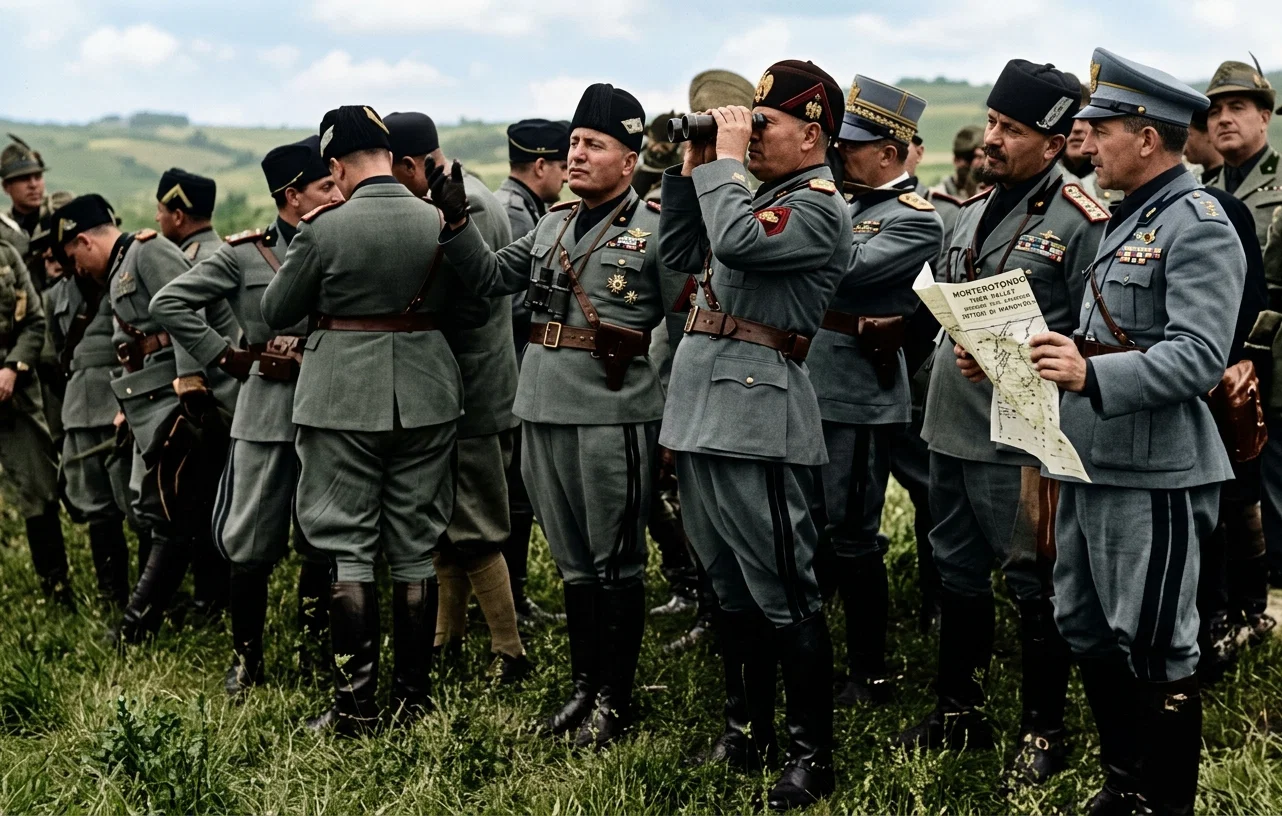
Benito Mussolini is here shown watching the maneuvers of the Fascist troops at Monterotondo, Italy, through a pair of binoculars. The Belgian Senator Louis de Brouckere, president of the Aviation Commission at Geneva, sees in Mussolini's movements a preparation for war.
Other Fascist countries, like Hungary, Turkey, Poland, Jugo-Slavia, and Spain, are experiencing their individual troubles. Spain, for instance, is torn with disgust of monarchy, with student rioting, labor strikes, and military plots; King Alfonso is unpopular, and for seven years the country has groaned beneath the yoke of a dictator who has tried rather unsuccessfully to imitate Il Duce of Italy.

THE SOVIET ENIGMA

Soviet Russia continues as the great national enigma. The Bolshevik propaganda for world-wide class warfare and revolution continues unabated, but in the homeland the much-heralded “five-year plan” for developing an industrial colossus seems on the verge of collapse. The government, we are told, “is driving huge armies of virtual serfs at a man-killing pace in order to flood the world wheat markets with low-priced grain, while Russian peasants who work in the wheat fields are almost unable to buy bread.”
In a recent dispatch from Paris dated September 23, it is reported that Mr. A. C. Simons, an American farm implement expert who was just returning from a long stay in Russia, “saw virgin steppes, where the Cossacks once pastured their herds, converted into the largest wheat fields in the world. He saw half-naked men—and women who were compelled to do men’s work—toiling in the fields under guard of Red soldiers until they often dropped in their tracks from exhaustion. He saw line after line of freight cars piled high with grain, rushing wheat to Black Sea ports where it was poured out into the rest of the world at prices which mean ruin to farmers anywhere else. . . . He pointed out that the Russians are buying thousands of huge tractors which are too powerful and too clumsy for agricultural purposes, but which can easily be converted into tractors for drawing heavy artillery in time of war.”
Mr. Simons also declares that the independent peasant farms have been practically stamped out, and tells of the “giant farm” in the Don River country upon which a fleet of two hundred thirty American harvester and thresher combines are operated.
“The workers,” he continues, “are paid what seems to be a fair wage,—thirty dollars a month. But they cannot buy anything with the money. They are not allowed to keep any grain for their own use, and if they are caught with a handful of flour, they are shot. Bread is rationed out, and each man gets only a small chunk daily. They live mostly on sunflower seeds. The workers can’t buy shoes because there is no leather. Sugar is scarce, and they even have to stand in line for a couple of hours to buy a pair of overalls.”

THE UNEMPLOYMENT PROBLEM

The Soviet industrial program has been poorly managed, and is far behind schedule. The leaders are in a desperate scramble for money, and while millions of their own people in various parts of the country practically face starvation, they export wheat to turn the staff of life into gold. In spite of all, Joseph Stalin and his group appear firmly in the saddle; but when severely strained, the Russian people sometimes arise to strike so quickly and so hard that no government can withstand.
The general business depression with many millions unemployed is severely felt throughout all continents. France appears as practically the only nation that is exempt. Her laborers are busy; her gold reserve during the past four years has increased $600,000,000; and she stands forth among the nations as a prosperous financial leader. Elsewhere governments are struggling hard; administrations are being overturned; and in Latin America there is a contagious epidemic of revolution, in which the “strong men” are said to be falling like ninepins. An “American diplomat from Chile” as quoted in the Literary Digest, explains:
“Revolutionary activities are rife practically everywhere, based primarily on economic causes.” “These republics have been particularly hard hit in the world commercial depression.” “Many of them went heavily in debt—largely to American bondholders—for public works improvements and for general development purposes. That money is spent; only the property acquired and the obligation to pay interest remains, taxes are high, and business falls to a low ebb.” “The combination creates a situation ripe for the revolutionist who always is present in a Latin-American country, kept down only by the strong hand of military government.”
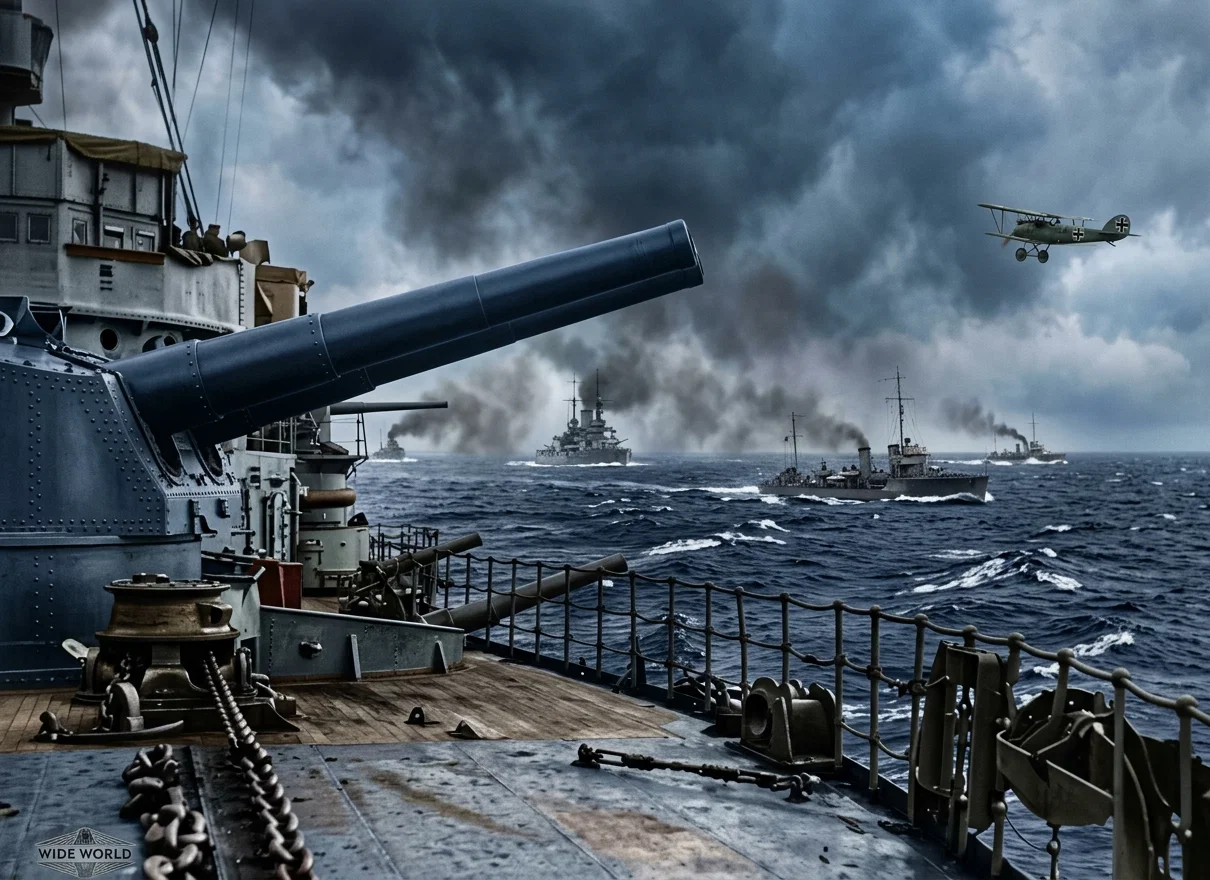
This picture shows some of the ships of the German navy in the Baltic during target practice. Surely these developments are not very encouraging peace omens.
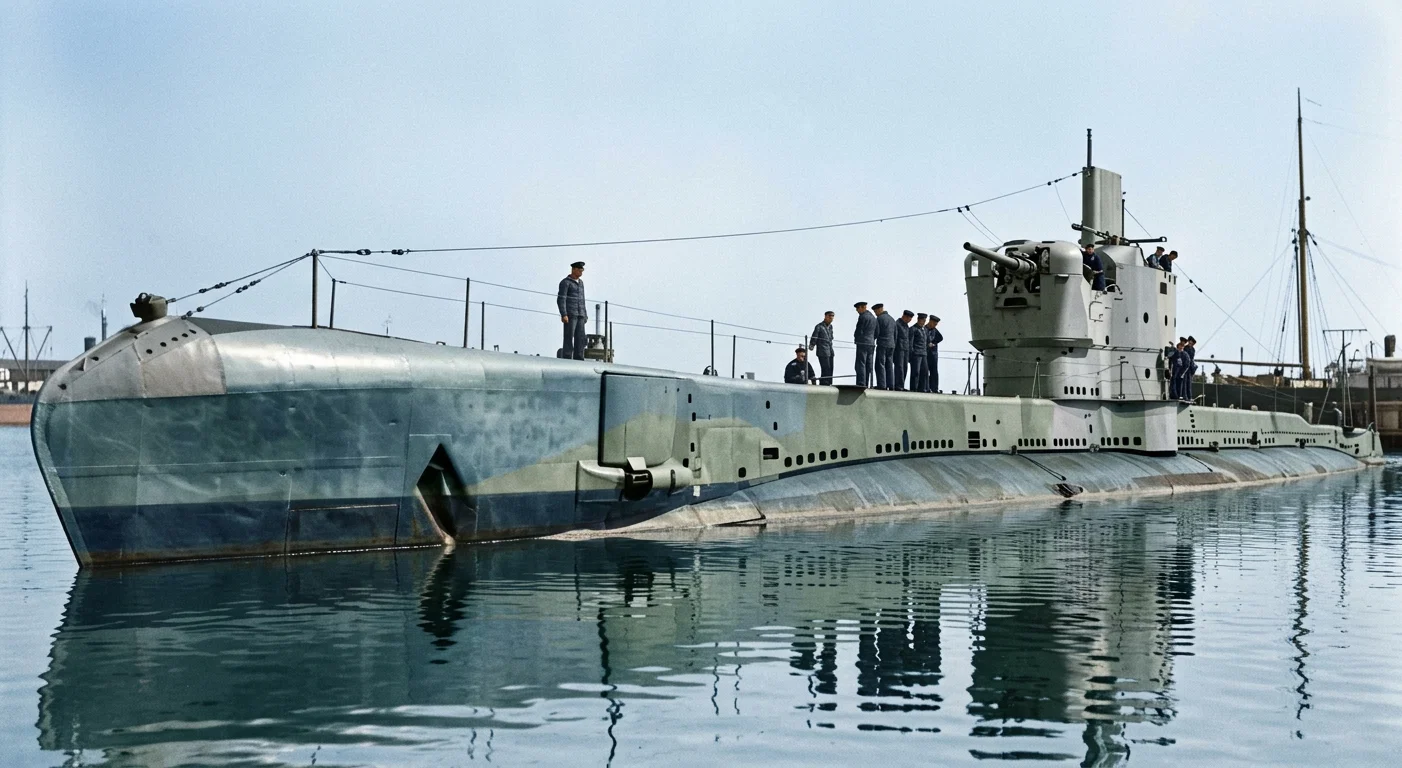
With the visit to our shores of Premier MacDonald of Great Britain and the subsequent Limitation of Arms Conference at London, Utopian hopes were entertained by many; but the results of the meeting were distinctly disappointing to the advocates of peace. Only three nations were able to perfect an agreement, the articles of which called for the scrapping of a few obsolete ships and the construction of many cruisers and other modern seacraft.
Multitudes are asking, Will war and strife never cease? Will the desire for peace never be realized? Does not the Bible tell of a time when war will terminate, and the spear and bow forever be broken asunder? To these questions, the book of God replies, and the answer is clear, convincing, and authentic. Idealists may hope and pray for better things, but so long as we live in “this present evil world,” where self-interest is the dominant trait, so long will sordid diplomacy and inordinate ambition tyrannize the nations. When dying, Alexander the Great was asked to whom he would give the kingdom. “To the strongest,” he replied, and after the lapse of nearly twenty-three centuries, the world still struggles to determine who the strongest shall be.
With all our boasted civilization and millennial dreams, war, “the final argument of kings,” is still regarded by the nations as the world’s supreme tribunal. And, as scheduled in the Book of books, the last scene in earth’s drama is that final political clash known as Armageddon. “The Lord hath a controversy with the nations,” runs the vivid description, “and a great whirlwind shall be raised up from the coasts of the earth. And the slain of the Lord shall be at that day from one end of the earth even unto theother end of the earth: they shall not be lamented, neither gathered, nor buried.” Jeremiah 25:31-33. See also Revelation 16:15-17.
Continued on page 14

The War Habit

Continued from page 3
Long ago it was written in the Holy Word, “Surely the Lord God will do nothing, but He revealeth His secret unto His servants the prophets.” Amos 3:7. Prior to the Flood, Noah was His faithful witness to a pleasure-loving generation. Before the Babylonian captivity, numerous spokesmen for God foretold the national downfall. For many centuries previous to the first advent of the Messiah, prophets of God foreshadowed almost every outstanding event along the way from the manger to the cross and the throne, all of which were accurately fulfilled.
In like manner Christ and His disciples visioned the closing era of earth’s history to be distinctly characterized by general lawlessness, anarchy, crime, and intense national rivalry. (Luke 21:25-28; 2 Timothy 3:1-5.)
Placing the prophecies of Scripture on the one hand, with current events as told by the newspaper and magazine on the other, the parallel is truly most complete. These things affirm and reaffirm that the crisis of the ages hastens. In all these things Christ is saying to His church, “Behold, I come quickly.” Erelong it will be announced, “The kingdoms of this world are become the kingdoms of our Lord, and of His Christ; and He shall reign forever and ever.”
No, neither men nor nations will be able to shake off the war habit until He who sits upon the throne declares, “Behold, I make all things new.” The desire for supremacy that began with the insurrection of Satan will continue to reign in the hearts and lives of unregenerate men until Christ shall return and the kingdom of evil is finally overthrown. According to the divine forecast there is a titanic struggle ahead; but, thank God, it cannot be of long duration, for the coming of Christ as King of kings draws on apace.
Yet, amid all the din and turmoil of these last days of strife, he who knows his God has rest and peace. “When He giveth quietness, who then can make trouble?” The tranquillity and confidence of heart established here gives entrance to the realm where reigns the Prince of Peace. Let others, if they will, engage in the rivalry of armaments; our greatest concern is to qualify for citizenship in a world where “nation shall not lift up sword against nation, neither shall they learn war any more.”