German East Africa

9%

Review and Herald Publishing Association · Takoma Park Station, Washington, D. C. · Mar 4, 1909

FromReview and Herald, Vol. 86, No. 9.

Read the full edition

German East Africa

L. R. CONRADI
On the twenty-ninth of September, Brethren W. C. Ising, Awada Abd-Elshabeed, and George Keough, and the writer left Beirut, Syria, after our good general meeting at that place. Our steamer of the French Messenger line was so overcrowded with emigrants for North and South America that the only place left was on the deck. Most of these emigrants came from the Lebanon Mountains, whence hard times had driven them out to seek new homes. Our steamer being a direct one, we reached Port Said the next day; but we had to lie there in quarantine for four hours, till the physicians had examined the many hundreds of passengers. After hunting for some time, we were able to find the two sisters who were en route to Abyssinia, who had arrived on the German Lloyd steamer the day previous. We were very sorry indeed that Brother P. Lindegren had to be left behind sick, in Beirut. At that time we hoped that he would be well enough to come ere the steamer would leave on the tenth of October; but to provide for all contingencies, we arranged with Brother Ising to return from Cairo in time to see the sisters off. As Brother Lindegren was ill for months, the arrangement was providential. We are happy to report that the two sisters reached Massawa in safety, and that they were met by Brother Julius Persson.
October 2 the steamer “Admiral,” of the German East African line, came in sight, with our four missionaries on board. During our twelve days’ trip, we had daily Bible studies, and did some missionary work among the passengers. We also met the doctor of the International Sanitary Commission, who is stationed in Arabia. All the Mohammedans coming from the south have to pass the quarantine station there. Among the many interesting details given us, he informed us that no believer in Mohammedanism in all the East Indies was considered a true Mohammedan until he and his family had made a pilgrimage to Mecca. Many of the people will virtually sell themselves to their landlords for eight to ten years’ service, in orderto secure sufficient advances to make the pilgrimage. Not only will they face slavery, but very often these pilgrims are robbed, and they are in danger of losing their lives on the journey. We surely can be thankful to God that the time has come when we need to go neither to Jerusalem nor to Mecca to worship.
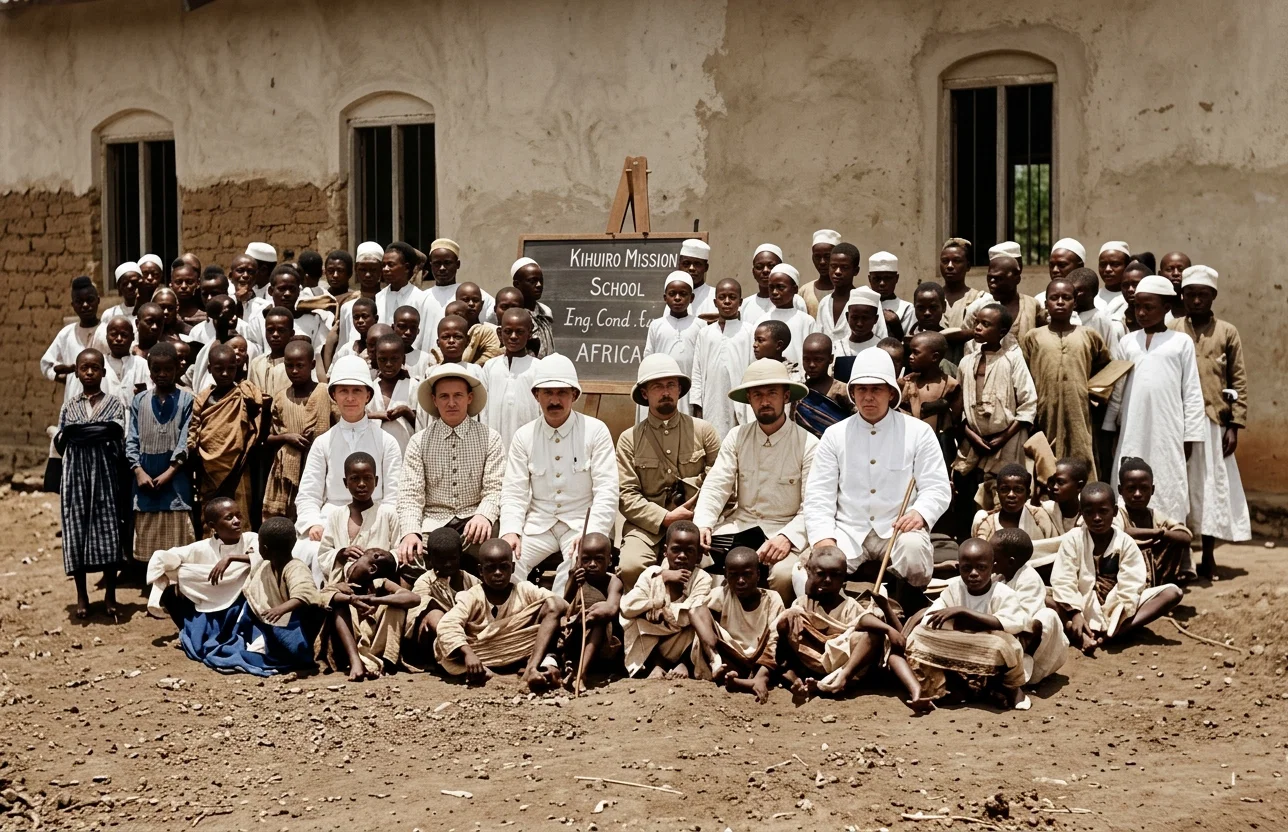
SCHOOLHOUSE AT THE KIHUIRO MISSION, GERMAN EAST AFRICA
On reaching Mombasa, on the fourteenth of October, I found a letter from Brother A. A. Carscallen, in which he stated that he was awaiting me, in case I should then come to his field. After securing a time-table of the steamers around Victoria Nyanza, I found it preferable to proceed with the workers to Tanga, German East Africa, first. Our steamer being somewhat late, we did not reach Tanga till late Thursday night, where Brother A. C. Enns met us. Early Friday we got our goods through the customs in time to take the nine o’clock train. It took us six hours and a half to make the eighty-five miles on the railway. On reaching the terminus at Momba, we found a small donkey team for our goods, but as we wished to be with the church in Kihuiro on Sabbath if possible, a few of us decided to push on that very night, which meant a thirty-five mile journey, nearly all on foot. We completely surprised our people at the station, and found them preparing for our reception on Sunday; but we felt richly repaid, and forgot our weariness occasioned by the night’s travel.
Five years ago we had arrived in Kihuiro about one o’clock at night. There was nothing but a miserable hut in which the two sisters who had accompanied us could rest, and I sat outside with the black boys by a small campfire, trying to fight off the swarms of mosquitoes. As the sun arose, some of the subchiefs met us, and we could talk to one another, mostly through signs. One of these offered us a sheep as a present. At that time most of the people had scarcely any clothing. There was no stopping-place, and there were no stores in the town. What a change the God had wrought during the intervening five years! A nice road led up to the mission station, a mile from town. On one side we saw a beautiful ten-acre cotton-field, and some good maize belonging to the mission station. At the station itself, we found a good dwelling-house and a number of good out-buildings.
MISSION SCHOOL AT KIHUIRO, GERMAN EAST AFRICA
We were very kindly received by the missionaries. And as we returned to the village, we found a commodious school building, which also serves as a chapel. This building will accommodate three hundred persons. It was packed full. The head chief of the town, and a number of his subchiefs, met us, clad in official attire. As we entered the house, we found one hundred fifty young people there, who are in regular attendance at our school. Brother E. Kotz announced one of our familiar hymns to be sung in the native language. Hundreds of voices joined in the praise to God. One of the converts offered prayer. It was then my privilege to talk through a ready interpreter to the natives, upon the love of God for fallen man. Most of the people were clothed. There seemed to be a change even in the town. Some stores had been opened, and the beneficial influence of the mission was apparent everywhere. But that which touched our hearts most was the fact that six of these young people had given their hearts fully to God, and had been baptized, while some others were under instruction for baptism, and over one hundred were daily studying the Word of God.
Mission work is slow work. It requires many sacrifices. It costs the lives of workers whom we dearly love. It costs money, and much patient labor. But the greater the sacrifice, the greater the final results. To see people who could neither read nor write, and whose language was not even committed to writing, who were bound in the darkness of thralldom, freed from all this thralldom, and enlightened by the gospel, praising God and worshiping him, is not only a sight to make the angels of heaven rejoice, but it is a sight that stirs our own hearts. The feelings caused by such an hour as this are the key to the explanation of the mystery why the missionary is so willing to leave home and all that is dear, to enter upon this glorious work, constrained as he is by genuine love for souls. Enjoying a sight like this would be sufficient to inspire our people throughout the world to put forth still greater effort to bring the glorious truth committed to us for this time to the dark corners of the earth.
Hamburg, Germany.