Manual Training for Our Primary Grades—No. 6: Sewing
By Mrs. E. M. Long
Manual Training for Our Primary Grades—No. 6
Sewing
WITH a good system, and a teacher who is desirous of carrying it out to its fullest extent, learning to sew may be as delightfully interesting and as educational as any other branch of learning. As a matter of fact, however, much more depends upon the teacher than upon the system or the particular set of models used; for an earnest, interested teacher will have a good degree of success with any system, while an uninterested, indifferent teacher will fail with the best system, and under the best conditions that can be provided.
CORRECT POSITION IN SEWING
It seems needless to say that a teacher should herself do the work, and become thoroughly familiar with it, before attempting to teach it; but there have been teachers who have not recognized that this was necessary.
The object of the course which will be given here is to teach the principles of plain sewing in a simple but practical way. Doubtless there are other methods and models which would accomplish the same purpose equally well; but this one has been tested personally, and has proved satisfactory. The material is inexpensive, and can be obtained almost anywhere. The work can profitably be given to children seven years of age. Beginning at that age, the average child will complete it in about three years, allowing for two forty-five-minute lessons weekly. The expense will average about twenty-five cents a year for each child. It may be given to boys and girls alike as far as the fourth grade.
In arranging the course, an effort has been made to avoid that which is mechanical, and to make the work easily and naturally progressive. It is of vital importance that every teacher should grasp the fact that while this is a sewing course, sewing is not the most important thing that is to be taught in giving it. Good judgment, self-reliance, a trained eye, and correct habits of working are more valuable than even technical skill; and the teacher who fails to recognize this defeats the most important aim of the work. If you can not teach more than the models, do not teach the models.
To the superficial teacher the precision of detail which will be required may seem unnecessary; but let me ask, Can real excellence be achieved without precision of detail? And further, little by little, hour by hour, and moment by moment, all unconsciously to them, and often to us, the children who are given into our hands for a little time to train, are forming characters not only for this life, but for eternity. Can we, then, afford to neglect any opportunity of bending them in the right direction,—of making deep the impress of right principles? And is the principle of thoroughness and exactness one that is to be regarded lightly?
We read of our Saviour that “in his earth-life, he was an example to all the human family. . . . He learned the carpenter’s trade, and worked with his own hands in the little shop at Nazareth. . . . He did not use his physical powers recklessly, but gave them such exercise as would keep them in health, that he might do the best work in every line. He was not willing to be defective, even in the handling of tools. He was perfect as a workman, as he was perfect in character.”—“Special Testimonies on Education,” pages 38, 39.
It is as true of this course of sewing as of everything else, that the importance of forming correct habits in the beginning can not be overestimated.
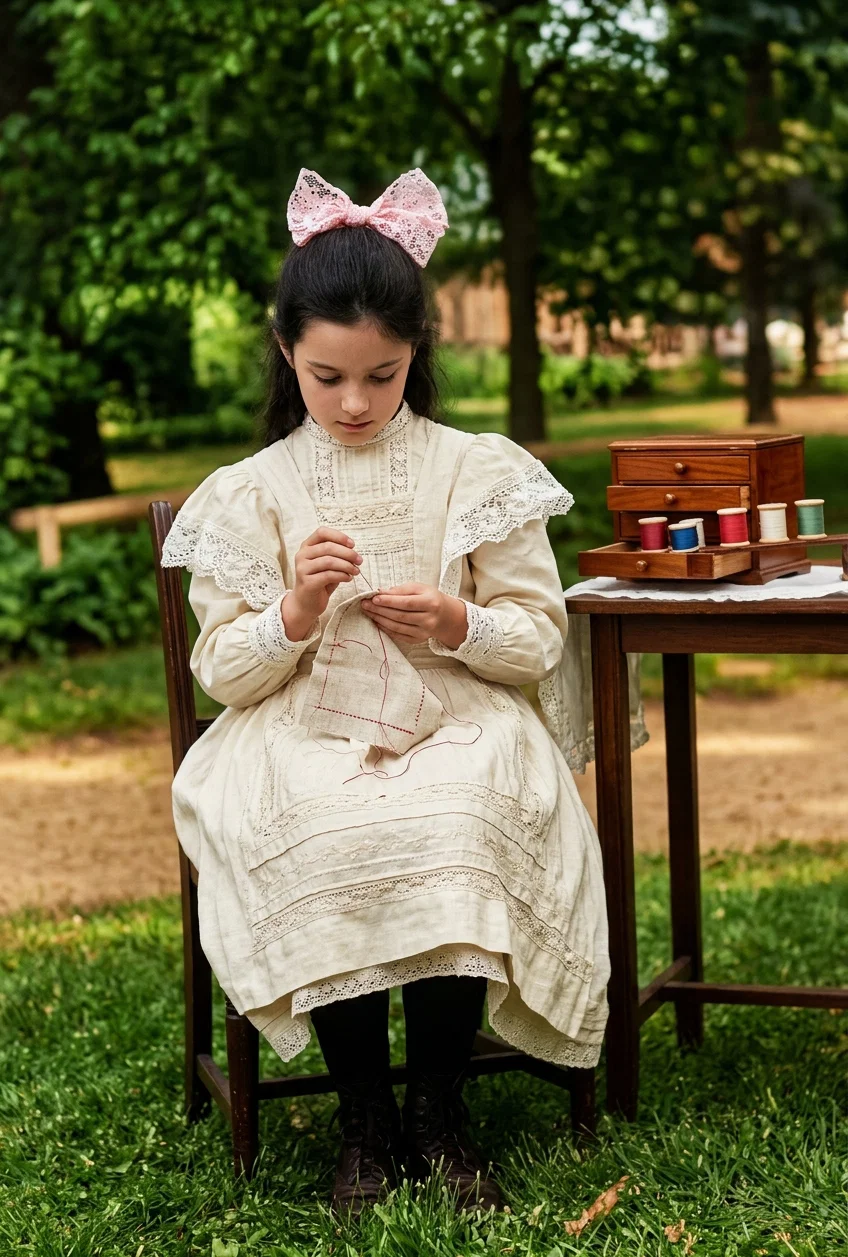
The first thing to be impressed upon the minds of the children is that their hands must be perfectly clean before beginning to sew, and this is a point that should be carefully looked after each time the class is called. Next, see that each child is so seated that, when sitting well back in the chair, the feet may rest squarely on the floor. Low chairs are greatly to be preferred, but the ordinary school seats may be used if necessary. If chairs are used, arrange them in a semicircle. The teacher should be seated during the class period, and in such a position that she can readily observe the movements of each child. A well-lighted room is, of course, essential.
The correct position is erect, with the lower part of the body against the back of the chair, the feet near each other, and resting easily on the floor. In this position the lungs are not cramped, and the arms have freedom of movement. The position may be maintained indefinitely without fatigue, as there is no strain or cramping of any part of the body.
The work should be held sufficiently high in the hands to prevent the need of lowering the head. It is seldom necessary to rest the work on the lap while sewing. The teacher’s own position should illustrate what she is attempting to teach, and her vigilance over herself and her pupils should never relax. Sewing in itself is not an unhealthful occupation. It is the bad position, and the wrong conditions under which it is done, that bring the evil results so often seen.
It would be preferable, of course, to have everything needed within reach of each child; but as that is scarcely possible for many of our schools, the supplies should be on a desk or table, to which each may go as he has need. It is possible to allow this and still maintain order and quiet.
A good spool-stand, which will accommodate a dozen spools of thread, may be made from a piece of board twelve inches long, five inches wide, and one inch thick. It should be planed, the corners cut off, and the edges beveled. Wire finishing nails of suitable size to receive the spools, should be driven into the upper surface at equal distances apart.
A thimble-stand may be made from a circular piece of wood of the same thickness, and six inches in diameter. The edges of this should also be beveled, and the desired number of five-eighths-inch holes bored to the depth of one-half inch. The holes may be arranged in some symmetrical design, as a star. A piece of wood of this size will accommodate two dozen thimbles. Bits of jewelers’ cotton may be put into the holes, and the thimbles put in, tops downward. This arrangement makes it easy for the children to fit themselves, and for the teacher to keep track of the thimbles.
Aluminum thimbles are quite satisfactory for school use, as they are inexpensive and do not tarnish. Teach the children that to fit properly, the thimble should allow the finger to touch the top, and yet not be loose enough to fall off if lightly shaken.
The materials for the first model are double-thread penelope or railroad canvas, and dark-red saxony yarn. Long-eyed, round-pointed tapestry needles, No. 21, should be used. The canvas is twenty-five cents a yard. One yard will make three dozen or more models. This material was chosen because it does not tax the unaccustomed eyes of the children, and there is no difficulty in securing a uniform length of stitches, as these are governed by the squares of the canvas. By the time this model is completed, the children should naturally assume and maintain the correct position. They should properly manipulate needles, thread, and thimbles, and should know the names and uses of the various stitches used in the model, and be quick to recognize any irregularities or imperfections in the work. This may sound large, but27constantly repeated experience has demonstrated that it is not expecting too much of either pupils or teacher.
CORRECT POSITION OF THE HAND
There are many grades of the canvas, but that having about twelve double threads to the inch should be chosen. Every tenth thread is dark, thus making a stripe. The piece for each model should be eleven full stripes wide, and nearly an inch longer than wide.
The yarn should be wound into a soft ball. The first step is to teach the children to measure off the proper length of yarn, and to thread their needles. The ball, to prevent rolling, should be placed in a small box or basket, and for the first lesson may be passed around the class, letting each in turn help himself. To determine the length, let the child take the end of the yarn between the thumb and forefinger of the right hand, and with the basket containing the ball resting on the lap, take the ball lightly between the thumb and forefinger of the left hand; then place this hand on the chest directly below the chin, and stretch the other out its full length to the right, letting the yarn pass freely through the left hand; then drop the end from the right hand, and break the yarn at the point which the left hand marks. This gives each child a length in proportion to his own arm.
Thread the needle by placing one end of the yarn over the side of the needle; hold both between the thumb and forefinger of the left hand, slip the needle out, pulling upward, and pressing tightly between the thumb and finger in order to make a sharp, wedge-shaped fold in the yarn. This will slip readily through the long eye of the needle. See that each pupil thoroughly masters this step before proceeding further.
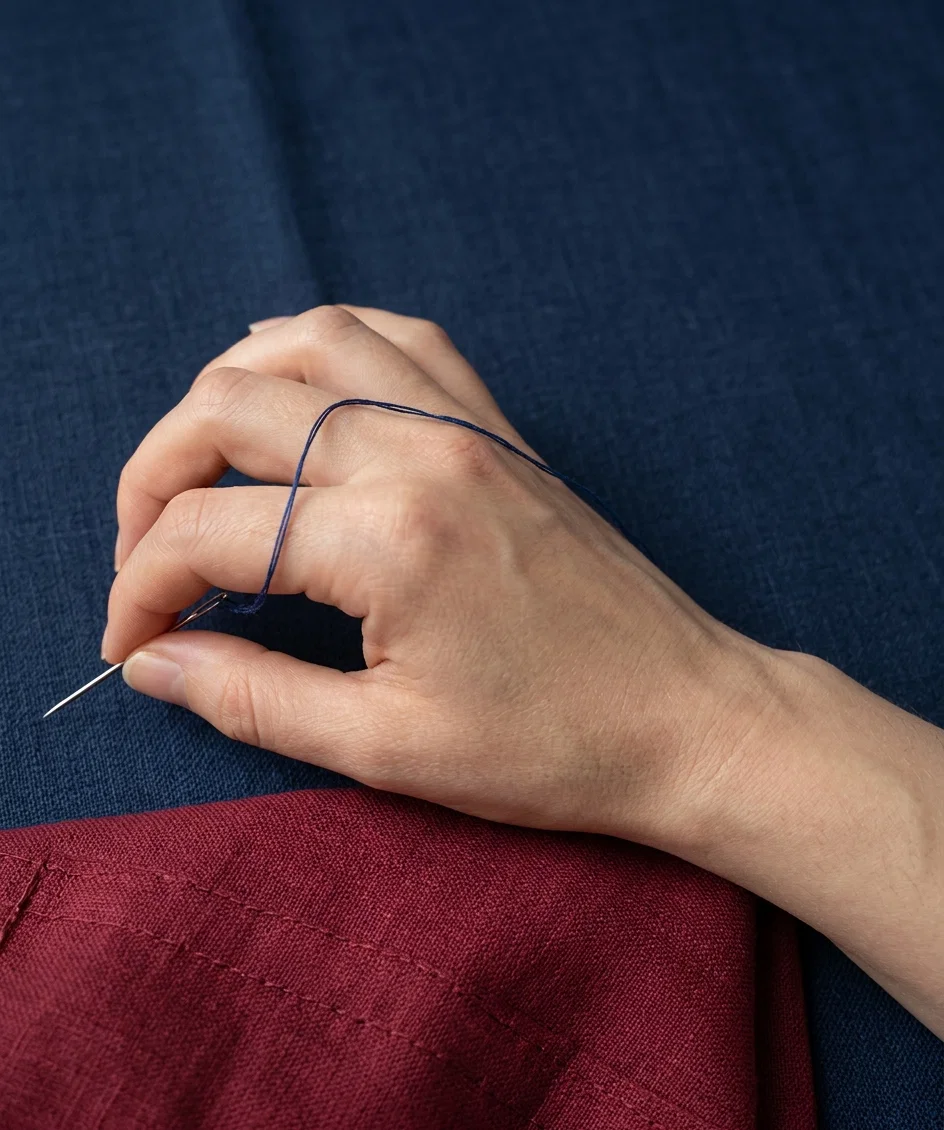
To prevent the canvas from being crumpled by inexperienced hands, it is well to spend a little time in learning to take the stitches in paper. See that the thimble is on the right finger, and properly used. In pulling the thread through, it should fall between the middle fingers. Do not neglect this seemingly small matter. It marks the difference between a clumsy, awkward movement, and a correct, graceful one.
Acquiring the correct position, the correct way of threading the needle and taking the stitches is sufficient for the first lesson, unless more time is allowed than the usual class period.