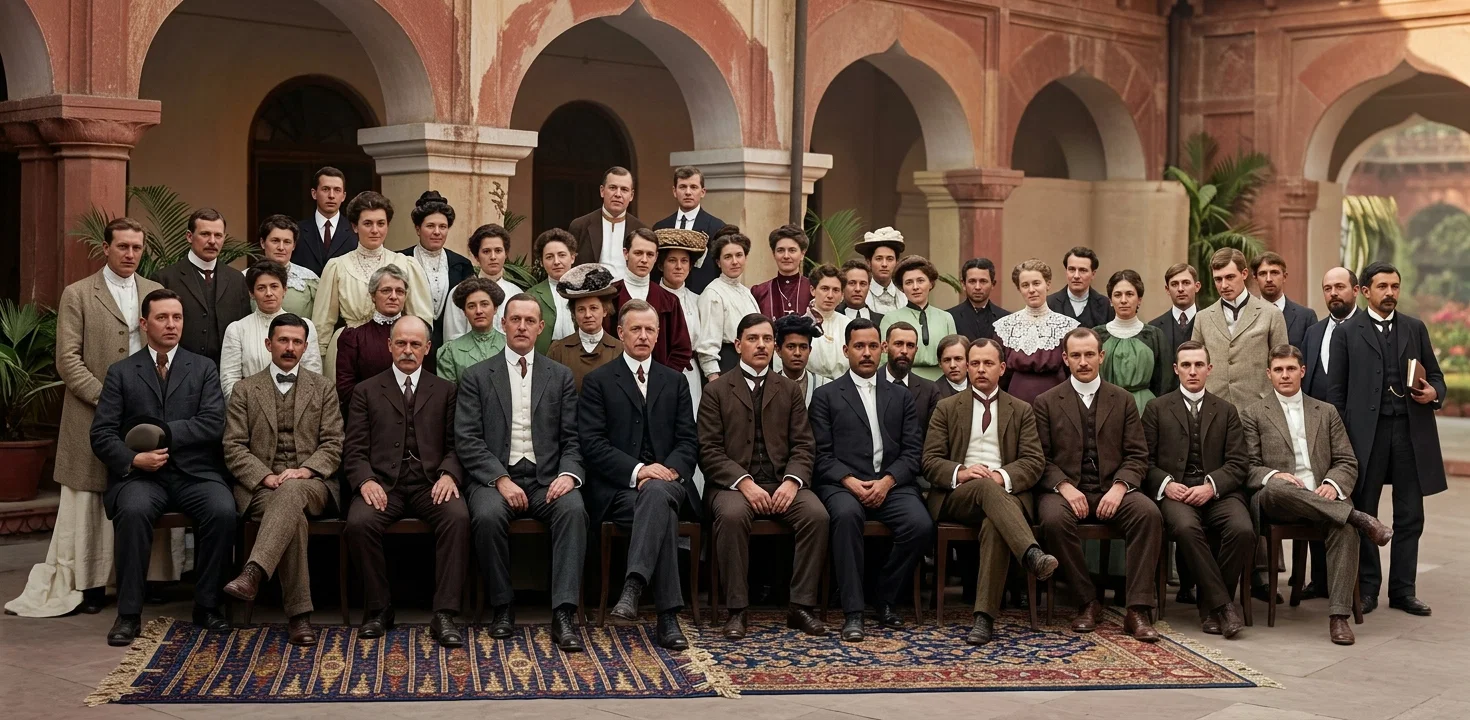
Biennial Conference in India

7%

Review and Herald Publishing Association · Takoma Park Station, Washington, D. C. · Feb 18, 1909

FromReview and Herald, Vol. 86, No. 7.

Read the full edition

Biennial Conference in India

THIS meeting was held at Lucknow, North India, from Dec. 25, 1908, to Jan. 4, 1909. There was a general attendance of all our workers in India and Burma. Some arrived several days before the conference opened. The few intervening days were spent in Bible study, prayer, and counsel, the result of which was a great blessing to the conference. As workers we were led to realize as never before our imperative need of a larger measure of the Holy Spirit for the work before us in India. From the first of the conference, there was an earnest, untiring seeking after God, and the result was the continual presence of the Spirit of God with us in our council meetings. We found ourselves facing conditions we knew not how to meet, and the way in which God gave wisdom to his servants while they planned and counseled together, the sweet presence of his Spirit pervading all that was said and done, will not be soon forgotten by our missionaries in the Indian Mission field.
WORKERS WHO ATTENDED THE BIENNIAL CONFERENCE, DECEMBER 25 TO JANUARY 4, LUCKNOW, INDIA
They came many hundreds of miles from different parts of India and Burma, intent on pleading with God, and claiming more of his power to meet the difficulties before them in India, and they were not disappointed. Their faith was strengthened, their courage increased. We parted from one another with a shout of victory in our hearts, knowing that we had been in the presence of God, that he had been with us, and would go with us and grant us victory where caste and prejudice and climate oppose the march of truth.
There were a number of Sabbath-keepers present from different parts of India. We were glad to have so many Hindustani people in attendance. Their interest in the truth was encouraging. A brother who accepted the third angel’s message about a year ago, came eighteen hundred miles at his own expense to be present at this gathering. He made an urgent request that an industrial school be opened among the Burmese in northern Burma. He had with him a letter from a prominent Burman, promising that fifty pupils would attend, and would be willing to pay tuition if such a school should be opened.
A survey of the Indian Mission field shows that the work is moving onward. The number of workers has been increased. While nine have left the field during the last two years, twelve others have taken their places. During the meeting, word came from the Mission Board that a company of five workers was sailing from New York for India, thus raising the number recently coming to the field to seventeen.
We have thus far started work in this country in seven languages, besides the English,— Bengali, Hindi, Burmese, Marathi, Tamil, Urdu, and Santali. The work which has been done in each of these languages was reviewed. Scarcely a beginning has been made. Much time has been spent in language study, which, by the way, with the tongues to be mastered in India, presents an undertaking our people at home can but faintly realize. A hundred fifty different tongues, mostly of the trying Sanskrit origin, call for years of untiring study on the part of many workers. We thank God for the earnest company of sons and daughters from the home land, who, working one here and another there, are burrowing into the seven Indian tongues mentioned above.
One interesting feature of the meeting was the convention held each afternoon for the purpose of studying the Indian Mission field, our work, and plans for developing it. Papers had been prepared on various subjects. Most of these had been given very careful preparation, and were extremely helpful and suggestive. In many instances the methods of labor are so different that wise plans can be developed only through much effort and experience.
Connected with the reading of the papers was not a little open discussion on various features of mission work. This was entered into with much enthusiasm, and proved very profitable. How to work successfully in India is not to be learned in a day. The Indian mind is deep, and has proved the study of a lifetime to many Europeans. It is safe to say that our workers are learning, though we often pray earnestly for the gift of the Holy Spirit for the discerning of spirits, lest we put too much confidence in man, or fail to encourage the honest in heart who are seeking after truth.
Our work among the Hindustani, Bengali, and Tamil Sabbath-keepers was carefully canvassed. Each field presents remarkable openings. We found ourselves altogether unable to answer the calls which came. Two lady workers, recently from America, were asked to begin the language study at once,— Sister Ayers to start in Marathi work, and Sister Shryock in Tamil. The appeals for other help, though imperative, were passed on to the Mission Board. We asked for more than ever before. Nearly every one of our mission stations should be strengthened the coming year. It is hazardous to have a man and his wife, with even a lady worker, in a language alone. Dr. Oberholtzer has been working alone for two years in Moulmein, Burma. If one man fails where conditions are trying, and the climate is unhealthful, there should be another one already familiar with the language to bridge the crisis until more help is available. Our workers believe that the time has come when our stakes in India should be strengthened. We must do that before we start any new centers, however loud the call may be.
The medical work is growing. From the hot, steaming climate of Calcutta the sanitarium was transferred a year ago to the salubrious climate of Mussoorie.Though it is early to predict what the outcome of the change will be, the first year presents a very encouraging report financially and otherwise. Though cramped for room, and laboring with small and unsatisfactory equipment, good work has been done. Surgical cases have made excellent recovery. One woman, given up to die by friends and physicians, rallied from a serious operation. We need more room and better facilities. Could our sanitarium managers at home see how unsatisfactory it is to operate a sanitarium in rented buildings in India, they would realize our great need of a building of our own for this purpose. Fifteen thousand dollars would provide a property large enough for the present.
The last Sabbath of the conference was marked with the special presence of God. The Holy Spirit worked upon hearts. At the close of the morning service, Brethren J. S. James and J. C. Little were ordained to the gospel ministry. In the afternoon the ordinances were celebrated. A stirring sermon by Elder Geo. F. Enoch, on “The Meaning of Earthquakes in the Light of Prophecy,” closed the evening meetings, at which the people of Lucknow were well represented. The organization of our first Hindustani church of sixteen members was effected at the close of the conference. Four persons were baptized.
The workers are now in their various places of appointment, but the good influence of the meeting still prevails. It was a mighty uplift to all present. Yet we are not satisfied. We need more faith, more power to turn men from darkness to light, more love which begets an overwhelming love for unwarned and ignorant souls all about us in heathenism. The work and workers in India are urgently in need of the unceasing prayers of our people in every land.
J. L. SHAW.