The spirit of Turkey is as much opposed to Christianity as was the spirit of the Saracen conquerors who went forth to push the banner of Mohammed into the heart of Europe centuries ago. It is only because of the severe pressure brought to bear upon Turkey by the powers of Europe that Christianity is even tolerated within her borders. The spirit of Mohammedanism possesses just as much hatred against Christianity as ever. As the weapon of Mohammedanism is the sword of steel, instead of the sword of the Spirit, so her methods to-day in principle are those of force, and not of persuasion.
Frequently some Mohammedan leader declares that the armies of united Mohammedanism will yet conduct a successful campaign against Europe. Of course this is more the expression of individual sentiment than of the prevailing intention and belief of the people. As I have already expressed in an article to the REVIEW a few months ago, it is the prevailing belief among many Moslems that the sultan of Turkey will soon be forced to move from his present seat of government.
The first statement reveals the spirit of Mohammedanism itself; this latter expresses the conclusion drawn from the political situation of Turkey to-day. The condition to which expression is given in the first statement is that under which we have to carry on our work. The conditions which produce the latter conclusion are those which are bringing about the fulfilment of the prophecies regarding the “sick man of the East.”
At this writing I desire to speak of those conditions which directly affect our work in Turkey. The only freedom granted to the non-Mohammedan sects or communities is restricted toleration. To convey a better understanding of the position in which we are placed, I will first show the general condition under which all denominations have to carry on their work. There is no civil government in Turkey. Primarily the Turkish government is the Mohammedan Church. Every tolerated non-Mohammedan sect is treated as independent, not only ecclesiastically, but nationally and civilly. Every citizen of Turkey who is not a Mohammedan is treated as a citizen of the sect to which he belongs, rather than as a citizen of Turkey. Thus each recognized denominational or sect organization is fully organized to administer, to a degree, both ecclesiastical and civil affairs.
Of course the civil functions are limited to the laws of Mohammedan administration. For example: every denomination has its headship. Each denomination is required to register all its members, and to appoint and maintain, at its own expense, men to administer such civil duties as are imposed upon them by the government. The government demands a tithe as a tax from all its subjects. This tithe is estimated by the government to the various denominational communities, and handed to their respective heads, who apportion the same among their people. All marriage permits and burial rights and privileges are secured from the denominational heads, and not directly from the government. Accordingly, in the case of marriage, the Armenian, Gregorian, and the
Orthodox Greek Churches demand that the parties to be married partake of their communion before the marriage can be solemnized.
In some cases the Protestants are very kind to our people; but, on the other hand, when they choose to turn against us, our people are laid before the government as violators of the law. However, it does not always require the disfavor of a religious community to involve our people with the government; because the authorities are thoroughly apprised of the existence and activity of our people, and of the fact that we are not recognized by any of the accepted religious communities.
From this brief outline of the administration of affairs in this country, it can readily be seen that Seventh-day Adventists, having no headship whatever, from a government standpoint (though One is our head, even Christ), are placed in an embarrassing position before the government. The Protestants do not recognize our work in Turkey. Consequently, those who unite with our companies must still be recognized by the government as members of the society, or denomination, out of which they came. Every citizen holds a private paper, showing what his religion is—to what sect he belongs. Whenever a native desires to travel, he must take, in addition to this private paper, a paper known as the teskereh, which permits him to travel to whatever point is designated therein. This teskereh must be secured through his religious head—if he be Protestant, by the Protestant head; if he be Gregorian, by the Gregorian head; etc. After people profess the faith of Seventh-day Adventism, their privileges of traveling, or of receiving any kind of rights civilly or ecclesiastically, rest in the will of the heads of the religious communities out of which they came. There are many difficulties arising from this situation, which place and time would not permit me to mention.
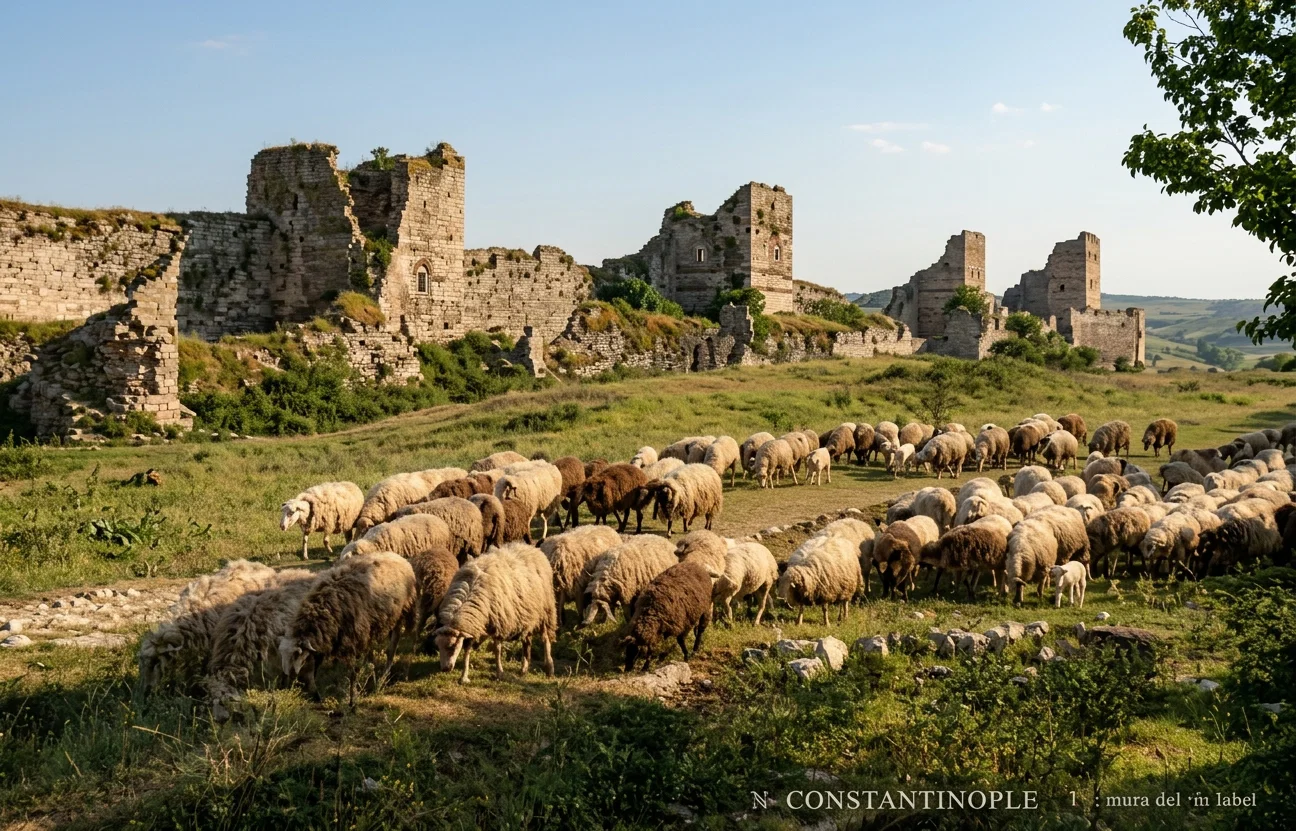
PART OF THE ANCIENT WALL BUILT BY CONSTANTINE THE GREAT, SEPARATING CONSTANTINOPLE FROM THE EUROPEAN MAINLAND
Since last May our religious services have been strictly prohibited here in Constantinople . Our people have been meeting in the open of a large common in one of the suburbs. So during the summer we have spent many pleasant Sabbath days under the cover of a large English walnut-tree, on the Asiatic shore of the Bosporus. The last Sabbath in July the writer baptized seven persons in Constantinople. Our company, together with the candidates for baptism, went by steamer to a remote suburb on the Asiatic shores of the Marmora Sea. After first enjoying a service under a large tree, we proceeded to the baptism. At this point two policemen appeared on the scene, to interfere with our work. They asked what we were about to do. When they learned that we were going to baptize, they forbade it. They wrote down the names of all the brethren, and proceeded to take four of them off to court. I intervened, and through my interpreter persuaded the police that there was no law forbidding us to wade into the edge of the sea, insisting that it made no difference whether the operation be called baptism, or swimming, or anything else,15as far as the legal status was concerned. This kind of logic will not always work in Turkey; but above all was the protecting, overruling hand of our Heavenly Father, and the police were dissuaded from their first course, and they permitted us to perform the rite. As three of those taken into custody were candidates for baptism, these were released. But one, the deacon of our Constantinople church, was held for the whole company, that he might appear before the court, to answer questions concerning what we were doing.
He was held in ward twenty-four hours, and then released on bail. He appeared two days later for examination by the proper officials. In the meantime we sought the Lord to overrule all for the best. When the time for his examination came, only a few simple questions were put to him, and he was released. Thus, what appeared at first, in view of former prohibitions, to be a matter which might develop seriously, turned out to be a complete victory for the truth. Considering that three of the four who were first taken by the police were candidates for baptism, it was no small test of their fidelity to the cause which they had chosen to follow. Of those baptized, two were Jews, two Greeks, and three Armenians.
In Brusa our work is closed up more than in Constantinople. Our brethren there have been forbidden to meet together under any condition whatever. Recently three of them were arrested for meeting together on the Sabbath day, and were fined twenty-five piastres (a dollar United States money) each. These brethren were threatened with exile, if they were found meeting together again. Since this arrest our people have been watched so closely that they have not even ventured upon outdoor services in the edge of the city. I expect to visit Brusa next week. We are seeking the Lord for wisdom, to know how to act under present trying conditions, that no mistakes may be made.
In spite of all these difficulties, the work is gradually progressing, souls are baptized every few weeks, and, with the exception of a very few, our brethren are firm to the principles of our faith. We are planning on holding a general meeting in this western part of the Turkish Mission in the late fall. We hope to gather to this session a good representation of the one hundred seventy believers in this part of the field. Elder Conradi has promised to be present. The meeting will be held in a retired place, where we are not likely to be molested by the authorities.
At present it is impossible to foretell in just what way the Lord will intervene in our behalf, that we may have liberty to preach the gospel. He has wrought for us, and the work is firmly established; and, knowing that he will continue to champion this cause, we are of strong courage in him. Remember Turkey before the throne of grace.