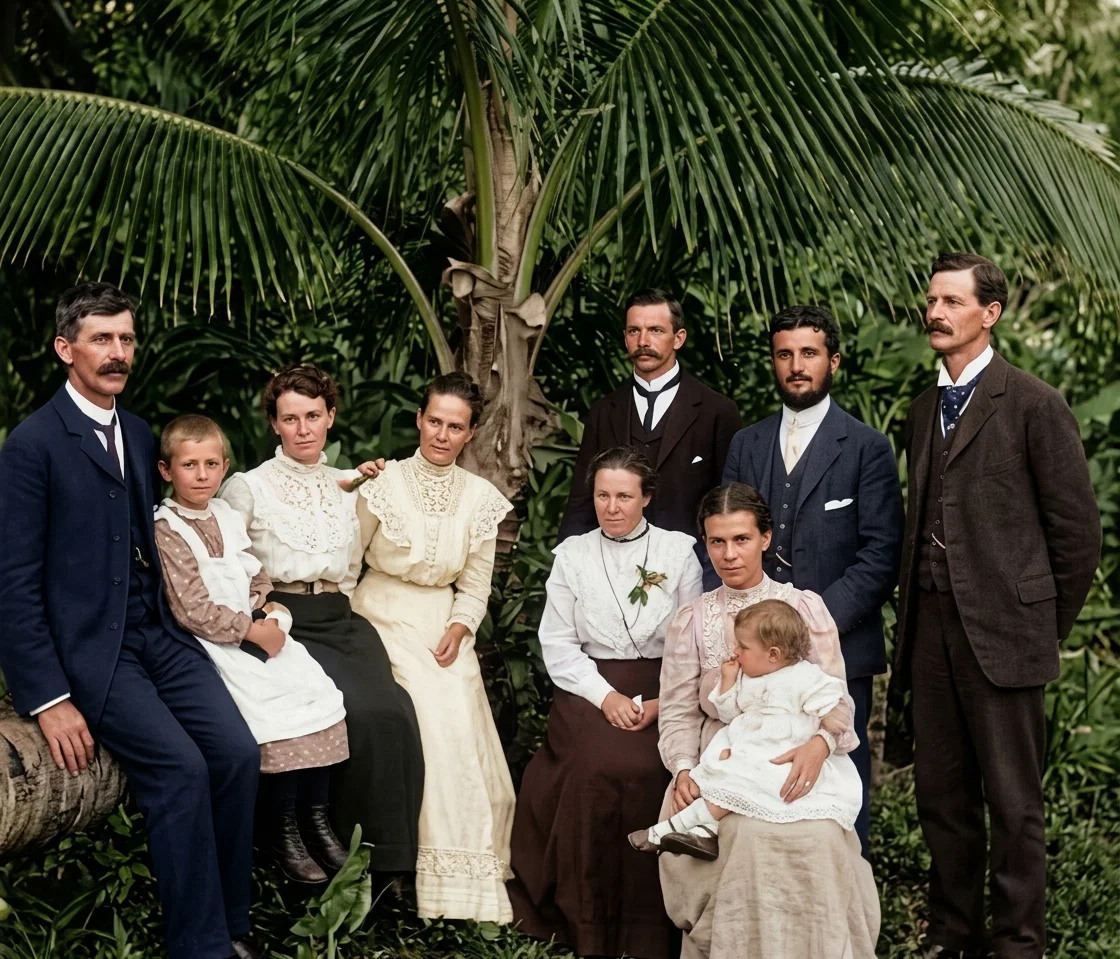
GEO. TEASDALE

7%

Review and Herald Publishing Association · Takoma Park Station, Washington, D. C. · Oct 17, 1907

FromReview and Herald, Vol. 84, No. 42.

Read the full edition

GEO. TEASDALE

Java

GEO. TEASDALE

This is a fine country, the best I have ever been in. So far we have found the climate all that we could desire, a little warm at times, but never so hot as it is in Cooranbong, N. S. W., in the summertime. The weather is never cold; indeed it varies but little the year round. When rain is falling in the mountains, or when there is a little more moisture in the atmosphere than ordinarily, then the thermometer will fall a few degrees. It generally stands between eighty and ninety, with a fall of a degree or two during the night. This is reported to be the wettest country in the world, and I would not be surprised if it were; at least, a country that had more rain would scarcely be able to comprehend the fact that the waters which were under the firmament were divided from the waters which were above the firmament. The rain, however, is not so objectionable as it is in cold countries, and we do not seem to notice it. Indeed, the comparative coolness is attributable to it, so we are glad of it.
WORKERS IN ATTENDANCE AT THE FIJI MISSION COUNCIL
The country districts of Java are beautiful, and the whole island is exceedingly fertile. Although only half the size of New Zealand, it supports a population of thirty millions, and exports a large amount of produce besides. Fruits are abundant, and such fruits as people in cool climes never dream about. Some of these we have not yet learned to like, and there are some which we are sure we shall never care for. One advantage this country has over almost all other tropical countries is a fairly good supply of vegetables, which are grown in the mountains of the interior. They do not have the flavor of vegetables grown in colder countries, yet they are very acceptable, and help to vary the monotony of our menu. Living is rather costly, especially in the cities.
The large cities are not very nice places in which to live, and I should be glad if we could make arrangements to live in the country. So far, however, our work is in the town, and it is impossible for me to move out of it, because, unless we go about fifty miles away, the place is so thickly populated and so low-lying, and consequently damp and unsanitary, that it is better to live in the city. The houses are built very near one another.
There are swarms of natives in Java. Even in the country they are everywhere; and the highroads are full of them wherever we look out of the train. In the town they are dirty, and not nearly so respectful as they are in the country districts. Their habits are unmentionable. When traveling in the country in the train, one can tell by the odor when nearing a campong (village) or a market-place. The natives are good-natured, and content to work for little, except when they are working for a person who is a stranger to the country; then their wants are never satisfied. There are a great many Chinese here, most of whom are natives, and are highly civilized. They are the nicest class of people here, and it is among them we expect to begin our work.
The Dutch government holds the natives in strict subjection, and is very careful about the admission of strangers. Life and property are more secure than they are in many of the civilized countries of Europe, and there is practically no poverty, as we understand it in other countries. The natives generally are very poor, and may not possess enough clothing to cover them, or have the semblance of a house to live in, yet they never suffer from want, as millions do in other places. Twopence [four cents] will keep a native for a day; and if he has a mind to be economical, it will suffice him. But as long as he possesses money, he is not economical.
Foreign missionaries have to obtain a special permit from the government before they are allowed to operate. It is now about four months since we sent in our request, and we have not received our desired permission yet. Twice I have had to appear before the dignitaries here to answer questions, and then my answers have had to be sent to the capital. So we do not know yet whether or not we shall be allowed to remain here. The Methodists from Singapore are operating a mission in Batavia, and have contemplated starting here. Two denominations are not allowed to work in the same district, so if we obtain permission here, it will shut them out. Dutchmen can go to work without all this trouble, and they have many advantages which foreigners do not enjoy, especially Englishmen and Americans. It is surprising how well Adventism is known here, and what a strong prejudice there is against it in the minds of many. However, this is not so pronounced as in other countries, and I feel sure that the Lord has a number in Java who will accept the truth.
The prospects for the work here are very good, much better than we had expected. When we came, but one woman was keeping the Sabbath. Now her husband is with her, and they are getting along very nicely. They are English Eurasians, and came from Singapore, where they learned the truth. The Eurasians seem to possess the puerilities of both the Europeans and the Asiatics, and few of the strong qualities of either. There are thousands of them in this part of the world. Those of Dutch descent seem to possess sturdier qualities thando others. We are hoping that many of them will accept the truth in this country, and form a strong nucleus for a church in the Dutch possessions in the East. Already one aged man and his wife are keeping the Sabbath through reading, and we know of quite a number of others who are interested. Our stock of literature is limited, and we can convey intelligence to them in no other way as yet. In order that a person may work to advantage with them, it will be necessary for him to be able to speak the Dutch language. Most of them do not care to speak to a European in the Malay, as an undue familiarity with that language is too suggestive of one half of their parentage. But this is not the case with all. A man, a Catholic who edits the Malay paper here, comes to the house twice a week, to help us with the Malay. We love him, and hope that some time he may be one of us. He is a very sensible man, and kind-hearted. He has discontinued the use of tea, etc., and is trying to stop the use of tobacco.
You would be surprised to know how many languages nearly every one can speak in this country. The Eurasian editor speaks English well, also Italian, and has a working knowledge of French, besides Malay, Javanese, and Dutch. A young Chinaman who comes to our house for lessons speaks five languages besides English. He is now taking lessons from me, and I am also giving him lessons from the Bible. We hope that he will accept Christianity as the result. We are putting our best efforts on the Malay, and in the course of a few months expect to be able to speak quite a little in that language. We ought to have a Dutch worker here to labor for the Dutch-speaking community now, while the prejudice is comparatively small, and while there is a desire on the part of many to hear. It is the best opening I have ever seen, and my constant regret is that I can not fill it. I would begin to learn Dutch immediately, but I find one language is quite as much as I can manage at once. If we could have a young couple, or a man from Holland, here with us to labor, I am sure we should soon have a good company.
In a few weeks we expect to start a school for the Chinese, to teach them English. They are anxious to learn, and are willing to pay a good price for it. We will make this the basis for missionary operations, as soon as we know the Malay—the language they speak.
Sourabaya, Java.