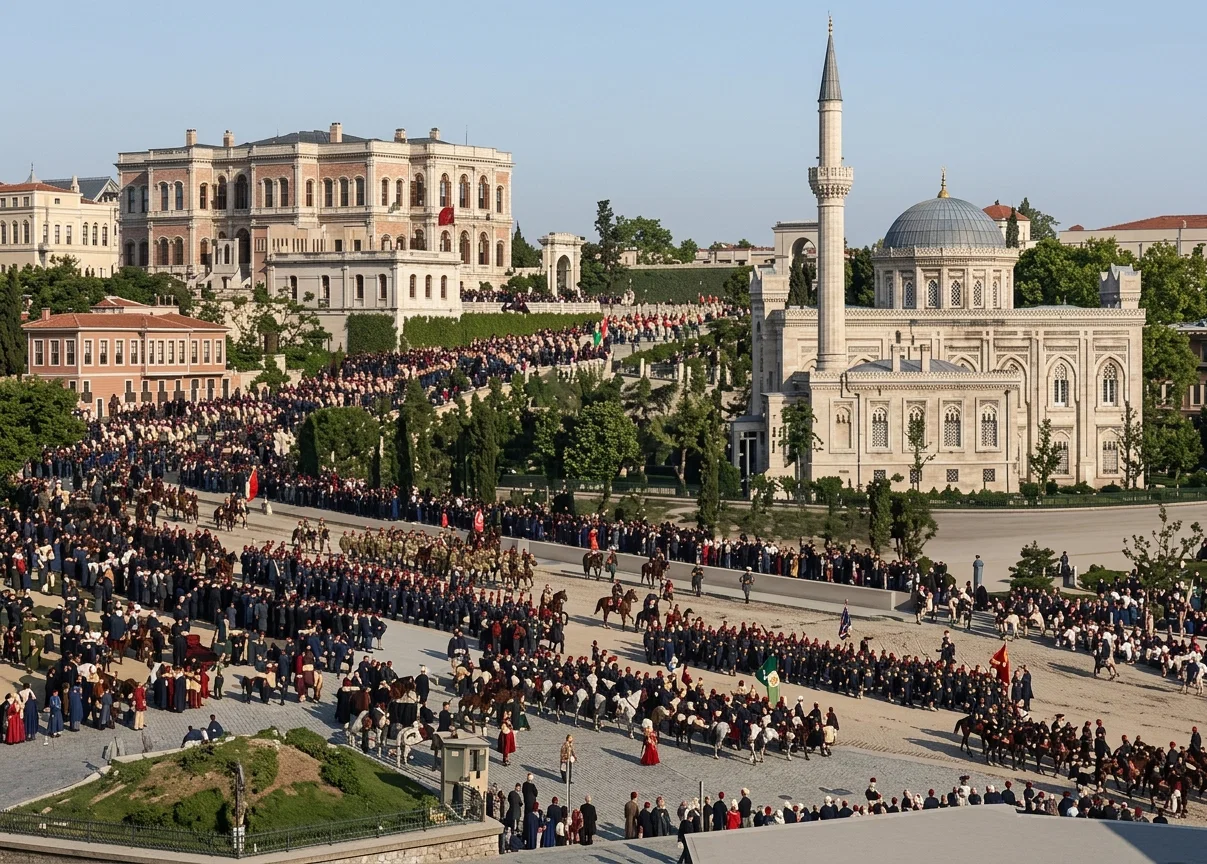
The Selamlik

4%

Review and Herald Publishing Association · Takoma Park Station, Washington, D. C. · Oct 3, 1907

FromReview and Herald, Vol. 84, No. 40.

Read the full edition

The Selamlik

CLAUDE D. AC MOODY
THE term Selamlik is applied to the appearance of the sultan of Turkey in state every Friday, as he attends worship at the Hamidieh Mosque. This is strictly a court ceremony. Accordingly, no one can attend Selamlik except the high officers of the Turkish government, the ambassadors of foreign countries and their families, and such foreigners as are able to secure special permission through their respective embassies. In the early spring, the writer, in company with Dr. A. J. Hoenes, who was at the time spending a few days in Constantinople, on a trip through the Orient, secured permission, through our American embassy, to attend this state function. The impression received upon that occasion, together with the information obtained since, has prompted me to give to the readers of the REVIEW a brief account of some things that have been of great interest to me, and some of the lessons that I have drawn from them.
The ceremony is attended with all the pomp and ostentation characteristic of Oriental custom. The palace and spacious gardens of the sultan, the Hamidieh Mosque, and the drive from the palace to the mosque, are surrounded by a great turnout of the infantry and cavalry of Turkey. Each main division of cavalry and infantry has a band, and a continuous round of music is kept in progress from the time the divisions leave their various quarters in different parts of the city until the ceremony is over.
The foreigners who have secured permission to attend start from the headquarters of their respective embassies, in company with an attendant from the embassy. From the American embassy to the Hamidieh Mosque is a delightful drive of about forty-five minutes.
The names of all the applicants at the various foreign embassies are telegraphed to the sultan’s palace, and then a reply is telegraphed back, notifying whether their applications are accepted.
The palace is very strict about this, since the bomb-throwing about two years ago.
A VIEW OF THE SELAMLIK

The building to the right with the minaret is the Hamidieh Mosque, where the sultan worships every Friday. The large building to the left is the sultan's palace.
A VIEW OF THE SELAMLIK The building to the right with the minaret is the Hamidieh Mosque, where the sultan worships every Friday. The large building to the left is the sultan's palace.
The admitted spectators view the procession of the sultan to the mosque from the Imperial Pavilion, which is before the Yildiz Kiosk, or summer palace. A kiosk is a Turkish summer house. Yildiz is the Turkish word for star. But as the emblem of the Moslem empire is “the star and crescent,” this term is sometimes applied to it, also. The full Turkish word, however, for the crescent coat-of-arms is ay-ile-yildiz, meaning literally, “the moon with the star;” hence, the Yildiz Kiosk, or house of the star and crescent.
As the companies from the various legations arrive at the Imperial Pavilion, their cards are passed in to one who has a list of the names that have been accepted. From this pavilion a most excellent view is obtained of the vast military display, of the Hamidieh Mosque, of the arched entrance to the main palace grounds, and of the way over which the sultan passes.
We arrived fully forty-five minutes before the procession to the mosque. During this time additional companies of infantry and cavalry kept putting in appearance, until every rod by which their chief was to pass was heavily guarded. Every few minutes some pasha or high military officer would arrive within the guarded space, with gorgeously liveried coachman and footmen.
Amid all this, one of the first things to attract my attention was many small piles of gravel in the way over which we were expecting the sultan to pass at any moment. Many workmen appeared presently, and scattered this gravel evenly and smoothly over all the “royal way,” and much more was brought by one-horse carts. This took considerable time. It was most thoroughly and carefully done, though the way was already well paved, much like the macadamized streets in America.
Soon a priest, having ascended the high spiral minaret of the mosque, stepped out upon the narrow gallery near its top, and began to call. The hour of prayer had come. This call to prayer, chanted forth in Arabic by the Oriental tongue, conveys a sound to the ear, yea, a feeling to the soul, that tells one he is in the East; that he is among the worshipers of the Arabian prophet.
Preceding the procession of the sultan, and while the workmen were performing the finishing touches of their gravel-spreading, several closed cabs passed, bearing some of his majesty’s wives from the imperial harem. Through the glass in the cab doors a glimpse of the occupants could be obtained. These ladies were richly dressed, their faces covered with white veils. In some cases their children accompanied them. One sultan is said to have had one hundred and fifteen children.
At last the sultan appears, surrounded by a heavy guard of mounted soldiers, before, behind, and on either side. Oriental matting and rugs are laid down from the carriage to the entrance of the mosque. The prayer service lasts only about twenty minutes. Then comes the return procession. The sultan does not return in the same carriage in which he goes to worship, but in a single-seatvehicle, driving his own horses. This is to indicate that he holds the reins of government in his hands, and that he receives this reigning power from Mohammed.
This over, our carriages soon appeared. The bands were engaged in a vigorous rendering of the Ohmedieh march, the Turkish national air; and the companies of infantry and cavalry began their march to their respective headquarters, and we were off upon our pleasant return drive to the American embassy.
A strong impression was left upon me. How great a contrast, indeed, between the apparent glory and power signified by this great display and the real strength of the “sick man of the East”—the Ottoman empire in its weakened condition!
Selamlik comes from selam and the Turkish terminal lik. Selam means peace, and is the common Turkish salutation; and when thus spoken signifies, “Peace to you.” Lik denotes the abstract essential quality or function of the thing named; hence, selamlik, or peacefulness, the possession of peace, or the foundation of peace. Now selam contains the consonantal radicals in Arabic corresponding to the Hebrew radicals in the Hebrew word salem, the only real difference being in the placing of the vowels in pronunciation. The Hebrew word salem means peace; and Melchisedec is called “King of Salem,” or “King of Peace,” in Heb. 7: 1, 2. Again, Jerusalem, or Yerusalem, means “abode of peace.” Altogether, the comparison of Selamlik and Jerusalem shows a striking similarity in the meaning which each may convey.
Now in view of the prophecy of Daniel 11 and 12, which shows us that we are living in the days when “he [Turkey] shall plant the tabernacles of his palace between the seas in the glorious holy mountain [Jerusalem],” and in view of the fact that the Moslems themselves believe in the early removal of the Ottoman seat of government, the foregoing similarity of terms possesses an interesting degree of significance.
The third angel’s message in the hearts and hands of those who are the ambassadors of Jesus Christ is “preparing the way” of the only King of Peace—the King of kings, and Lord of lords. The angel of Revelation 10 has ascended the great prophetic “minaret,” and since 1844 has been heralding, “Time shall be no longer.” And in these recent years this has been especially emphasized under the construction, “There shall be delay no longer,” expressed in what has come to be our watchword and banner—“The advent message to all the world in this generation.” And Isaiah proclaims: “Prepare ye the way of the Lord, make straight in the desert a highway for our God. Every valley shall be exalted, and every mountain and hill shall be made low: and the crooked shall be made straight, and the rough places plain.” As I witnessed the thorough preparation of the way over which an earthly king passed, I longed to see the way of our heavenly King being prepared more rapidly in these great Eastern lands. His way passes through all nations and climes.
The preparation of the way of our God is the carrying of the third angel’s message to the world, to separate from earth’s millions those who desire not only to witness, but to unite in the great triumphal procession of King Jesus. All who attend must first have their names sent to the sanctuary in heaven, and be accepted there. The condition of acceptance is perfect loyalty to the King and kingdom, that no more outbursts of rebellion shall ever mar the peace of our King’s dominions. And “we are ambassadors for Christ,” who should beseech an entrance into Christ’s kingdom for those now in darkness.
There is time still for names to be sent beforehand to the sanctuary. Soon mercy’s door will be forever closed. Soon the last name of those who with joy shall attend, yea, in this case join, the procession heavenward, will have been accepted. Let us hasten the preparation of the way of our King! The door of mercy is open against time; for the time of our King is at hand.
Words are weak to express my feelings as these truths were reinforced in their meaning to me, through the event herein described. “Young people, to the front” for the fields of the East—fields laden with history, indeed; but how shall we relate ourselves to their future?
Constantinople, Turkey.