A Mighty Movement—A Strong Purpose

6%

Review and Herald Publishing Association · Takoma Park Station, Washington, D. C. · Aug 1, 1907

FromReview and Herald, Vol. 84, No. 31.

Read the full edition

A Mighty Movement—A Strong Purpose

From the fourteenth to the seventeenth of July there was held in the city of Indianapolis, Ind., the sixth annual convention of the American Federation of Catholic Societies. It was an enthusiastic gathering, a convocation of men with a set purpose. Throughout the entire convention there was manifest a spirit of zealous devotion to a central idea; and that central idea was federation for power to achieve a definite purpose.
It is the design of the leaders to bring every Catholic organization or society in the United States into the organization. The movement was started six years ago by the Knights of St. John, a Catholic secret society. Last year the Federation reported a membership of 1,500,000. This year they claim to have nearly reached the two million mark. Not all the Catholic societies have joined the Federation; but they confidently expect soon to enrol the entire membership of all the Catholic societies in the United States.
The Federation has organizations in forty-three States and Territories, besides Porto Rico, the Hawaiian Islands, and the Philippine Islands. Eighteen prominent Catholic colleges and institutions are affiliated with the Federation, and fourteen national organizations have now been enrolled.
It is not their purpose, however, tolimit the field of their operations to this country. Already the work of the federation propaganda has begun in the Old World, in such countries as England, Spain, and India, and the work is expected to be taken up without delay in all countries.
One of the most striking features of this convention was the pronouncement of the pope's blessing upon the Federation and its purposes. So important and so necessary to his purposes does the pope consider this vigorous, growing Catholic force, that he sent a special delegate to Indianapolis to pronounce his blessing in person at the first meeting of the Federation, Sunday morning, July 14. To make the occasion more impressive, pontifical high mass was celebrated at the same hour. The papal delegate, personal representative of the pope, was met at the railway station by a large concourse of priests and lay delegates who vied with each other in doing him reverence. This was a striking feature of each occasion when he made his appearance.
A great mass-meeting was held on Sunday evening in Tomlinson Hall, which seemed to be crowded to its capacity. Three thousand was the estimated attendance on this occasion. The appearance of Archbishop Chatard in red hat and robes of lustrous red silk, followed by Monsignor Diomede Falconio, the papal delegate, in gray robes and red hat, leading a procession of “holy fathers, bishops, and archbishops,” was the signal for a storm of applause, the people rising to their feet and demonstrating in every possible way their reverence for the personal representative of the pope.
The meeting was conducted by Archbishop Chatard, who made a short address upon the object of the organization and its importance in furthering Catholic aims. He stated that the underlying idea of federation was to bring the various Catholic forces of this country and of the world into unity for action of a more general nature than any of the various organizations could accomplish by themselves. He declared one of the most important undertakings of the Catholic Church at the present time to be the cementing of Catholic bodies into one organization to carry out the purposes of the church. He wanted Catholic bodies to become more conscious of their strength, and to use that strength not merely as American citizens, but as Catholic citizens.
The writer could but wonder what the archbishop could mean by Catholic citizenship in contradistinction to American citizenship. His words were not used thoughtlessly, but were indicative of a purpose on the part of that organization to bring this nation into harmony with the purposes of the Catholic Church; and the American Federation of Catholic Societies is the hammer that is to forge the nation into the desired shape.
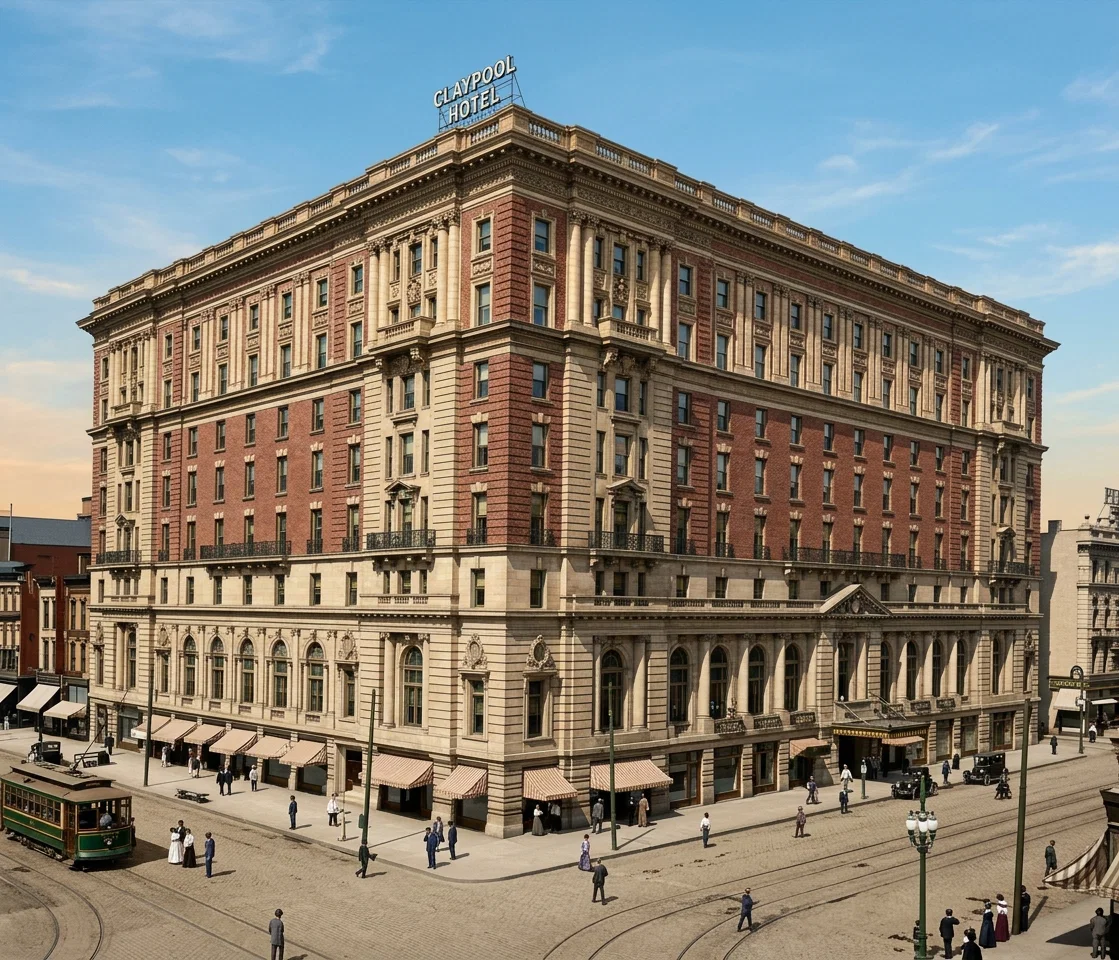
CLAYPOOL HOTEL, INDIANAPOLIS, IND. Headquarters of the American Federation of Catholic Societies’ Convention.
The delegates to the convention were warmly welcomed to the city by Mayor Bookwalter, who though declaring himself a non-believer in Catholicism, highly lauded the purposes of the church and the names of the first Catholic missionaries to this country, and complimented the church on what it was seeking to do “to upbuild this nation.”
The president of the Federation, Edward Feeney, replied to the mayor’s address of welcome, and proceeded to set forth the aims of the organization. Early in his address he said:—
I say to our separated brethren [Protestant denominations], join hands with us in preserving Christianity in these United States. Statistics show that half the population in this country never enter the door of a Christian church. Something must be radically wrong. Infidelity grows; discontent in the great centers of population is swelling. The men who founded this nation were Christians. The men whose blood mingled with the turf on a hundred battlefields since 1776 to preserve this republic were Christians. We propose that their sacrifice shall not have been in vain.
Mr. Feeney was right about there being something radically wrong. There has been something radically wrong ever since sin entered this world. But that wrong can not be righted by combinations of men whose purpose is to coerce other men into harmony with their belief and practise. That wrong can not right the other wrong. But it is in that wrong course that they are now calling Protestantism to join them. Many do not attend church. They must be induced or compelled to do so, or our patriot fathers will have shed their blood in vain. With such arguments they will win the favor and the co-operation of those who do not understand the principles of the government, nor what its founders were fighting for.
Will nominal Protestantism join them? It was only last year that nominal Protestants were inviting Catholics to join them in a similar work. With each party inviting the other to join, the union is bound to take place. One of the “reforms” for which nominal Protestantism is working is the enactment and enforcement of Sunday laws. One of the chief purposes of the American Federation of Catholic Societies is the enactment and enforcement of Sunday laws. Why should they not join? and what is to hinder them?
Next week we will give our readers an idea of what this Federation is doing, and how it is doing it. C. M. S.