Hayti as a Mission Field

5%

Review and Herald Publishing Association · Takoma Park Station, Washington, D. C. · Aug 1, 1907

FromReview and Herald, Vol. 84, No. 31.

Read the full edition

Hayti as a Mission Field

W. JAY TANNER
A "BOCOR," OR VANDOUX PRIEST
Supposed to have power to work miracles
A "BOCOR," OR VANDOUX PRIEST Supposed to have power to work miracles
In the troubles that arose between France and the ex-slaves of Hayti in the closing days of the eighteenth century, it was not the intention of the latter to separate from French rule, and set up an independent government. Even the ambition of Toussaint Louverture does not seem to have included this idea; for he promptly rejected an offer from England to sustain him at sea, if he would break with France, and establish himself as king of St. Domingo.
Freedom from slavery, and a reasonable recognition of their civil rights, were all that was demanded by these sons of the soil. And had France been willing to grant these reasonable terms, without doubt the colony would have remained under her rule to the present day. But Providence thrust upon these ex-slaves more than they had asked for, and, perhaps, more than they were prepared for.
It is not surprising, under such circumstances, that Hayti has made failures; rather, it must be acknowledged that injustice has been done her by unkind criticisms, especially when the great and extraordinary difficulties of her career are fairly considered—difficulties that must have rendered independence for more than a century impossible, had there not been real stamina somewhere. And it must be remembered that not only was the responsibility of self-government thrust upon this people so recently emerged from the ignorance of slavery, but that the wheels of the chariot of state that they were compelled to construct were further hampered and clogged by the non-progressive influence of Roman Catholicism.
The shame of Roman Catholicism in Hayti is Vandouism, a superstition which was imported with slavery from Africa. “The disciples of this cult are generally found in organized and united societies which are bound by a solemn oath to secrecy. Vandoux, the presiding god, is represented by a snake, which the devotees worship in secret.” The immortality of the soul and the power of the bocors (priests of the cult) to work miracles are also important tenets of this creed. “The dance connected with this system is exceedingly weird and serpentine, and usually terminates in the greatest obscenities.”
It is impossible for a people to progress where such superstitions are practised. Rome professes to have the only remedy that can cure such ills of humanity. She has here been face to face with this degenerating African superstition for three centuries, and has been afforded every opportunity to demonstrate the efficacy of her claims. Yet to-day Vandouism continues to raise its vile head in all parts of the republic, swaying a remarkable and inexplicable influence over the minds of a large portion of the population; while in other countries where it was also carried with slavery, and where it came under the purer teachings and influences of Protestantism, it has almost, if not entirely, disappeared.
It is true that the government and the better classes have a laudable desire to exterminate Vandouism. But with the Catholic priests everywhere teaching the people doctrines which are the very foundation-stones of paganism, how can any progress be realized? Indeed, it often happens that the very ones who are most anxious to see this evil removed are themselves handicapped by false ideas that they have imbibed from Rome.
To enter into all the evils resulting from Catholicism in Hayti would be to repeat what is well known about the same things in other Catholic countries; and it would be also to record the fact that a reaction seems to be setting in, and that there is reasonable prospect that at a convenient date Hayti will refuse to renew her present concordat with the papacy.

Protestantism

Protestantism first made its appearance in Hayti in 1816, when two Wesleyan missionaries established a mission at Port au Prince. They were soon followed by the Baptists, and later, by a mission of the American Episcopal Church. These early missionaries experienced the usual troubles of those who would unfurl the banner of free salvation in a Catholic country. The senseless and enraged populace on one occasion wheeled stones by the barrow-load to convenient places, and then hurled them against the Wesleyan missions, thereby doing more or less damage to the buildings and worshipers. In the name of the law, many of the converts were imprisoned, and the government asked the missionariesto leave, which they did.
The converts, who were thus bereft of their pastors, endured the persecution remarkably well, remaining loyal to their convictions, and continuing, in an unobtrusive manner, to hold their meetings in private residences. However, after several years, the missionaries were gradually allowed to return and resume their work, and in 1843 religious liberty was granted to Protestants.
At the present time the work of Protestant missions in the republic is not, generally speaking, in a very flourishing condition. For various reasons, the different home societies have withdrawn a large share of their support from the field, and as a result there are but six foreign missionaries in the French part of the island, two of whom are Seventh-day Adventists. There are about twice as many native missionaries, but only a portion of them have any regular salary. Some of these support themselves by teaching, the government giving them a small subvention; and at least one who has been a “self-supporting missionary for over thirty years” supports himself, in part, by the manufacture of rum. But then this latter fact does not seem to excite any astonishment here; for, generally speaking, it is to be feared that the cause of temperance has very few advocates among the Protestants of Hayti.
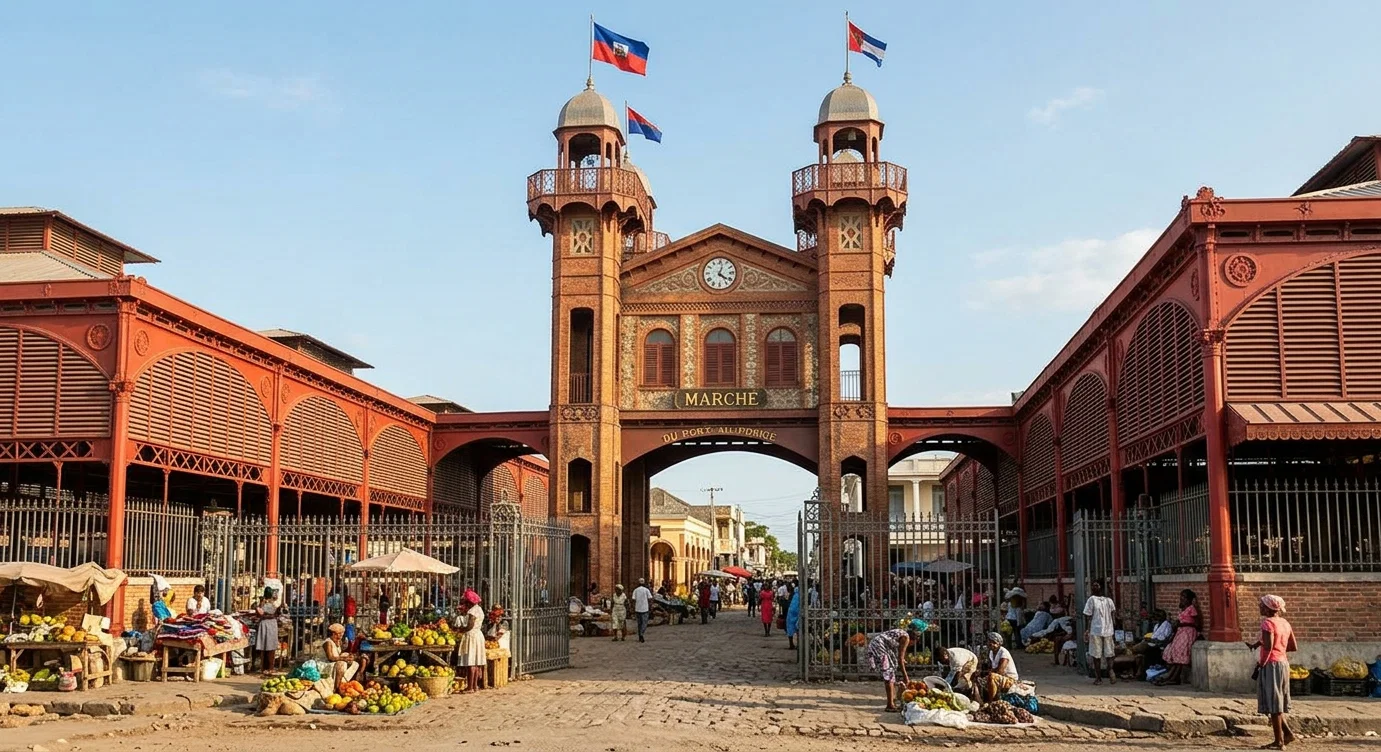
THE MARKET, PORT AU PRINCE, HAYTI
As to the numerical strength of Protestantism, it is doubtful if two thousand communicants could be found in the republic, and a large portion of these are British subjects from other West Indian islands. The spiritual life among these believers is practically dead. Undoubtedly there are some honest and conscientious pastors and members among the various missions; but it must be confessed that it is disappointing to the sincere newcomer to learn that professed Christians of the evangelical faiths sometimes employ sorcery and charms for the purpose of healing the sick, or that they should so mix the sacred and profane as to use a lottery ticket as a temporary Bible-mark. But the worst feature is that these and other evils do not seem to excite any criticism or surprise. That a Protestant predicateur (preacher) should buy a lottery ticket, seems to excite no comment whatever.
One of the first difficulties that the missionary to a strange land has to encounter and overcome is that of language. Nominally speaking, the language of Hayti is French, which at the best is usually difficult enough for an American to master on the points of accent and fluency. But what makes this work more than usually hard in Hayti is the prevalence of the patois or, as it is called here, the creole, which in reality is the dialect of not only the lower classes, but also of the upper classes and of business affairs; the pure French being reserved for society, legislative assemblies, and the church. And it must not be supposed that the creole is so very similar to the French. Some seem to have the idea that the difference is somewhat similar to that of the dialect of the negroes of the Southern States and the English. But this is a mistake; for the dialect of our Southern negroes is usually the result of bad pronunciation and bad grammar.
The French creole, on the other hand, has only a few words that are French, a few that are evidently corrupted French, and many that are totally different from the French, these latter being, it is said, a mixture of Spanish, English, and African.
In view of these facts, the missionary must, first of all, strive to be a master of the French; for in this language all his public work must be performed, in order to get the respect of the better classes. And he must, also, become familiar with the creole; for there are many who can be reached only by this means, they being unable to understand the French.
In conclusion, let it be impressed on the mind of the reader that now is the opportune time to give our message to Hayti. Never was a Catholic field in better condition to receive the truths of the gospel. The parable of the good Samaritan, which we have been told illustrates the work that needs to be done for our colored people of the South, also illustrates the case and needs of Hayti. This little republic has truly fallen among thieves, and has been stripped and left for dead. The other denominations nations have missed their day of opportunity, practically passing by “on the other side.”
It behooves those who know God’s will to act the generous part of the good Samaritan, and, by their prayers and means, help these poor people where they are.
Cape Haytien.