The mission selected and located by Brother Anderson, and known as the Barotseland Mission, consists of five thousand acres, part of which is open and part bush—veldt or prairie. The place is two and a half miles wide, and three and a half miles long. It lies the long way east and west. The Magoi River, a small stream the year round, runs through the farm the narrow way, dividing it with three thousand acres to the east, and two thousand to the west. The buildings and improvements are on the west side. The whole farm lies on an elevated plateau that constitutes the water-shed between the Zambezi and Kaffue Rivers. The soil is a deep, sandy loam, and very productive, if one can judge from the crops and native grass, much of which is ten feet high. In addition to the Magoi, there are two other small streams running through the farm, and a large fountain, or water-hole, from which water is obtained for cooking and drinking purposes.
It is now nearly two years since Brother Anderson began to make improvements on this place. In that time, he has built a pole-and-mud dwelling-house, twelve by forty-eight feet; a storeroom, twelve by thirty-six; a dining-room and schoolroom combined, twelve by twenty-four, and eleven round huts for natives, six feet high and twelve feet across. All these buildings are made of poles and mud, and roofed with grass, except the dwelling, which is covered with corrugated iron. About three hundred feet back of the natives' quarters, they have built a large cattle kraal, and divided it into different compartments, one to contain the oxen, another the cows, and a third the calves and goats. These kraals are built by planting long poles side by side deeply into the ground, and binding them together toward the top with bark, or withes. When finished, it makes a strong enclosure, averaging from twelve to fifteen feet in height, and furnishing perfect protection for the cattle against lions, hyenas, and other ferocious beasts with which the country is at present infested.
In addition to these improvements, he has a good-sized dooryard enclosed with posts and wire fence, and a back garden through which there is a walk leading back to the boys' quarters, on either side of which there is a row of papei-trees in bearing. In the same lot, back of the rows of papei-trees, he has planted seventy citrus-trees, divided between the orange, lemon, and grapefruit. Around this same lot he has twelve banana plants, fifty guava-trees, and nine passion-fruit vines. Elsewhere on the place he has twenty-five grape-vines, six apple-trees, six apricot-trees, six fig-trees, one plum-tree, and twelve quince-trees. Of farm crops he has eighty acres in mealies that look remarkably well; eight acres in peanuts, and twelve acres divided between potatoes, pumpkins, Cape gooseberries, and tomatoes. In the stock line, he has seventeen oxen, thirty-six cows, thirty-two calves, and thirty goats. The mission family at present consists of thirty-six boys, one married woman, and a young girl. No buildings have as yet been erected to accommodate girls. All the work of caring for the stock, planting and cultivating the crops, and looking after things in general has been done by the boys outside of school hours. The daily program by which the mission is run is as follows: Rising, summer, 5 A. M.; winter, 6 A. M.; work from 5 to 7; breakfast and worship, 7 to 8; work, 8 to 10; school, 10:30 to 1:30 P. M.; dinner, 2 to 3; work, 3 to 6; worship, 6:45 to 7:15; evening study, 7:15 to 8:45; retiring bell, 9.
It is Brother Anderson's plan to build up a central mission at this place, from which native teachers may be sent out to the tribes living within a radius of fifty or one hundred miles. Already one of his boys has begun work at a point fifty miles from the mission. We visited a few kraals during my short stay, that I might get some idea of the people, and their mode of living, and general habits of life. The ones we visited were indeed raw heathen, living in ignorance, squalor, and filth, almost on a level with their cattle and goats, with whom, in some instances, they shared their dwellings. It is certainly virgin soil in which this mission is located, and the prayers of God's people, far and near, should ascend to heaven, that Brother Anderson and his assistants may be preserved in health, and given wisdom to know how to reach this people with the gospel, which alone can rescue them from the darkness of heathenism and ignorance into which they have fallen, and fit them for a home in the kingdom of God.
In harmony with the program laid out for my trip, I was obliged to leave Brother Anderson's mission on Wednesday, February 20, and return to Buluwayo, at which place I arrived Friday morning, February 22, and was met by Brother Sturdevant, and driven in a farm wagon, drawn by four mules, to the Solusi Mission, which is located thirty-two miles a little south of west of Buluwayo. Owing to the recent heavy rains, the roads were bad, and some of the rivers we had to cross were swollen, which, with their steep banks, and deep, sandy bottoms, made them both difficult and dangerous to cross. But the Lord favored us on our journey, and much to our delight, we reached the mission nearly15an hour before the beginning of the Sabbath.
Little did I think, when associated with Brother and Sister Sturdevant in labor in the southern part of the United States eleven years ago, that the next time we should meet would be at the Solusi Mission in South Africa. I was pleased to see them looking so well, and to learn that the Lord had dealt kindly with his servants during their five years' residence at the Solusi Mission.
Word had gone out that I was expected at the mission on Sabbath, so when the day came, there was a large attendance of the natives from the kraals near by. Among the company there were five chiefs, including the paramount chief of the district. I spoke to them through an interpreter for over an hour upon the third angel's message, giving the time and showing from the large map the place of its rise. I then traced its progress through the different countries, pointing out the places where our various missions in their own country were located, telling them at the same time how rapidly this message is going in these last days, and that it will be closed in this generation, by the coming of the Lord, when those who are prepared by the forgiveness of their sins and obedience to his commandments, will be taken home to glory. They all listened intently, and seemed to comprehend the greater part of what was said, for in the years that this mission has been in operation, they have heard more or less about the third angel's message.
The Solusi Mission consists of two farms, of six thousand acres each. This land was selected by Peter Wessels and Brother Druillard in the year 1892, and the mission was formally opened in 1894 by the arrival of Brethren Tripp and Anderson and Dr. Carmichael. This mission was first known as the Matabele Mission, but lately the name was changed to “Solusi,” in honor of the head chief of the district. During the Matabele uprising of 1896-97 our brethren had to flee to Buluwayo for a time for safety. During their absence the government built upon the mission farm, one half mile from the mission buildings, what they called Fort Solusi. It consisted simply of earthworks, thrown up around a good-sized umquoampunzi-tree, in three forks of which, about fifteen feet from the ground, was placed a Gatling gun, so as to command the mission and surrounding country. The primary object was to protect the loyal natives in the surrounding kraals, yet at the same time it stood as a protection to the mission.
The first few years of this mission were marked with an up-and-down experience, not occasioned, however, by any lack of energy or consecration upon the part of the missionaries, but from the absence of any definite plan to work to, and the lack of experience in this kind of work, and a series of calamities over which they had no control. Just as they were getting fairly started in their work, the Matabele uprising broke out, and they were compelled to flee to Buluwayo for protection, where they remained nearly seven months. Directly after this was over, and they were fairly getting started again, the famine came on as a result of the war, and a large number of the natives died. The famine was followed by a plague among the cattle, known as the rinderpest. In September, 1897, Brother and Sister Armitage connected with the mission, and he at once began the erection of three brick dwelling-houses. These houses were finished by the end of the year, and taken possession of by the three families at the mission; namely, Brother Tripp and family, Brother Anderson and family, and Brother Armitage and family. In about one month following, or in February, 1898, an epidemic of fever broke out, which prostrated nearly every member of the mission family, and resulted in the death of Elder Tripp and his little boy, Dr. Carmichael, Sister Armitage, and Brother Sparrow's little girl.
Brother Taba, their native interpreter, and a number of other natives connected with the mission, also succumbed to the disease.
In the month of April, 1899, the mission force was strengthened by the arrival of Elder F. L. Mead and family, Dr. Green and wife, Brother Lloyd and wife, Brother Chaney, and Sister Hiva Starr, in all a company of ten. This number, added to those who survived, or escaped the fever; namely, Brother and Sister Anderson and Brother and Sister Armitage (formerly Sister Tripp), made a company of fourteen. Up to this time, practically nothing had been done in the way of a school for the natives, except the teaching of the twenty-five orphans who had been gathered in as a result of the famine.
After the arrival of Elder Mead, school work for the natives began to develop gradually, but for the two years following his arrival, nearly the entire time of the men connected with the mission was devoted to trading with the natives, buying their grain in small quantities, and hauling it to Buluwayo, and selling it at an advanced price. Two or more outposts for trading were established, and in this way quite a profitable business was carried on. The means thus obtained was used in paying the workers, erecting buildings, and increasing the facilities for carrying on an industrial mission for the training of native evangelistic workers.
Near the close of the year 1899 Hiva Starr returned to the States, and in 1900 Brother Lloyd and wife followed. In the early part of 1901 Dr. Green and wife also returned to the States. Later on, in the same year, Brother Armitage and wife went to Somabula, one hundred and fifty miles to the northeast, and opened up a new mission. During the same year Brother Chaney went to Cape Town on account of failing health. Near the close of the same year, Elder Mead died at Kimberley, on his way to Cape Town to attend the meeting called to organize the South African Union Conference.
Early in the year 1902, Elder Sturdevant and family arrived to connect with the mission. Shortly after his arrival, Sister Mead and her son and daughter returned to Cape Town, where Sister Mead died a few months later. Thus in a little over three years, the company of ten that came to the mission with Elder Mead were all gone from the mission and mission work, except Brother Chaney,—five returning to the States during the first two years, Elder Mead and wife having died, and their children taken up their residence at the Cape.
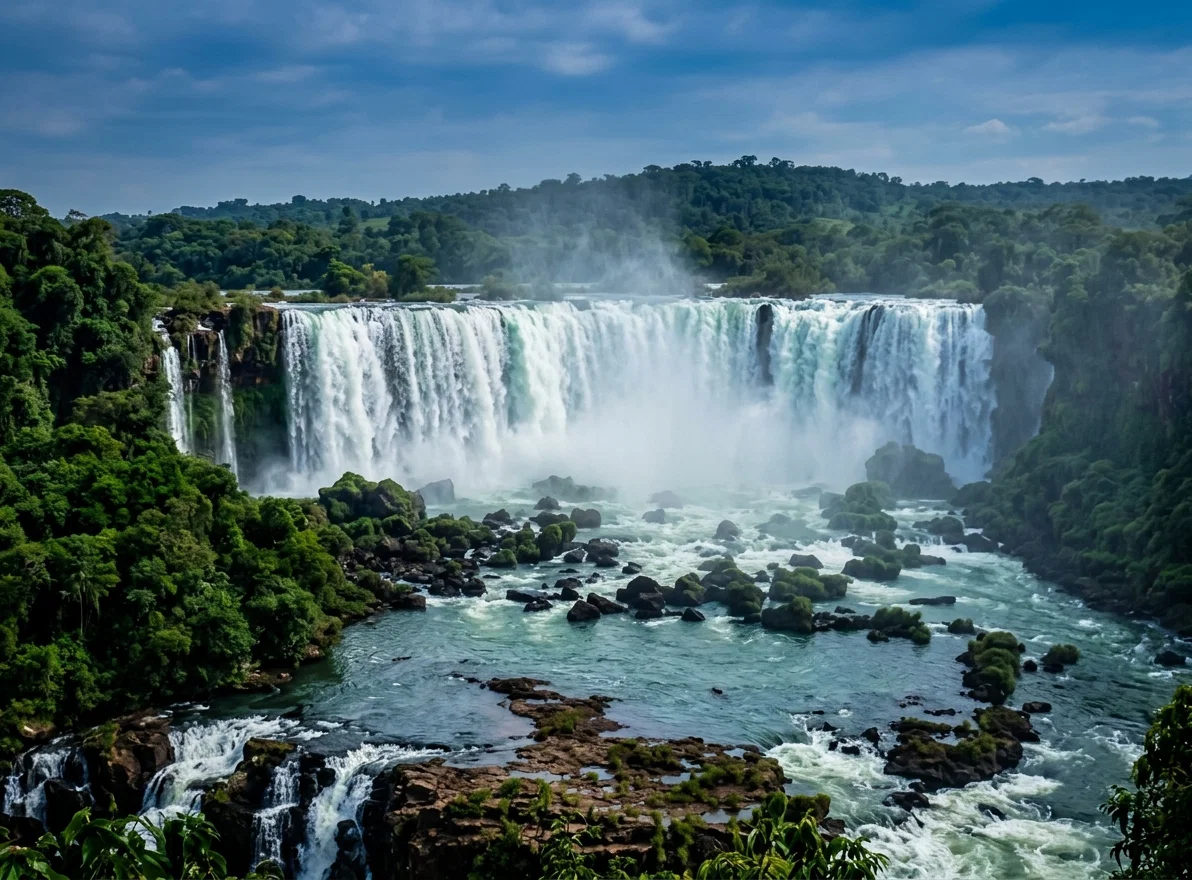
FALLS OF THE PARANA — THE NIAGARA OF SOUTH AMERICA
In 1903 Brother Anderson left the mission, and spent a few months in Barotseland, searching out a site for a new mission. Returning from this expedition, he spent a short time at the mission, and then went to Cape Town, where he remained until the first of March, 1904, when he and his family sailed for the States for a year's vacation. Returning to Africa in May, 1905, he and family went directly to Barotseland, and began work on their new mission in the month of June. In this way, the company of fourteen referred to elsewhere in this article as all being at the Solusi Mission at one time, were all gone inside of four years, and Brother and Sister Sturdevant were left alone.
The Solusi Mission, being the first one established, and the largest and best equipped of any of our missions in South Africa, and the one where all our experience thus far in conducting native missions has been obtained, I thought that this bit of history, gleaned from different persons formerly connected with the mission, might be read with interest, and studied with profit.