Monastic Life in the Church of Rome

8%

Review and Herald Publishing Association · Tacoma Park Station, Washington, D. C. · Jun 13, 1907

FromReview and Herald, Vol. 84, No. 24.

Read the full edition

Monastic Life in the Church of Rome

CHAS. T. EVERSON
FATHER DENIFLE, of the order of Dominicans, in his recent onslaught on Luther, in a voluminous work entitled “Luther and Lutherdom,” makes the statement that in attacking monasticism and the rules of celibacy, Luther was striking at one of the citadels of the church. The truth of this statement is not difficult of verification.
Monasteries and convents represent to the Church of Rome recruiting stations and centers of influence. As the monks and nuns have no family ties, they can be called upon to change their field of labor at almost a moment’s notice. The celerity with which the orders of the superiors can be obeyed, contributes very much toward the success of the Catholic cause.
The clergy of the Catholic Church are therefore much in the position of an army which can be sent here or there almost immediately when a point is endangered by the enemy, or vantage-ground can be gained. This is one of the great secrets of the success of the church, and the foundation of that remarkable, organization for which the church is famous.
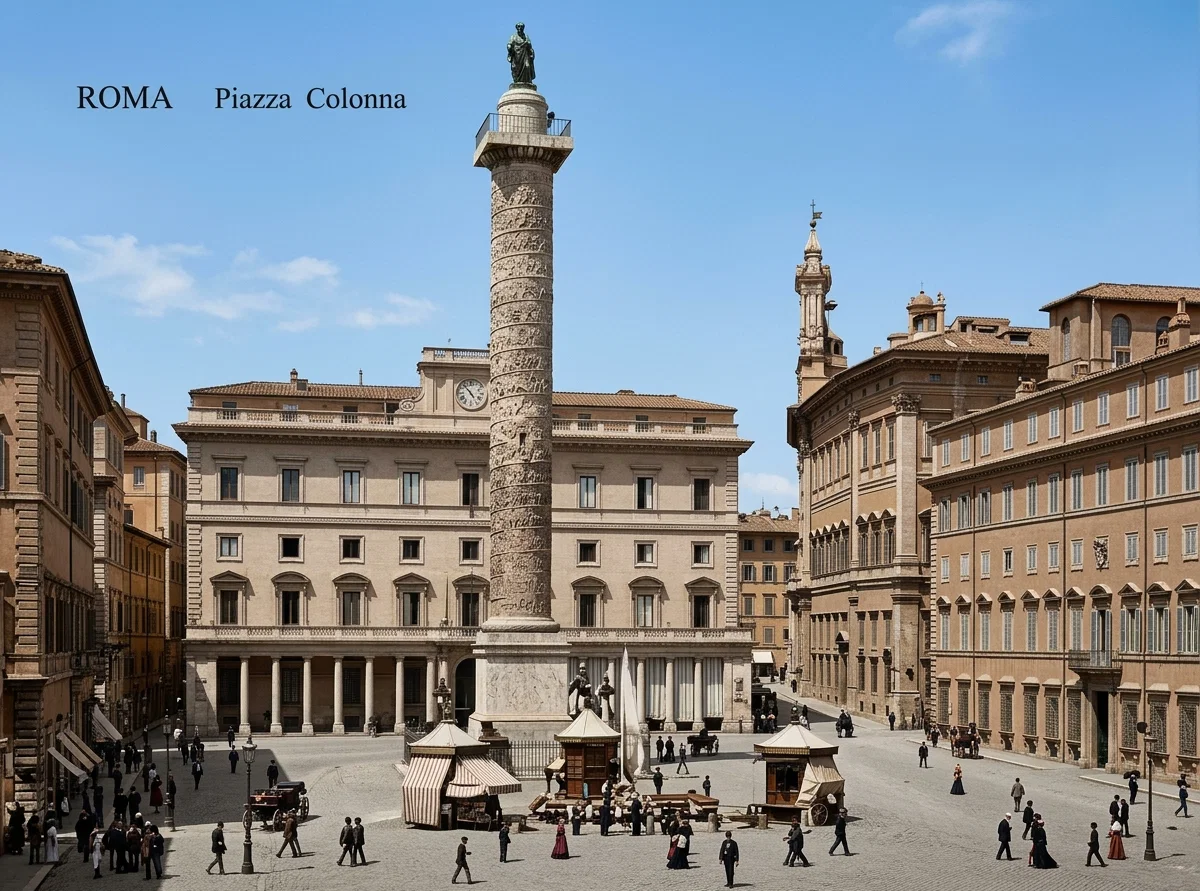
ONE OF THE CHIEF SQUARES IN ROME
However, the monastic life and the celibacy of the clergy carry a tremendous amount of corruption in their trail; but for a church that seeks aggrandizement and political preferment rather than godliness and purity, they attain the end aimed at in a remarkable way under this system.
The power that the papacy exerts in its monastic system and over the inmates of the convent is almost incredible. Just across the street from where we live there is a reclusory convent of nuns. They are counted as dead to the world. The shutters on the windows are so made that the nuns can gaze upward, but not downward into the street. It is impossible to get a glimpse of them. Under long training, they have acquired an adroitness in their movements that is remarkable. The windows are opened and the curtains drawn as if by magic, as the nuns dexterously elude discovery even under the gaze of the most curious and persistent observer. Also in the chapel that is attached to the convent no trace of them is to be discovered. The church is so arranged that they sit back of a partition and hear the mass, or are back of iron bars in the upper part of the church, where they are equally well hidden from view. They are really in a living death.
By this means they hope to gain merit before God and assure themselves a place in paradise. But he who thinks that by shutting himself up between convent walls he can shut the world out, does not know that the world is within him. We may shut ourselves up in the narrow confines of the reclusory cell, but the world is shut in with us; for, after all, the real battle lies in the heart.
These poor souls that are striving by every means in their power to gain heaven by works of penance and abnegation, sink into despair, realizing that their works of merit fall far short of the divine requirements. In the gloom of the convent cell they find darkness without and warrings within. They, as a consequence, sink into a profound despair or become indifferent to heart religion. They become mere machines, mumbling their prayers, and hurrying through their genuflections; and many of them lose themselves in lives of sin. In fact, we have often marveled to see the hard look that characterizes the faces of the nuns we meet in the streets of Rome.
We have a young lady attending our meetings who has had the monastic life depicted to her in such glowing colors that she was determined to make herself a nun. The priests and the nuns instil into the minds of the young a desire to enter monastic orders. They teach them that the nun is more holy than other women, for she has Christ only for her husband. The life in the convent is represented as one of tranquillity, holiness, and freedom from the worries and the perplexities of the world. Through these flowery representations, the young come to see almost paradise itself in the convent life. But once inside, how quickly the sad reality dawns upon them! They awake to find that the flowery dreams melt before a life of rigorous discipline and empty formality. The head of the convent rules with an absolute sway, and often with a hand of iron. Petty jealousies and surmisings render their lives miserable; while the corruption and sin that abound put an honest soul in torment, or cause her to lose herself in the vices of the convent.
We have tried our best to show this young lady the real conditions of the monastic life, but it has been a long struggle to save her from falling into the convent abyss. The virus of Babylon is infused into the young minds, and it takes a great measure of the grace of God to act as an antidote against that diabolic poison. This is one thing that makes the work go slowly in these countries; we have so much to undo before we can do anything. We ask the prayersof God's people upon our work in the proclamation of the message in the center of Catholicism.
Rome, Italy.