Tsoan Chiu is a city situated about seventy miles north of Amoy, on the banks of a river near the seacoast. Last week Elder B. L. Anderson, Tan Khi,—a native worker,—and I took a trip to this place, where there are between twenty and thirty adult Sabbath-keepers. A trip of this kind is so different from a journey of seventy miles in the United States that it may be of interest to the readers of the Review to have a detailed account of it.
We packed our bedding, food, clothing, little kerosene stove, and cooking utensils in the evening, so were ready for an early start in the morning. At six o’clock, having eaten a hurried breakfast, we set out for the launch, and two hours later we were off for Tsoan Chiu, expecting to reach there before sunset that evening. But we met a strong headwind, and when we had gone about halfway, we were forced to turn back, and anchor in a sheltered bay. That night we made our bed on the open deck, preferring a night in the open air to one spent between the decks in company with about one hundred Chinese, most of whom were smoking tobacco or opium.
Although we were quite unprotected, and among almost utter strangers, we lay down to sleep that night, feeling sure of our Heavenly Father’s protecting care while we slept. The next morning at four o’clock, the wind having fallen, we started, and by eight o’clock reached the mouth of the river leading up to Tsoan Chiu. Here we transferred ourselves and belongings into a sailboat. But the tide being unfavorable, we found the boat could not go up the river until eleven o’clock; so we walked over to a neighboring village, where Tan Khi preached for about an hour to the people who gathered around to see the foreigners.
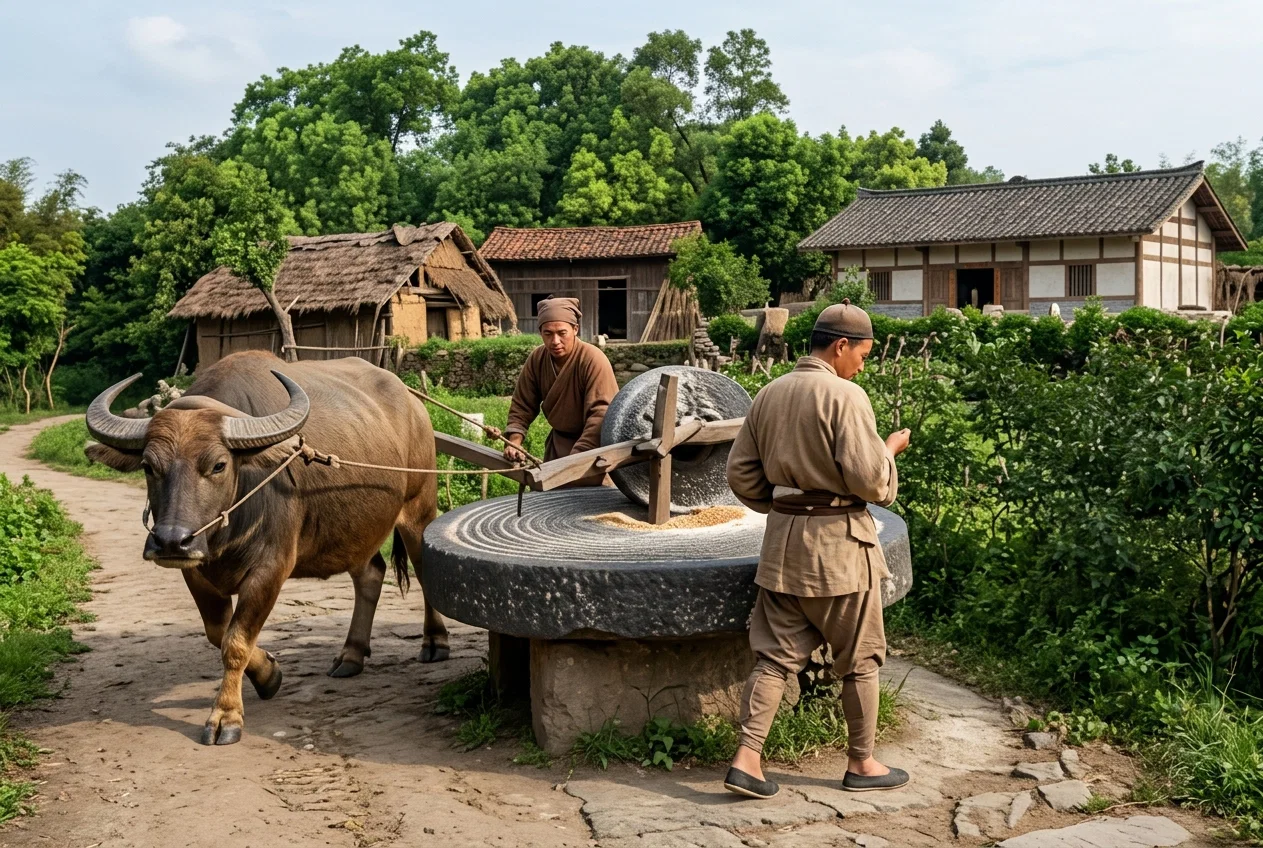
A CHINESE FLOUR MILL
About eleven o’clock our boat started for the city. But the tide was still very low, and we often stuck on a sand-bar. It was quite amusing to see how the boatmen would improve these opportunities to eat some rice, while they patiently waited for the incoming tide to lift the boat off the bars. If they finished eating before the boat was off the sand, they would take their long bamboo poles and push off.
We arrived in Tsoan Chiu at 3 P. M., almost twenty-four hours later than we had expected. Two coolies trotted off with our luggage fastened to the ends of their carrying-poles, and we followed as best we could.
Tsoan Chiu is a walled city of about one hundred thousand inhabitants. The walls are of stone, being about forty feet high on the outside, and over twelve feet thick at the top. The streets are exceptionally wide for a Chinese city, and, like all the other native cities I have seen, are paved with irregular stone flags. Some of these are long and quite broad, while others are almost like the cobble-stones, one sees in some of the cities in the United States. All these stones have been worn smooth and slippery by hundreds of years of constant use, and one must be very careful how and where he steps, or he may suddenly find himself lying on his back, in the midst of the dirt that is always inseparably connected with a Chinese street.
I wish that I could describe the queer shops, utensils, furniture, eatables, dogs, pigs, children, modes of dress, etc., that one always sees in walking through the streets of a city in this country, so that you might have some idea of what it is like; but they should be seen, to be appreciated, so I shall not attempt it. After a time these sights become so familiar to us that we no longer think them curious. But there is one thing that it is doubtful whether foreigners shall ever become accustomed to, and that is the odors. The Chinese are notably one of the most unsanitary people in the world, and one always feels like thoroughly disinfecting his nose and mouth after passing through the streets of one of these cities or villages.
After walking for about an hour, we arrived at the little house which we are using temporarily for chapel purposes. We were very tired. But washing our faces and hands revived us somewhat, and we soon had some rice cooking for dinner.
That night we made our bed on the soft side of some hardwood boards, which were arranged across two wooden benches, and, using a thick cotton comforter for a mattress, and another for cover, we slept the sleep of those who have spent the last thirty-six hours in the open air.
The next day was largely spent in talking business with our brethren, as we very much need a house which we can use permanently for chapel purposes, as well as for general headquarters for our work in that section. There is a house that is quite suitable to our needs, which can be bought for about four hundred dollars, and which could be put in nice condition for about two hundred dollars, making the total cost about six hundred dollars. But there is no money in the China Mission treasury that can be used for this purpose, so we must wait until our brethren in the States will help us to secure it.
There are thousands of large cities in China where we must establish stations, but often our hands are tied for lack of funds. It is almost always necessary to open a chapel, which must be leased or bought, and in either case it takes money. If leased, the rent must be paid several years in advance; and there is always a large bill for repairs.
At first our great need was consecrated young native workers, and the Lord is supplying these as we need them. Then we need money for their support, and the Lord has been impressing the hearts of our brethren at home to give toward supplying this. And now we must have means that can be used for securing chapels, and we feel sure that the Lord will impress the hearts of our loyal brethren in the United States to supply the necessary funds.17
We who are at the front are trying hard to press the battle to the very gates of the enemy, but we must look to our brethren in the home land to supply the munitions of war. It will not be long now until the victory is ours, and then we can all be mustered out, and go home.
Having finished our business at Tsoan Chiu, we prepared to return, and about four o’clock the next morning we arose, and packed our luggage while the two young workers who were coming back with us ate a light breakfast. The launch we were to take had entered the river, and lay at anchor just outside the city, so that shortly after six o’clock found us on board, and homeward bound.
As we entered the open seas, we were met by a strong wind from the north, and a very heavy sea. For more than an hour after we left the harbor, the wind and waves struck the launch on the side, and many times it seemed as if they would succeed in capsizing her. It was all the more dangerous as this launch was very old and quite rotten. But God’s protecting care was ever with us, and brought us through in safety, very much shaken up, but very, very thankful to our Heavenly Father for his loving care.
And even as we reached home safely, at the end of this short journey of ours, and were given a glad and loving welcome by our families, so shall we all, if faithful, soon be welcomed to our eternal home by our Saviour. True, we must first pass through trials and dangers; but trusting in him, we shall pass them safely, and at last, weary, footsore, seasick, perhaps, on life’s rough sea, but triumphant, and singing the “song of Moses and the Lamb,” we shall reach home.