An Appeal from Jamaica

6%

Review and Herald Publishing Association · Takoma Park Station, Washington, D. C. · Mar 21, 1907

FromReview and Herald, Vol. 84, No. 12.

Read the full edition

An Appeal from Jamaica

I am glad to report that the work is onward here. A month and a week have passed since the great earthquake disaster. Thousands of persons not of our faith, but who were as sheep without a shepherd, flocked to us for advice and protection. Elder Tanner, and my wife and I have been kept busy almost day and night.
The erection of the big tent on the race-course was a God-send to the populace. We furnished shelter to more than two thousand persons nightly for over three weeks. Our letter to the governor, placing the tent at his service, was acknowledged with thanks, and a free medical dispensary was run in the big tent for three weeks. The government took over the fifty-foot circular tent for hospital service, and is still using it for that purpose.
More than one hundred and fifty persons have decided to obey the truth. It has been a stirring, shaking time, but a soul-strengthening experience to us in spite of all.
I shall never forget that day in the church. We were singing No. 732 in “Hymns and Tunes.” We had reached the third stanza— Whate'er events betide, Thy will they all perform; Safe in thy breast my head I hide, Nor fear the coming storm.
Just as we finished singing the last line of that stanza the earthquake was upon us. It came with a moaning, rumbling sound that caused the earth to tremble, and the church building quivered from foundation to roof. Then there were two or three seconds of stillness—a deathly, oppressive stillness such as I never felt before—then a rushing, roaring, rumbling noise, and the storm was upon us, as a wild beast might spring upon its prey.
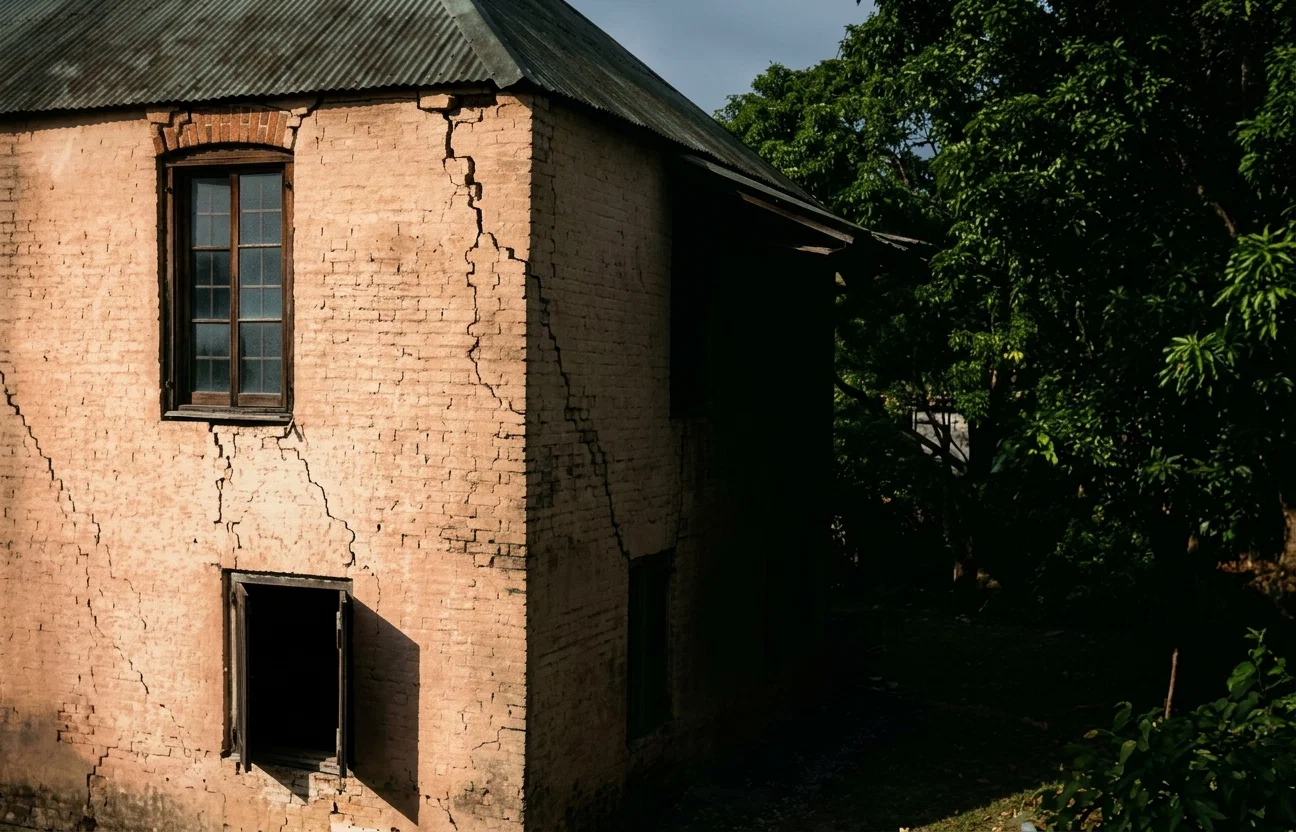
REAR VIEW OF S. D. A. CHURCH, KINGSTON, AFTER THE EARTHQUAKE
The building shook with a violence that made it difficult for one to stand upon his feet, the floor rose and fell like the waves of the sea, the building swayed back and forth, the walls twisted as though a mighty giant were trying to wrench off the roof. (The meeting room was on the second floor, the book depository and schoolroom being below.) Outside could be heard crashing walls and the shrieks of people. The timbers of the church cracked as though the building were at the point of collapse, falling plaster filled the place with dust, so that a twilight prevailed, and the arched brick entrance gave way and fell with a crash.
When the entrance fell there was an impulse to stampede for the door, the people not knowing what had happened. I sprang from the pulpit and stood between the people and the door, and began to sing “Praise God from whom all blessings flow.” In two seconds there was perfect order, all signs of excitement had disappeared, and our people sang that grand old doxology—sang it gloriously. When we had finished singing we hurriedly examined the steps to see if they were safe for the people to stand upon, and then assisted the congregation out, quietly and orderly, one by one, until every one had passed out without hurt or harm. It was the angels of God who kept the building from falling.
No official death list has yet been prepared, but I am certain that the number of missing will not be far short of three thousand. How good God was to us, only one adult of our number, Brother Norman Johnston, being killed. A three-year-old child of Sister Burke died after a few days' suffering from injuries received. The little child was buried beneath a falling wall. Its death caused the father to give his heart to God.
The remains of the ruined city present a sad sight indeed. Thousands are living in tents and in hurriedly constructed huts. A peculiar form of pneumonia, or some kindred disease, has appeared, and many are dying.
The upper story of our dear church has already been torn down. We have secured a lot, and are to begin the erection of a new church at once.
But we need money. Our people are badly supplied. We need help. Homes, house furnishings, and clothing are gone, and the ways for earning a livelihood have been taken away. The earth still groans and trembles beneath our feet. But we are not discouraged. Kingston is the most important center in the West Indies, and the work must be kept moving here. We must have a church and a schoolhouse. We are going to do our best, our very best.
You may depend upon every Seventh-day Adventist—man, woman, and child—in Kingston doing his part nobly. If you could see some of these poor people who have lost everything they had, coming forward and placing upon the table the few pennies they have earned clearing away wreckage, it would touch your heart and win your admiration and confidence for Jamaica and Jamaicans. I promise you that you will not be disappointed with the work of our brethren here.
But under the circumstances, with homes and occupations gone, we need help. We are asking that America help us to the extent of two thousand dollars. That is a small sum compared with the losses and our needs, and but a pittance for the great disaster. We could use more to great advantage, but we can not do justice to the cause with any less. Elders U. Bender and J. B. Beckner and Prof. C. B. Hughes endorse this appeal, and they have instructed me to use their names. Please do all you can for us, at as early a date as possible.
And now for a personal matter. My bicycle, almost a new one, was buried beneath the ruins of the brick-arched entrance to the church, and was completely destroyed. I can not possibly buy another this year. The demands upon my purse are more than I can meet. A bicycle is an absolute necessity here. If any of the good brethren or sisters in the States wish to do a real helpful missionary deed, they can do so by supplying me with a bicycle, and it will be greatly appreciated.
J. A. STRICKLAND.