Burma, India

6%

Review and Herald Publishing Association · Takoma Park Station, Washington, D. C. · Jan 31, 1907

FromReview and Herald, Vol. 84, No. 5.

Read the full edition

Burma, India

L. F. HANSEN
As the rains set in this season, my climatic trouble of last year returned as promptly. I made straight for a dryer climate, and came to Sagaing, a station nine miles from Mandalay.
The temporary improvement from the change of climate was very slight. But I was at least able to be about most of the time, while last year I was confined to my bed for about ten weeks. This time, I was not confined to bed for more than six weeks at one time.
After I had been in Sagaing a few days, a young man came to my room one evening, and asked if I could baptize a young Christian convert. This call resulted in several studies with him, as well as with the candidate in question. After a few studies they came no more. My first caller, however, admitted that the seventh day is the Sabbath of the Bible. In all, I met about twelve individuals, most of whom are students of the government school.
I believe here is material for work when we begin operations in Upper Burma. A Burmese worker would doubtless do well, for while the people here have a smattering of English, it is not sufficient to convey to them the great truths of salvation.
Sagaing is one of the four ancient Burman capitals. It is the oldest, having enjoyed that distinction from 1351-1380. Later, Ava became the capital, famous for the early experiences and long imprisonment and torture of Dr. Judson. It was to Ava that Judson and his fellow laborers made the memorable expedition which consumed several weeks, and no small amount of money. A river boat having been fitted up and manned by a crew of ten besides the missionaries, who with many presents to pave the way, and open the gates to the “golden feet,” and not without a magnificent present for the “Golden Face” himself, left Rangoon for Ava. The present for the king was the English Bible in six volumes, gilted entirely on the outside. Their purpose in this visit was to secure liberty to preach and make converts to the Christian religion, and liberty in particular for the converts to enjoy their religion.
Their mission proved a failure. The present to the king was spurned; a treatise on Christianity in Burmese was thrown to the floor by the king after the reading of the first sentence. And later, when the British entered Lower Burma, the missionaries were imprisoned, at first in Ava, for eleven months, and in Oung-pen-la, ten months; in both of these places they lay in heavy irons, and at night a bamboo pole was passed between their feet and hoisted up by ropes till only their shoulders touched the ground. Thus in filth, heat, and torture, twenty-one long and weary months at last wore away. Then the war ceased, and reluctantly the prisoners were liberated.
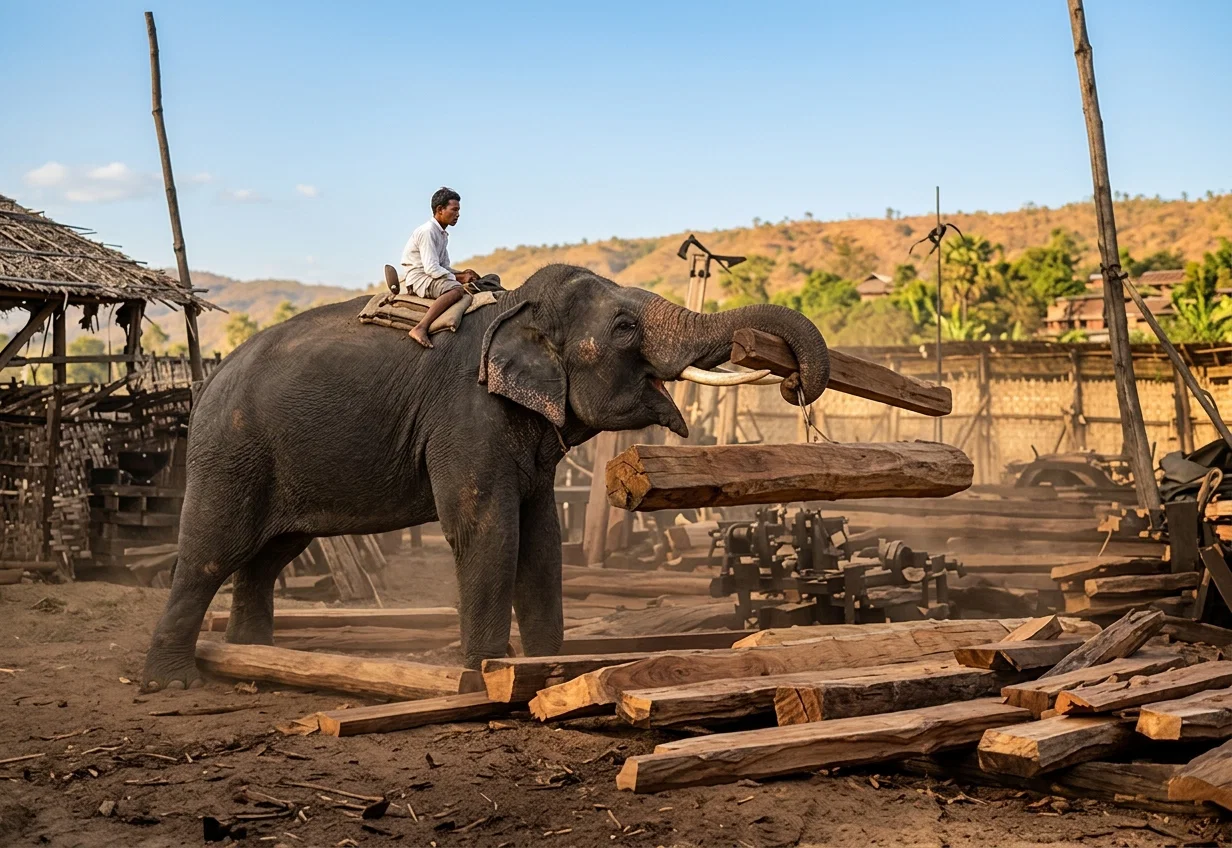
ELEPHANT STACKING TIMBER
Directly opposite Ava on the Sagaing side is a hospital, where Mrs. Hansen was taken when she had the cholera. Together, we spent twenty-four days at this hospital, reflecting on the history of Ava.
Following the close of that war King Mindon Min, the father of Theebaw, built Mandalay, after having reoccupied Amarapura for a short time as capital.
Mandalay is a modern city, and during the twenty-five years of British rule has not lost much of its former glory. Indeed, the palaces of the kings and queens are very much as though the occupants had been absent for a time while the place was getting in need of general repairs. The “golden” aspect so inseparable from Burmese royalty is quite in evidence at the present time.
There are, however, many signs of Western industry; and there are mighty agencies slowly working and modifying the present generation. The gospel is meanwhile having its influence. For while old and established customs are remodeled, it is a very opportune time to also change religious opinions.
The Burmans seem to feel that the old ways are not able to keep pace with modern progress, and they are taking kindly to the new state of progress and speed. The situation for teaching the gospel to-day is a thousand times more favorable than in the days of Judson, a half century ago. One involuntarily exclaims, in view of all the forces working for the better, “What hath God wrought!”
After spending ten weeks in Sagaing, Mrs. Hansen was convalescing, and I was somewhat improved in health. Our trials and blessings while there were of an unusual kind, and will live while memory shall last. We hope that God will some day raise up reapers for Upper Burma, so that many of these much-blessed people may be looking with rejoicing for the King of kings.
At the time when our afflictions had reached the climax, we were much cheered by an unexpected visit from Brother and Sister Votaw, who were much in need of a little change. Their coming was evidently of divine order, for at that time we were at our wits’ end to find suitable food for Mrs. Hansen, as she was gradually recovering.
They were accompanied by Brother Parker, a Sabbath-keeping soldier. And as Brother Parker is very “handy” about the house as well as in the kitchen, his services were highly appreciated. And when he came to go down to Rangoon, the train ran over a bullock before it reached his station, which gave him time to get his train. For, disliking to crowd the departing Sabbath hours, he had but thirty-eight minutes to make six miles after dark. By the accident, the train was delayed long enough for him to reach the track, and signal to have it pick him up. He was the happiest man on that train, for this special blessing of God to him.
We have numberless reasons to be grateful for the goodness of God to our work and workers in this new field.