A New Conference in Central America

8%

Review and Herald Publishing Association · Tacoma Park Station, Washington, D. C. · Nov 29, 1906

FromReview and Herald, Vol. 83, No. 48.

Read the full edition

A New Conference in Central America

J. A. STRICKLAND
The general meeting of the Panama Mission field was scheduled to take place at Bocas del Toro, Panama, September 7-17. On account of quarantine regulations, caused by the prevalence of smallpox at Colon, I had to take a lengthy and circuitous route, leaving Jamaica August 25.
Monday, August 27, we called at Savanilla, an important Colombian port. A stop there of twenty-four hours permitted us to see something of South American manners and customs, and form some idea of what qualifications our worker should possess who first enters there with the truth for our times. Wednesday we entered the harbor of Carthagena, and were soon traversing the narrow streets of that quaint old town that remains a relic of the days of piratical plunderers and sea-rovers. A solid stone wall surrounds the city, builtto repulse the attacks of marauders of the Captain Kidd class. It stands to-day firm, and seemingly untouched by the hand of time. My limited Spanish vocabulary was taxed to the utmost as I visited the shops, public buildings, and churches of this ancient Spanish stronghold. Here I saw the result of Romish ritualism fully matured: massive church buildings, embellished with altars on all sides, which were laden with gaudily dressed dolls representing supposed saints, before which the ignorant masses reverently worshiped, while the educated classes stood with stoical countenances, silent and motionless; men working in the street had near them a cheap lithograph of a woman, which was thought by them to be a picture of the Virgin Mary. Candles burned before it. The poorer class of women bowed as they passed, while the men who happened that way crossed themselves as they went by. What an eloquent, though silent appeal these things were for us to send them the light of the blessed gospel of Christ! While viewing the sights of Carthagena, a fellow passenger from the steamer said to me, “Will your people ever preach the Sabbath in this superstitious old city?” “Yes,” I answered; “these stone walls can not exclude the sound of the third angel’s message, and the darkened minds and sad hearts of these people will soon be made light and glad by that gospel which proclaims the commandments of God and the faith of Jesus. Some here will receive the Word, and it will be to them the power of God unto salvation.”
Sabbath, September 1, we dropped anchor in the harbor of Port Limon, Costa Rica. Here we have an organized church, with a membership of thirty. A frame church building has been erected on the outskirts of the town. I was in time for Sabbath-school, for which I was heartily thankful. I remained with the brethren of Port Limon four days, holding meetings each night. Large crowds attended these services, and an encouraging interest was manifested. Wednesday, the fifth, in company with Brethren E. N. Rogers, local elder of the Port Limon church; A. J. Wright, deacon; H. L. Mignott, a licentiate of the Panama Mission; and Brethren Ashley and Horton of Pacuarito, Costa Rica, we took passage for Bocas del Toro, on the “Kearsage,” a two-mast schooner, with Brother T. M. Robinson, deacon of the St. Andrews Island church, as owner and captain. Seventeen were aboard the boat, and all but two were Sabbath-keepers. Brother J. B. Haughton, of Old Providence, had very thoughtfully brought his folding Estey organ, which was a great help in the song services, and an acceptable addition to the morning and evening worship we held on board. Captain Robinson looked after my every comfort, with the tender solicitude of a father, which enabled me, in spite of the twenty-four hours’ calm we experienced, and twelve hours of terrific tropical sun, to pronounce my passage on his vessel a rare and pleasant treat.
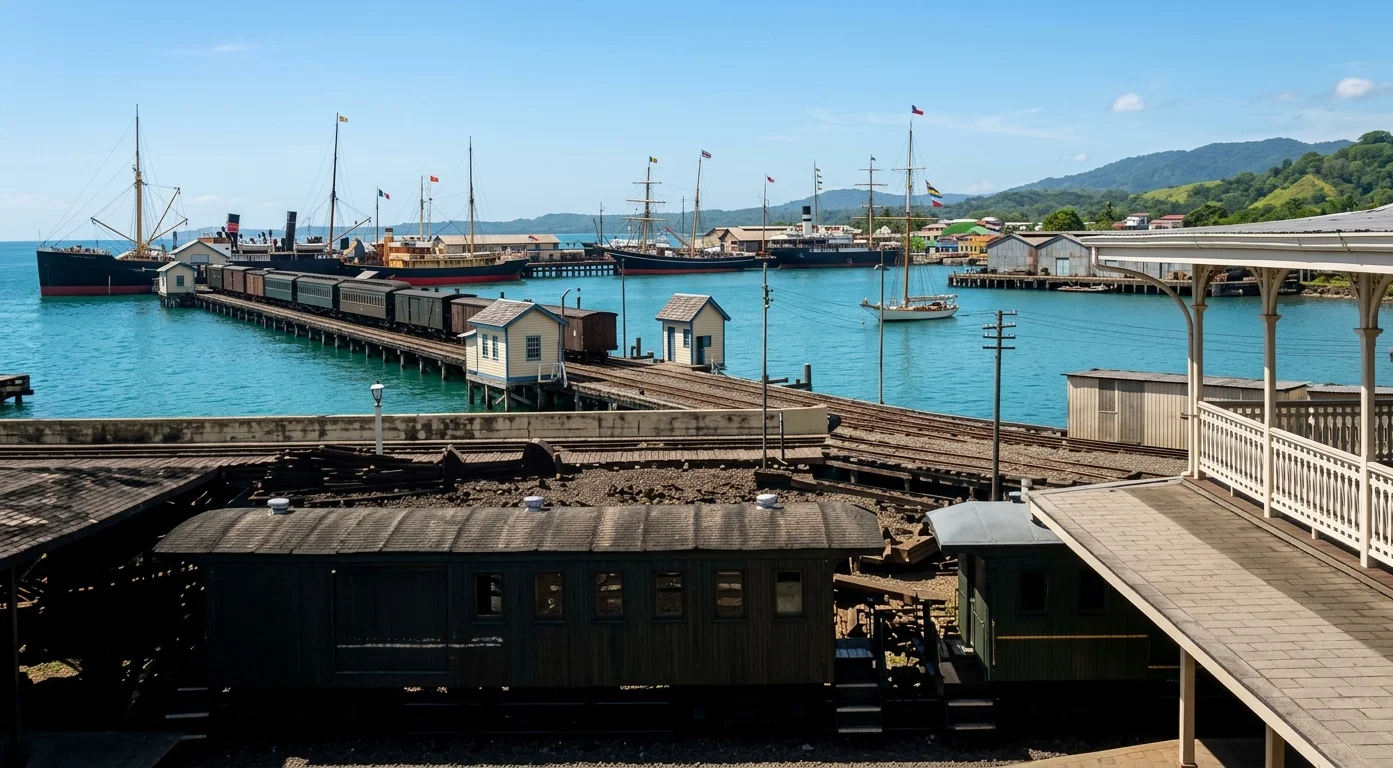
RAILWAY PIER, PORT LIMON, COSTA RICA
Early Friday morning we anchored in the calm waters of Bocas del Toro. Soon passengers and crew gathered for morning service. As we sang that grand old hymn,— ‘Lord, in the morning thou shalt hear My voice ascending high; To thee will I direct my prayer, To thee lift up mine eye,’ a crowd gathered upon the wharves near by, and the news went like wildfire through the town that a schooner-load of Adventists had arrived. A messenger hurried to the mission house, and informed Elder Knight, and in a few minutes we heard the puff of a gasoline launch, and saw, rounding a projection in the lagoon, with her prow pointed toward us, that splendid and shapely little mission vessel, the “Harbinger.” And I wish to say here that the money invested in the “Harbinger” was well spent. The success of the Panama Mission is largely due to the fact that Elder Knight had this boat. The territory is composed of scores of lagoons, with as many islands that can be reached only by a boat.
Glad were the greetings when the boat, bearing Elder I. G. Knight, Sister Carrie Knight, and their little boy, came alongside. But they could not come aboard our ship, because we had not yet been inspected by the port authorities. A wait of a few minutes brought the doctor and the customs officials. The examination of our baggage was brief and most polite, for our work and workers have won the respect and confidence of the officials at Bocas del Toro. Half-past eight found us ashore.
The services were held in a tent, pitched on an attractive spot in the center of the town. From the start the power and presence of God was felt. Perfect harmony prevailed in all the deliberations, and every act of the assembly breathed faith and courage. Over one hundred believers were counted. Many more would have been present but for the fact that traveling expenses are exceedingly high, and transportation can not always be secured from one place to another.
The work in this field was started in 1901, by Elder F. J. Hutchins. In 1902 he died. Elder I. G. Knight and his wife were sent to fill the vacancy the following year. The name was changed from Central American Mission South to Panama Mission, in 1904. At that time there were about twenty-five Sabbath-keepers. Now there are two hundred and fifty Sabbath-keepers, six organized churches, and several unorganized companies of believers.
This field needs two good men—competent, consecrated men. They are needed now. We must have them, brethren, or the price you will pay for your failure to supply them will be many souls, and the loss of much vantage-ground already gained.
By a unanimous vote, it was decided to organize the field into a conference. Happy, harmonious, and hopeful was the West Caribbean Conference, launched amid the hearty amens of more than a hundred loyal hearts. This field was self-supporting last year. There is at present more than five hundred dollars in the treasury. At this meeting the brethren pledged $279.50 to the West Indian Training-school in Jamaica. Of this amount, one hundred and five dollars was paid in cash. The territory of the conference includes the republics of Panama, Costa Rica, and Nicaragua, and St. Andrews, Old Providence, and Corn Islands. Officers were elected as follows: President, Elder I. G. Knight; Vice-President, Elder Hubert Fletcher, of Jamaica, who was invited to begin his labors here at once; Treasurer, Elder I. G. Knight; Secretary, Mrs. Carrie Knight; Secretary Sabbath-school and Young People’s Society, Mrs. A. J. Read; Executive Committee, I. G. Knight (Chairman), T. M. Robinson, H. L. Mignott, Samuel Knapp, A. E. Comer. Credentials were given to Elder Knight. H. L. Mignott was ordained, and received credentials. Ministerial licenses were granted to T. M. Brown and A. J. Read. Missionary licenses were given to A. J. Wright, J. B. Stuyvesant, W. H. Dean, Sheridan Archibald, and Mrs. Carrie Knight. The meetings were largely attended by the people of the town, who paid respectfulattention to the truths that were proclaimed from our platform. I never saw people more eager to hear. The service on Wednesday night, when Brother H. L. Mignott was set apart for the gospel ministry, was especially solemn and impressive. Unfortunately, I had to leave after the service the next night, or be delayed three weeks in reaching home, but my heart was made glad by knowing that more than twelve souls decided that night to walk in obedience to God.
I reached Port Limon Friday morning, but was refused permission to land. The authorities were afraid I had brought smallpox or yellow fever to their shores. The Costa Rican government claims, and I believe justly, too, that white men born in temperate climes take those diseases more readily than do other people. So I was banished, if I may use that expression, to a little island near Port Limon. As I stepped from the boat upon the shores of the island that is to be my home for five days, a group of Spaniards saluted me in their own language. Not hearing one English word, I said, “Hay alguien en este lugar que habla ingles?” (Is there any one here who speaks English?) The leader of the group answered, “No, senor; nos hablamos espanol” (No, sir; we speak Spanish). I have no fault to find with my accommodations, nor with the health regulations that placed me here. I spend the time resting, writing, and studying Spanish. As I write now, I discern far away on the southern horizon the funnel of a steamship sending forth a column of black smoke. It is approaching Port Limon. Perhaps it is the ship that will take me home. But whether it is or not, I know in a few days I shall say to my pleasant Spanish detention guards, “Hasta la vista, senors,” and will go aboard some steamer that will bear me back to dear old Jamaica, where loving hearts pray for my safe return. Quarantine Station, Port Limon.