The Holland and Flemish Belgium Mission
10%

Review and Herald Publishing Association · Tacoma Park Station, Washington, D. C. · Nov 29, 1906

FromReview and Herald, Vol. 83, No. 48.

Read the full edition

The Holland and Flemish Belgium Mission

GUY DAIL
Our general meeting here was held in the delightful capital of Holland, The Hague, August 16-19. This pleasant city, with its fine streets and canals, contains about two hundred and thirty thousand inhabitants. It has no unimportant place in the history of the Netherlands, and it has not been without influence in the politics of the civilized world. The Binnenhof is the home of the Parliament, or States-General. Portions of it date from the thirteenth century, when it was a castle of the Counts of Holland. Some of the most important events in connection with the long struggle of the Netherlands for freedom occurred in this building. One admirer of Dutch institutions writes: “To me, whenever I visit it, the square of the Binnenhof at The Hague is the holiest spot in modern Europe, for here the great deliverance was wrought out.” Not only have scenes of glory to the people of Holland been enacted here; also acts of violence and caprice have been perpetrated, for it was opposite the “Hall of the Knights,” that, embittered by theological differences (which were very marked in the early days of Dutch independence), Stadholder Prince Maurice of Nassau caused his former friend and coworker, Johannes Van Olden-Barneveld, to be unjustly executed in May, 1619. Here, too, the visitor is shown the old gateway and tower where was imprisoned Cornelius de Witt, who played a leading part with Sir William Temple in securing the treaty that culminated in the triple alliance between England, Holland, and Sweden (1667) in favor of the Protestant States. Five years later, incensed by his enemies' reports that he had conspired against the life of William III, the Orange mob broke into the prison, seized Cornelius, with his brother John, who happened to be visiting him, and murdered them. And most of our readers will remember The Hague Peace Conference, which so shortly antedated one of the briefest, but most severe, of the wars of recent years.
Last June our brethren began a series of quite well-attended lectures in The Hague. At the same time several col porteurs were engaged in the canvassing work in the place, and thus a number of interested persons were found, some of whom were able to take their stand definitely for the truth during the conference. At the close of the Sabbath, six were baptized. The Sabbath had been one rich in blessing to the eighty or ninety delegates who had been together in the hall we had secured for our meetings. In the afternoon the dedication of the new mission boat, “Maranatha” (the Lord cometh), recently secured and fitted up for service in the Rotterdam harbor by Capt. J. Christiansen, was an occasion of encouragement to the people.
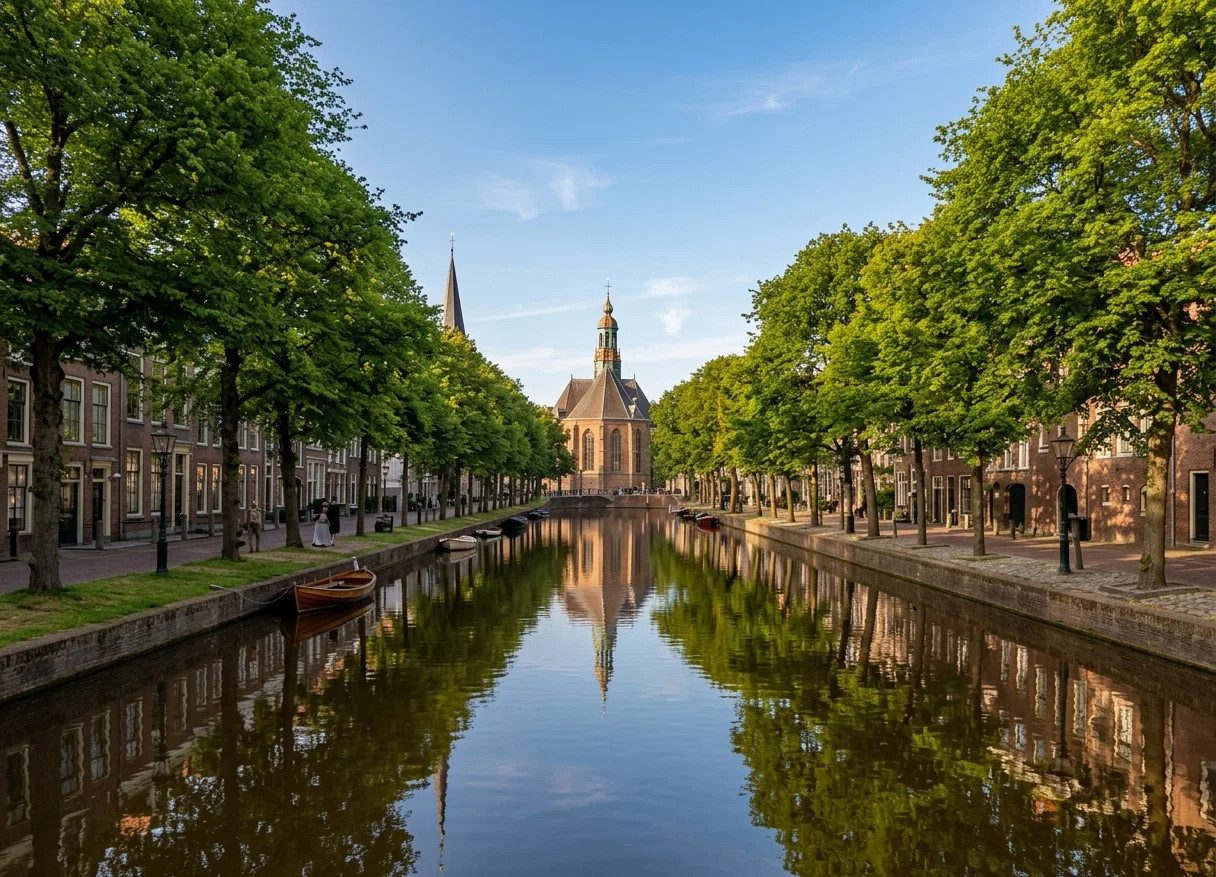
TURF MARKET, CANAL, AND NEW CHURCH, THE HAGUE
The assistance rendered by Brethren Conradi, O. Luepke, and G. Schubert, was appreciated by the local workers and lay members, as the counsel and teachings of these more experienced laborers were helpful and timely. Brother Peter Nyambo, who here attended the last general meeting at which it was his privilege to be present before leaving for East Africa, was also enabled through his intercourse with the people, to quicken their interest in missions and missionary work, especially for those waiting for the light in Africa.
There was no lack of union and harmony in the councils of the committee, or in the business transacted in the open sessions of the conference. The only ordained minister, Elder Klingbeil, was again unanimously chosen as director of the field; and the other members of the committee are as follows: J. Wintzen, M. Arendse, E. A. Traarbach, J. Wibbins (Secretary). Ministerial credentials were granted to R. G. Klingbeil; ministerial licenses to Brethren J. Wintzen, J. Wibbins, and P. Schilstra; missionary credentials to Brethren Arendse, Loots, Girou, and SisterMaayer. Thirteen were chosen as canvassers, with Brother Arendse as General Agent.
The funds at the disposition of the mission field are continually being increased by the gifts and tithe of the brethren themselves, but there is not yet enough native income to support the workers, so that this is one of the fields that must be assisted by subsidies from the German Union treasury. In 1904 the native tithe amounted to $625; gifts, $104; book sales, $1,123; in 1905 the tithe amounted to $714; gifts, $183; book sales, $794. We are glad to state that the canvassing work during the first half of 1906 shows a good growth,—sales amounting to $915 being reported,—and the outlook for this branch is cheering for the future.
We are especially pleased that the work in Flemish Belgium has been doing well, and that Brother Klingbeil now has the assistance of two Bible workers there, one of whom is working in Brussels, and the other is with Elder Klingbeil in Antwerp. Brussels, the gay capital of Belgium, with its wide streets, public squares and markets, and artistically arranged buildings, contains 598,000 people, and we are now just entering it; while in Antwerp, which has 292,000 inhabitants, a nice little company of believers has been gathered out. We surely ought to think of our workers in Belgium, as well as in Holland. The Holland and Flemish Belgium Mission field is about twice the size of Massachusetts, but has a population of about 8,860,000, nearly three times as many as live in the Bay State.
Our wish is that God may hear the prayers of his children, that the work here may progress faster than ever, and that this part of the great vineyard may soon hear, in its fulness, the message for this time, and such as are being saved be gathered out to the remnant people.