A Glimpse About Canton

6%

Review and Herald Publishing Association · Tacoma Park Station, Washington, D.C. · Oct 4, 1906

FromReview and Herald, Vol. 83, No. 40.

Read the full edition

A Glimpse About Canton

MRS. J. N. ANDERSON
It is encouraging to us in far-off China to know that, through the liberality of our brethren, the Father is keeping to us the promise to “supply all your need according to his riches in glory.” The money sent is being used carefully; but as the work enlarges, our wants increase. Still, I believe the Lord of the harvest has his means at command for the prosecution of this work, even in China, till the great ingathering shall have been accomplished.
Sometimes I think it may be well that our people do not see this great mass of people, for they might not feel equal to the demands this work will make upon them. Here in Canton we get sight of such denseness of population. The city is not large in area: a man may walk from one extreme to the other in one and a-half hours—this taking in the later additions outside the wall. Canton has so doubled herself outside the walls that it is only on the hills of the northern limits, toward White Cloud Mountain, that this ancient barrier of feudal days is visible. But any space that is large enough to admit a man’s body will do for his nightly lodging, and when daylight comes the people pour into the streets. At any place where labor may be exchanged for a means of subsistence, human beings swarm like flies over a pot of honey. No wonder the scent of a better way, which the more adventuresome have brought back from Japan and Western lands, has quickened a sense of dissatisfaction. China is moving rapidly in a popular wave, and it seems quite apparent that the old wine-skins must go. Some phases of this new life are hopeful; but Satan sees to it that enough that is bad is mixed to make the whole odious to many of the more conservative class, who are really the more desirable and more stable class.
Many girls’ schools are being established. Their course of instruction, and their more open relation to boys’ schools, will tend to a larger freedom for women, and, eventually, to the breaking down of many of the time-honored customs relating to engagements and marriages. There is supposed to be absolutely no courtship in China. One can easily see the effect this unaccustomed liberty may have upon girls, and the evils that may arise therefrom.
Among the boys’ schools lately established, the passion seems to be for a maximum of leisure and a minimum of study. At the new school near us, the boys come in their military uniforms, caps also, in spite of queue, go through their drills, study from three to four hours, and so far as we can see, are then turned loose to wander aimlessly about, usually in groups. There is a great deal of military pretense and parade, and in this I suppose they think they are establishing schools after the Western model. Among those who work I think the demand for short hours and light work more urgent than I have known it at home. With it all they need a summer vacation, and plenty of smoking.
On the other hand, there are sober signs to indicate that when this mist of display and shadow of effect has cleared away, it will be seen that some real advance steps have been made toward more hopeful conditions in China.
One thing I like to see is the falling off of the queues; for, like the New Testament writer, I agree that if a man has long hair, it is a shame to him. Another change that is equally refreshing is that of the new half-military style of dress among men. It consists of trousers and a sack coat, the latter buttoned to the neck, where it is finished with a narrow standing collar. A light, absorbent under garment is all that is needed besides. With this suit and substantial leather shoes is worn a straw hat, or cap with front piece. Dressed like this, a man looks much more like a person let loose to do something than when he comes out in a long silk robe of so delicate a color that a hint of work soils it. Then, too, these robes are so narrow that a fairly masculine stride would split one. Usually the sleeves are a full foot longer than the wearer’s arms, and both hands are kept busy wrinkling back the superfluity of material, to let the hands out into the open. With such a gown there go tight silk trousers, or leggings, which begin somewhere above the knees, and reach to the ankle, where they are banded down over white socks with silk garters. These white socks are, in turn, let down into brocade or satin shoes, which, to be really genteel, should not have even so much leather in their make-up as to cover the sole.
In such an outfit they look about as unmanly as it is possible for a man to look, and not at all prepared for the realities of bread winning or any other useful service. I do not at all wonder they are obliged to get their wives through the intervention of professional match makers.
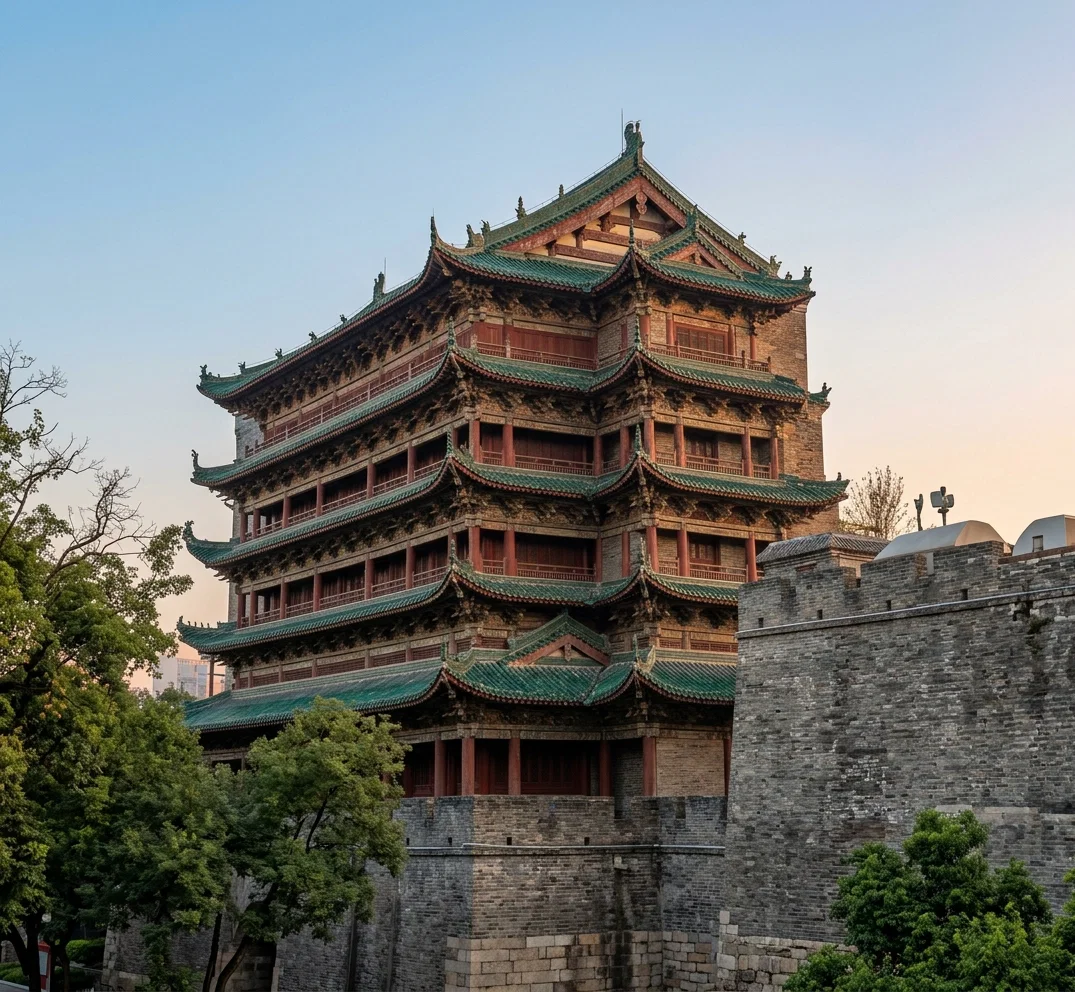
A FIVE-STORY WATCH-TOWER ON THE WALL OF CANTON, CHINA
There is much unrest in these southern provinces. The Cantonese in all classes are more progressive, aggressive, and anti-dynastic than perhaps any of the other people of China. One week ago a foreign river steamer, sailing under the English merchantman, was held up by a very large band of pirates. Some of these had taken passage at Canton, others got on at points along the route, and still another crew waited in junks, at a favorable point about one hundred miles up the river, near Sam Shin. The Indian watchmen were covered, the ship’s arms seized, the officers wounded, and everything was in the pirates’ possession within a few minutes after the ship had struck the cable which bound two boats on either side the stream together, and brought her enemiesto both her sides. The captain survived his bullet wounds, but Dr. MacDonald, of the English Wesleyan Mission, died almost instantly, from a bullet in the temple. Dr. MacDonald had been here more than twenty years, and had built up a large hospital at Wuchow. This is the third work he had laid. At Fat Shan, ten miles from Canton, is a large hospital, with schools, chapels, and all that pertains to full, rounded work—the fruit of his earlier labors. The Wesleyans do not support medical work. It must grow by its own strength.
Our first trip up this West River, while we yet lived in Hongkong, was made on this boat, and we were entertained for the night at Dr. MacDonald’s hospitable home. At that time his whole-heartedness as a worker, and his skilful use of the medical work for the furtherance of evangelical effort, strongly impressed us, and I may say he has always stood in our estimation as a model medical missionary.
Only a few days after this daring deed, the government customs at the same place—Sam Shui—were looted by a band of about two hundred thieves. In the skirmish several Chinese were killed. Two weeks ago a country village on the borders of Canton was raided. The village was located just back of Christian College (Presbyterian). One of the faculty told us two days ago that for the assistance the college settlement is supposed by the raiders to have rendered the village, an attack upon the college and resident faculty of foreigners has been openly threatened. Several junks have been held up in the open river some twenty miles below Canton, in daylight, and in sight of the Chinese forts at Whampoa. It is said that most of these robbers and pirates are old soldiers and naval bands, grown accustomed to the laziness of a standing army and navy, and now that the modern methods are introduced, and they are found unfit for service, they take to this reckless life. The state of affairs is really quite serious.
We have never felt very proud of the appearance of our China Mission home, which, by the way, is also our own family home, but perhaps you would like to see a picture of it. Maybe you will feel that it is not very representative; but perhaps it is just as well to have this as to have a place where a great deal would have to be paid for rent, so long as our work could be accommodated. I wish you might see old Canton, and China in general. I am sure you would find it quaintly interesting.
Our coworkers are all away for a change. Miss Vanscoy went with Dr. Law and his wife to Macao, an island Portuguese possession, about one hundred miles from here. Their teacher has promised to spend a part of the time with them.
Brother Wilbur’s family and Ida Thompson have gone up to Amoy. Our brethren there have a good foreign house, right at old Pacific’s edge, and will do all they can to give them a well-deserved change and rest. Their accounts of sea-bathing and fresh sea air cool us at this distance.
Our work is slowly making progress, and we expect to see the message find its way among these millions.