In Asia Minor and Constantinople

4%

Review and Herald Publishing Association · Takoma Park Station, Washington, D. C. · Sep 20, 1906

FromReview and Herald, Vol. 83, No. 38.

Read the full edition

In Asia Minor and Constantinople

L. R. CONRADI
I LEFT Rome, May 8, via Ancona, where I took the night steamer for Fiume, the Adriatic seaport of Hungaria, which I safely reached next morning. Fourteen hours’ ride from here through Croatia, on the fast train, brought me to the Servian border. Throughout this whole trip, from Fiume, through Croatia and Servia, to Philippopel, Bulgaria, there is not a single Sabbath-keeper to be visited,—a distance of about seven hundred miles. This is a large, inviting field, where we could easily keep a score of workers employed; it is ripe for the harvest.
While passing through Hungaria I improved the opportunity to get rid of all books, letters, and other matters of that nature that I could, knowing that the Turks were quite particular about such things. When I reached Constantinople, the morning of the eleventh, after a ride of sixty-seven hours by boat and train, I was pleased indeed to meet Dr. George and his wife at the station.
The customs officers were easily satisfied with my passport, but they carefully searched my luggage, and, not satisfied with what was found there, an officer began to look at my pockets, to see what I had there. So I pulled out my Bible, and some signatures of “Ministry of Healing” I had with me; but that would not answer, I must also show the letters I had with me; and even after that, he felt all my pockets to be sure I had nothing in them. I told him that while I had showed my letters that he might see there was no dutiable things with me, yet I desired my mail to be given back to me. I went so far as to appeal to the police officer, who said I should come later to secure my letters. I went home with the doctor, who lives in Stamboul, where we have a three-story building that has been fitted up as a health home. When I told the American consul what had happened about my papers, he at once sent a messenger to the customs office, and the letters were delivered up, and brought to me, the excuse for detaining them being that the officer thought I had some forbidden manuscript with me. On that day I secured my Turkish pass for Asia Minor.
The narrow building we occupy for our health institution overlooks the Marmora Sea. It is located in the Greek quarters of Stamboul. In the basement are the bath-rooms, in the first story is room for the offices, and in the upper story Dr. George lives, and also has two rooms for patients. He has for helpers a Greek sister as nurse, and a Greek brother who assists in giving treatment, and a young Armenian boy who assists in his correspondence.
In view of the suspicion which the government had against Elder Baharian, there had been very few meetings in Constantinople for five years. Naturally, the work in the city has been at a standstill. We improved the time to have a number of meetings with the believers, and were able to choose the necessary church officers, and ordain an elder and a deacon, and have the ordinances; all seemed to be refreshed by the meetings.
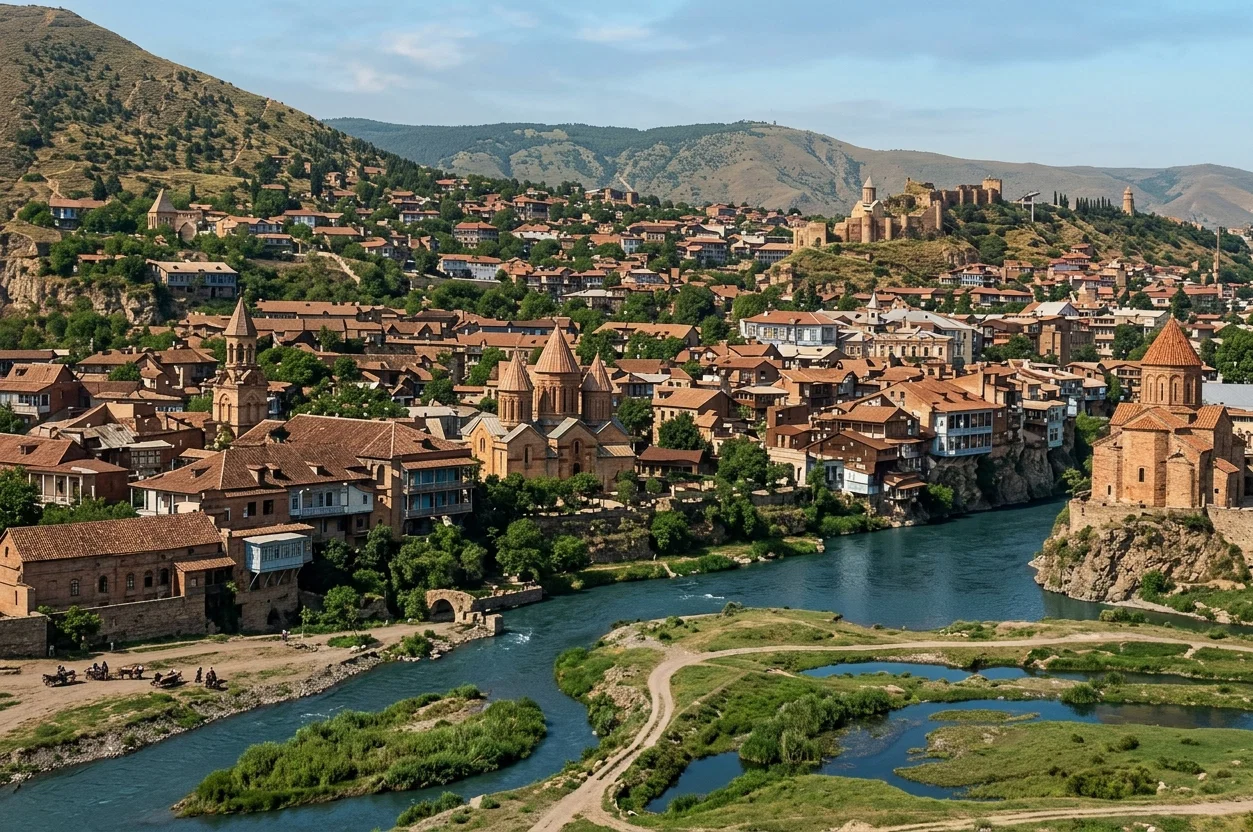
A VIEW OF TIFLIS
A VIEW OF TIFLIS
While I had questioned going to Turkey at the time, on account of the threatened trouble between England and Turkey key about the Egyptian border question, yet the papers in Constantinople did not contain a word about this, as the censor undoubtedly forbade mentioning the affair. I suppose that if anything had occurred, the first we should have known about it would have been the appearance of the English battle-ships before the city of Constantinople, so far as the papers were concerned: it might of course have been announced by letter from outside. The Turks are so suspicious of everything that no newspapers or letters would get into the hands of the Europeans there containing any such news, were it not for the fact that the great powers have insisted on establishing their own post-offices in Constantinople and other leading cities of the empire. If anything shows the weakness of this government, it is that while even the smaller States would not submit to the establishment of a post-office by a foreign power within their borders, such post-offices have been established in Turkey. But even in Turkey, one must be careful that he goes to the post-office himself, for it has happened that when natives were sent, they have obtained the mail, and have had it taken from them by the officials after they had started off with it.
The morning of the fourteenth, I left with one of our Armenian nurses as interpreter, for Adabazar, a town of twenty thousand inhabitants, about one hundred miles into Asia Minor. This is the first time I ever visited the place. Although Paul was not permitted to visit Bithynia (Acts 16:7), I was more fortunate, for this privilege was granted to me. I was glad to meet a number of our brethren at the station. We have about twelve Sabbath-keepers in the city, and another company some miles in the country, a company of about twelve Greeks, whom I was much pleased to meet. We remember how Christ was impressed as he heard of the Greeks who desired to see him (John 12:20-24); in their coming he saw a type of the ingathering of the Gentiles, through the sacrifice he was about to make. And we hope that through these Greeks who have now accepted the message, many others of that nationality may be brought to the truth. Although it was in the midst of their silkworm season, they took time to attend the meetings from early morning until late at night. Everything went on nicely, and we were able to celebrate the ordinances, and select officers for the church. We would have had baptism, but our time was so limited that we had to leave that until later on.
From here we went to Ismid, Nicomedia, a town of about twenty thousand, and from there one of our brethren took us across the bay to Bardizag; here and in Ovajuk we have about sixty Sabbath-keepers. In Bardizag there are about ten thousand people; it is an Armenian town, well known for its schools. Here are the American high school with about two hundred students (Armenians), a Catholic school, a German orphanage, and two large silk factories. The town is on the mountains about three miles above the bay; thus one has a splendid viewof Ismid, the ancient Nicomedia, from which Pliny wrote his noted epistle to the Emperor Trajan about the Christians, as early as 104 A. D. The doctor was out to this place, also, and found his hands full of work. We had most excellent meetings in different houses, as many as one hundred being present at a time. Through his medical work, the doctor became acquainted with some of the Armenian professors in the school, and this gave me opportunity to call upon them. When I began to talk about our mission work in Africa, the professor became so interested that he excused himself from his class, asking if I would not continue the conversation longer; and, in the end, he requested me to speak to the students about Africa. This I consented to do. Formerly there had been considerable prejudice against us as a people in this neighborhood.
During the few days of my sojourn in this place, there was quite an interest awakened among our young people through the youth’s meetings I held, and a number of them offered themselves for baptism; so on Friday evening I told them to go home and talk the matter over with their parents, and then early Sabbath morning we would go up into the mountains for baptism.
Early Sabbath morning, about five o’clock, as I was getting ready to go to the place of baptism, the father of one of the boys who desired to be baptized, called on me. When I visited the place about five years before, he was quite an active member of the church, but he was at that time somewhat against the baptism of young people. Somehow he gradually lost his first love; and while he attended every one of my meetings, yet I learned that he had opened a store, and was living in constant violation of the Sabbath, and had been disfellowshipped. To my surprise the man, instead of opposing his son’s baptism, broke down, as he related how his boy had come to him the evening before, stating his desire to be baptized. His first impulse had been to refuse the permission; but as the lad had asked the father’s pardon for his former mistakes, and had prayed that the father, too, would again follow the Master, there was such power in the youth’s testimony that the father could not resist; and in praying with him, his own heart had been broken, and the father therefore had come to ask the pardon of the church elder for the manner in which he had treated him, and he desired to be rebaptized, and re-enter the church with his boy. Thus God is turning the hearts of fathers to their children, and causing the children to long for the salvation of their fathers, as Malachi said should be in the last days.
So we walked up the mountains, finally following the bed of the small stream when the way became so narrow that there was no other place for us to go, until we reached a place where there was sufficient water, and baptized eight. This is the same place where I had baptism five years ago.
During the Sabbath we celebrated the ordinances of the Lord’s house, and had most excellent meetings; and another brother who had been away from the company of believers for some years, was reclaimed, and more young people offered themselves for baptism. As I saw how willing these souls were to receive the truth, even when spoken in weakness through an interpreter, my heart was pained at the thought that for years they had been deprived of the labors of a minister. What good could be done with these bright youth, if we had the proper ministerial help to train them for the cause, and to teach them how to labor! We ordained a new elder and a deacon here, all being united in the selection made.
In the evening I went over to the school, where I had promised to speak about the work in Africa. I was surprised to find their chapel crowded, professors and pupils being present. They received me in Turkish fashion—standing up and clapping their hands on my arrival, to assure me of a hearty welcome. I was then introduced, and the professor interpreted for me. All seemed to enjoy the words spoken. The teachers thanked me very much, and were surprised to find that we had such an encouraging work in Africa, among the heathen. They never had dreamed of our efforts in this direction. The students crowded around me to get a glimpse of some of my photographs representing African scenes and peoples.
This school was started as other institutions of its nature must be in Turkish countries—without any special permission from the government authorities; they simply erected one building, and then another, and now the school is an established fact, with which the government has to reckon, and which it can not very well obliterate.
Early Sunday morning we again had baptism, four being buried with their Lord at this time. And our meetings that day were well attended.
An interesting visit to another school was brought about in this way: One day while sitting in an Armenian brother’s house, I heard below some one singing a familiar German tune. I listened attentively, for I could hardly believe my ears; and I discovered that the child was not only singing a German tune, but German words also. Upon inquiry, I found there was a German orphanage here. In conversation with the teacher, the girl told her of my presence in the place; and so I was invited to visit the school. I found about a score of orphans present, and learned from the teacher that a few noted persons in Germany had become godparents for the children, two persons generally combining to sustain one child, at a cost I think of about thirty dollars a year. The children sang a number of German hymns, and spoke several German pieces. Thus the messenger of God finds opportunities to the right and to the left to make known the truths of the message.
A group of our brethren were so taken up with the study of the Word that they followed us down to the seashore three miles distant, and then hired a large sailboat, so that during the hour we were crossing the sea, I could continue the Bible study; and it seemed to come so easy as I could look out upon the hillsides and the towns, and repeat the precious teaching given the disciples of our Lord under similar circumstances.
When we returned to Constantinople, we learned that the government had sent spies around to get some details about our whereabouts, but as usual, they had been several days too late. We had several other meetings. We now have in this important field, with probably four or five million people, about one hundred and twenty-five Sabbath-keepers, and no ordained minister, the only help thus far rendered being that of the doctor, who is busy with the treatment rooms. Constantinople itself is a city of over a million, and it is one of the great international centers of the world, and the great city of the Mohammedans, and yet it is without any ministerial help. They need not simply some one who can preach the gospel to them, but some one who can take the many bright young people we have there, and educate them for laborers. That our brethren feel the great need of this is evidenced by their raising a subscription of nearly three hundred dollars in a short time, to serve as an educational fund.
When we glance at the Oriental field to-day, we see that there is, first, Egypt and the Sudan, with about twenty-five million people and a few native workers and no outside ordained minister. Here we have all the liberty we desire, and every facility of traveling by water and by rail, and Egypt is waiting for the message. There are about thirty Sabbath-keepers in Alexandria, Cairo, and Luxor, Upper Egypt. Where is the ordained worker who can go to this field, master the Arabic, and do the work that is to be done?
In Syria there are about ten millions, if we include Arabia and Mesopotamia. We have about twenty members at Jerusalem, Jaffa, and around Beirut. No ordained help of any kind is engaged in gospel work in this field.
In Turkey and Asia Minor we have probably two hundred and twenty-five Sabbath-keepers. There are two native ordained ministers, but they are not able to visit freely among the people. We must have outside ministers, for they can travel much more freely. In the Orient we have about sixty million people, all told, who must hear the message, and there are many languages represented. Other missionary societies have schools and other institutions here; but thus far we have not been able to furnish even the necessary help to organize and superintend the work thoroughly. This is truly a Macedonian field and a Macedonian call, for Macedonia is located within its territory. Where is the money, and where are the men God calls to develop this field?
Hamburg, July 2, 1906.