Among the Waldensians

5%

Review and Herald Publishing Association · Takoma Park Station, Washington, D. C. · Sep 13, 1906

FromReview and Herald, Vol. 83, No. 37.

Read the full edition

Among the Waldensians

L. R. CONRADI
The early Christian church at Rome, hidden away in the spacious subterranean catacombs, the church in the wilderness, carried on eagle's wings to the lofty heights of the snow-covered Alps, and Babylon the great, with its magnificent palaces and churches strewn over the seven hills of Rome, form a strange contrast. As the writer was able to visit all these places within a week's time, the contrast was all the more vivid to his mind.
After spending Sabbath, April 28, at Gland, where I found about twelve young people in our school, receiving an education for the great Latin Union field, and where there were about twenty patients in the sanitarium, I left Sunday via Geneva and the Mont Cenis Tunnel. Although there was fine spring weather in the valley, Sunday night as we slowly climbed upward toward the Italian border, we found ourselves in the midst of a blinding snow-storm; but when we had crossed into the Italian plain, we found the most perfect spring weather.
Our first stop was at Turin, one of the best-built cities in Italy. Here I called on several of our people, and, as the weather was pleasant, and the atmosphere clear, I improved the opportunity to climb the fine tower of the Ricordo. This building was originally designed as a synagogue; later it was taken possession of by the government, which has changed it into a museum. The tower is about five hundred and forty-five feet high, being one of the highest stone buildings in existence. As beautiful as the art work on this building is, yet it was the hope of beholding a grander scene which inspired me to ascend this noted tower, because from its summit one has a view of the Alps that is unsurpassed, so far as the extent of the vision is concerned. Not only is the whole northern horizon one solid panoramic wall of mountains towering up as high as fifteen thousand feet, but these massive battlements of nature extend from west to east as far as the eye can reach—from France, across Switzerland, and into Austria, forming a mountain chain about five hundred miles long, which was prepared in the very heart of Europe as the “fountains of waters,” a refuge to which God carried his persecuted church, and kept it safely for many centuries during the Dark Ages.
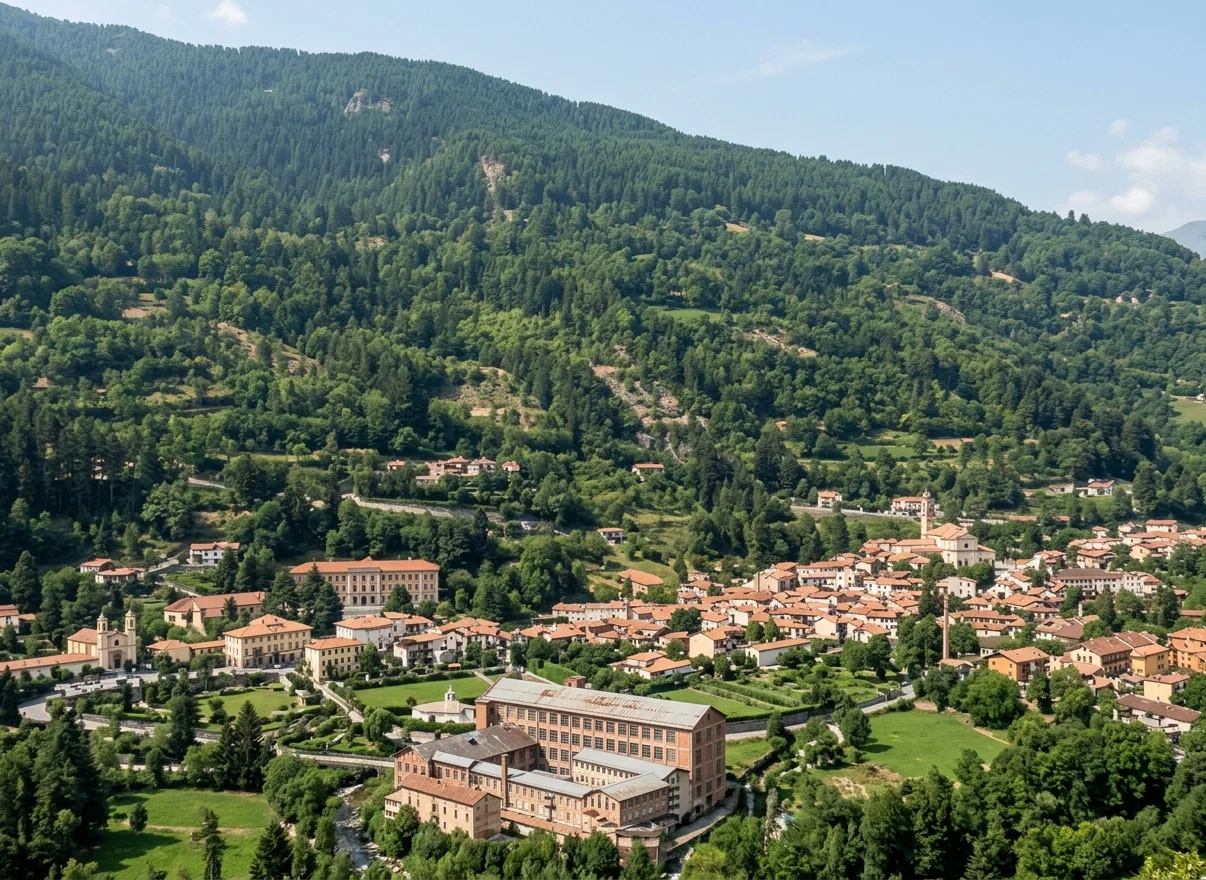
Elder Vuilleumier met me in Turin, and the next day we went to Torre Pellice, in the Waldensian Valleys, about thirty-five miles to the west of Turin. These historic valleys extend over an area about fifteen miles wide and twenty miles long. They are formed by several branches of the Po, chief of which are the Pellice, St. Martin, and Perouse Valleys. They ascend from the Lombard plain to the height of thirteen thousand feet, and form the present border between France and Italy. At the present time the Waldensian Valleys are mostly under the Italian government, but the people still speak a special French dialect. There are to-day seventeen pastorates in these valleys, while they have forty-eight churches and forty-five stations throughout the world.
TORRE PELLICE, IN ONE OF THE WALDENSIAN VALLEYS
Some of their churches are in North and South America, and they have a number of colonies founded in Germany at the time of their persecution.
Torre Pellice is a small town of about five thousand inhabitants, and is beautifully located at the juncture of the Pellice and d'Angrogne Valleys. About thirty of our people live in the neighborhood. There was quite a good interest when Brother Curdy labored here some years ago. Since his departure there has been no regular worker in this field. Five years ago I visited these brethren. They enjoyed having Brother Vuilleumier remain with them for a week, that he might encourage them, and celebrate the Lord's Supper with them. Some of our people live in the town, and some are scattered along the mountainsides. We found Sister Revel, the oldest Sabbath-keeper in the valleys, of good cheer. It is now about thirty years since she accepted the message.
During the day I had the privilege of visiting the headquarters of the Waldensian Church, where they have their conference hall, their offices, and a library of about twenty-four thousand volumes. The librarian had spent some time at the university in Berlin, and had lately visited the Waldensian German colonies, and he very kindly showed us quite a number of interesting volumes. Among these was the Olivet Bible, printed in harmony with the decision of the Waldenses, at Neuchâtel, Switzerland, 1535. In the evening I had the privilege of speaking to about one hundred people in the Baptist church.
As we had ample time next day, we decided on a foot tour up the Angrogne Valley, the most noted valley in Waldensian history. Ascending, our first stop was at St. Laurent, about two miles up the mountains. Here, hidden among the rocks, is one of the most ancient of the Waldensian churches, a building dating from 1555, although it was several times rebuilt and destroyed. Half a mile from the place, we came to a large cliff of rocks where the Waldenses have many times beaten back their enemies. According to our guide-book, we knew there must be some cave among these rocks, in which the inhabitants of the valley had often held their meetings during seasons of persecution. We looked in vain until we hailed one of the farmers near by, who brought us to a cave among the rocks, after a few minutes' walk. We had to creep in on our hands and feet, and when we had entered the small opening, we found ourselves in a cavern perhaps twelve by thirty feet. The light entered through crevices in the roof of the cave. From here we had another ten minutes' walk, and came to the Chanforans; here the noted synod of 1532 was held, in the open air, under a chestnut-tree, where it was decided to print the Bible.
About three more hours' walk, during which time there was nothing left of the valley, save a small, gushing currentand a foot path, we reached the famous entrance to the highlands, which was so often stormed in vain by the enemy, a few Waldensians being able to defend the place against large opposing forces. On either side of the pass are very high and steep precipices, making such a defense possible. The force of the falling water has formed great basins in the bottom of the torrent bed, in many places. In 1561 the Waldenses were able to hold the whole force of the enemy in check at this pass.
After four hours' walk, we reached Pra du Tour, which the enemy vainly tried to take, for centuries. Here the Waldenses had their school that for ages sent forth evangelists who had to brave all sorts of dangers.
The short motto on the Waldensian church is indeed significant—a lighted candle, with seven stars, and the superscription, “The light shineth into the darkness.” While it almost seemed, during the Dark Ages, that the light of God's truth would be extinguished, yet it was then, as in the days of Elijah, in the caves and rocks there were still thousands who in the midst of the darkness caused the light of God to shine brightly.
En route from the valleys to Rome, I stopped in Pisa, a city of about fifty thousand inhabitants. Since spring, two of our workers have been trying to get acquainted with the people in this place through the circulation of literature, thus preparing the way for a course of lectures. Pisa is visited by tourists because of its noted cathedral with the leaning tower, and its celebrated baptistery. These buildings date from the eleventh and twelfth centuries. The leaning tower is about one hundred and eighty feet high. Its first three stories were erected perpendicularly, and then they settled to one side, so that the remaining four stories (especially the last story), were constructed at a slight angle, to prevent the structure from toppling over. In the cathedral, there is a noted chandelier hanging down from above, on which Galileo is said to have observed a slight pendulum-like motion, occasioned by the earth's rotation. The baptistery is famous for its wonderful echo, which is superior to anything I have ever met in any other building. Our attendant, by giving a few musical tones in succession, was able to produce the effect of an organ playing in the distance. We hope the day is not far distant when we shall secure a good foothold in this place, through the efforts of Brethren Benezet and Vaucher, who are laboring here.
I remained in the city of Rome from May 4 to 8, the longest stop I ever made in the “Eternal City.” Here I was met by Brother Everson. We had meetings Sabbath and Sunday in their assembly hall, which they have rented on the ground floor of one of the principal streets of the city. About twelve were at the services. Naturally, there is great opposition from the priesthood in Rome, where the clergy is still very powerful; but we are glad that some have been gained for the truth, four having embraced the message, and others being interested. When I spoke Sunday night, several Catholic priests were at the door, trying to keep the people from entering the hall. I was pleased to find Brother Faund holding on faithfully. He now has a home for ex-priests, but we hope he will soon be able so to arrange his affairs that he may give his whole time to the gospel work. While visiting him, I met a young German Catholic priest from Alsace-Lorraine, whose father is the director of a factory in that district. This young man had been educated in Rome for the priesthood by his father; but from reading the Bible and witnessing what he saw in Rome, the young priest became rather skeptical as to the holiness of the Catholic Church. In spite of the efforts of his father and the endeavors of his coreligionists, he decided to leave the church. The very day he met me, he had had quite an interview with one of the cardinals, and also with his superior, but on that day he had decided to entirely break away from the church. Thus we see there are still honest souls here who by proper effort can be reached.
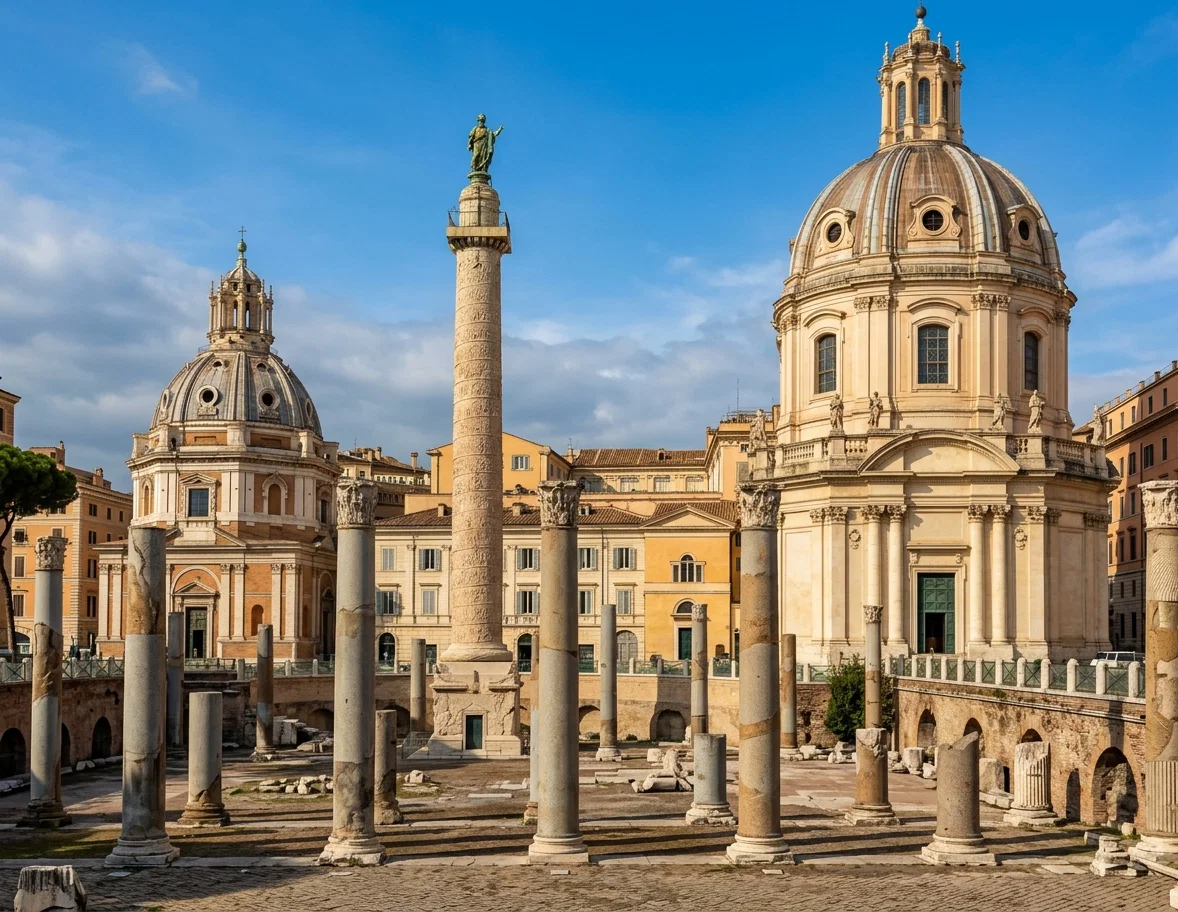
FORUM OF EMPEROR TRAJAN, CONSTRUCTED 114 A. D.
When we remember that there is actually more freedom to proclaim the message in Rome than there is in Germany or Austria, and that the Italians are an intelligent people, we surely would expect that ere long the work here would make the same advancement as is seen in other Catholic lands.
During my stay in Rome we visited the old prison of the emperors, where probably Paul and Peter were imprisoned; then we went to the Palatine Hill, where the Mamertine, the imperial palace, the Forum, and all these things stood. These vast structures of the ancient emperors of Rome are indeed a wonderful sight. We also visited St. Peter's, and noticed a number of intelligent-looking Catholic priests from the States, stepping up to the statue of St. Peter, and kissing his toe as devoutly as any one could.
They were just making preparations for the canonization of two new saints. In carrying out this ceremony large pictures were made, representing the miracles wrought by the priest and the nun who were to be canonized. (Before any person can be canonized, it is necessary that at least two miracles be credited to him.) The miracles of the two to be thus honored as saints, were portrayed on the large painting, which represented some wonderful cures they had performed.
We shall be truly pleased when the day comes that not only in Rome, but also throughout the length and breadth of Italy, there will be representatives of this message, proclaiming the gospel everywhere.