In Cuba

5%

Review and Herald Publishing Association · Takoma Park Station, Washington, D. C. · Sep 13, 1906

FromReview and Herald, Vol. 83, No. 37.

Read the full edition

In Cuba

E. W. SNYDER
It is with keen pleasure that we note the signs of the progress of the third angel's message among the people of Cuba. The advancement of the work in this island will aid in the hastening of the kingdom. Thus far the efforts put forth have been of the nature of seed sowing, since we must sow before we can hope to reap; but we have the promise that we “shall reap if we faint not.” God is verifying this promise to us here.
Some time ago, on calling upon a native pastor, we were invited to speak to his people on the prophecies. At the close of the first service, he publicly thanked the speaker, and wished to know if they could not have more than oneservice a week. This did not last long, however; for after a few weeks the truths presented touched him, and the meetings were closed. But some of the seed sown had already found a lodging place in the heart of one man present. He drank in every word as it was presented, and the following week he made inquiries as to where we lived, and called. He has known the gospel less than a year, and his heart is full of love for it. It has been his custom to spend several hours twice a week in searching his Bible. When Bible readings were suggested, he quickly accepted, and he now comes to our home, walking three miles, three or four times a week, for his lesson. He has kept two Sabbaths, and is eagerly studying every point of present truth.
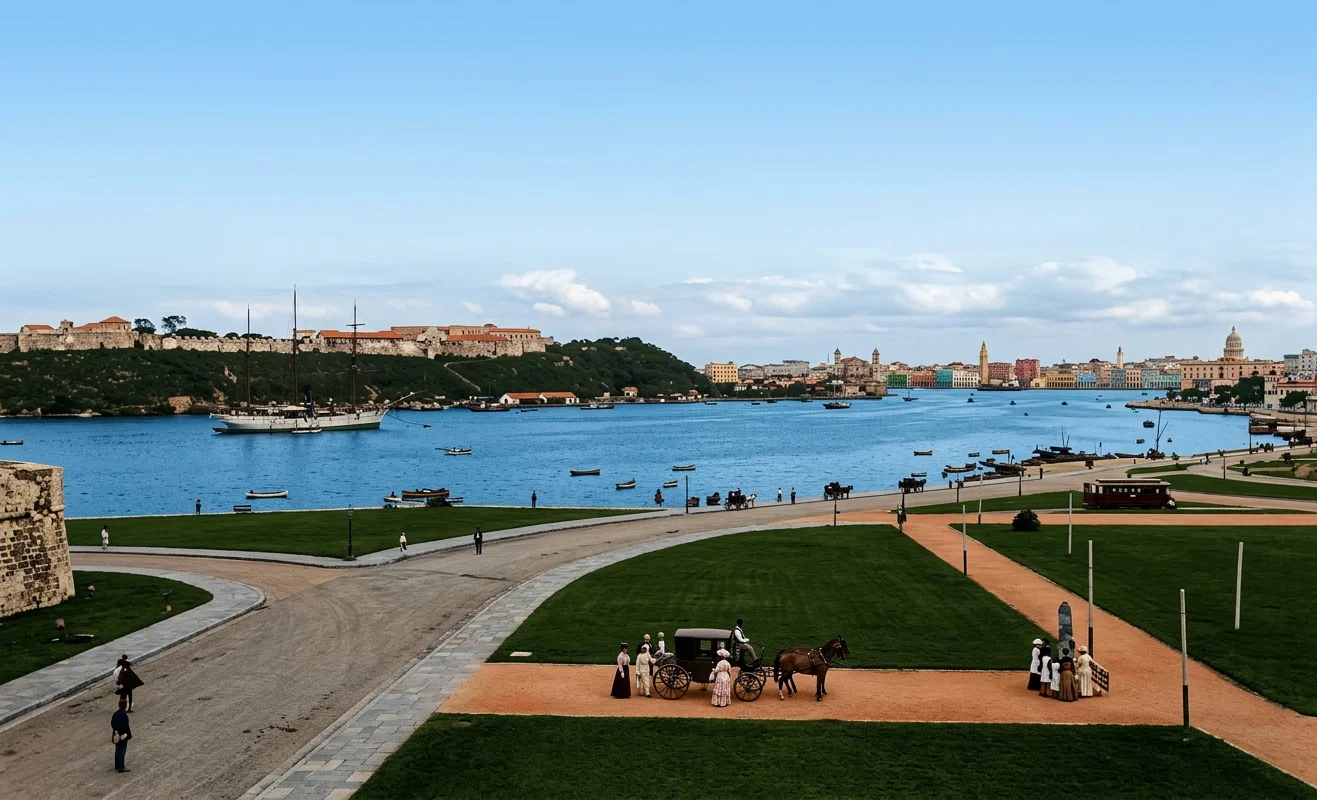
A VIEW OF HAVANA BAY
In his private study, this gentleman found the list of clean and unclean beasts, and it grieved him very much to think that only the day before he had eaten a piece of pork. “But I did not know any better,” he said; “I will ask God to forgive me.” He is having his hardest struggle on the tobacco question. Like all Cubans, he is a heavy smoker, averaging thirty-two cigarettes and from ten to twelve cigars daily. So one can readily understand that his struggle is no small one. But he is gaining the victory. He is studying now with the object of fitting himself to teach the truth to others. He loses no opportunity of talking it to others; for we frequently see him, in front of his barber shop, with open Bible, talking to the men who congregate there.
Returning from a recent trip into the country, we met en route a young Cuban, a mail carrier of Havana. He had formerly made a profession of religion, but had grown cold and indifferent. The study of the Word was suggested to him, and he readily agreed to this. He invites his neighbors in, and at a recent study, at the close of prayer by the leader, he voluntarily followed, thanking the Lord for having sent us among his people, and desiring that their hearts might be opened to receive the light. He is now planning that he may be free to observe the Sabbath.
Who can tell but that God is raising up workers right here from among this people, to aid in spreading the message over this little island republic?
Cuba, as is known, belongs to the family of countries and islands over which the Roman Church has had control for centuries. Added to this is the fact that for four hundred years she suffered under the cruel yoke of Spain. As a nation, she has existed for but four years, so it is not to be wondered at that she is even farther behind in the scale of progress and advancement than are the other Latin-American republics, which freed themselves from the mother country, some of them, a hundred years ago. All this has left its impress on the people mentally, morally, and physically.
It is hard to believe that lying so near the doors of our own fair land there can be found a people practising all the forms of witchcraft and superstition, as dark and hideous as that found to-day in darkest Africa. But such is the case. There are practised to-day in Cuba, in Havana, the capital, all the heathen rites and ceremonies that we have always associated with Africa; and even human sacrifice is offered, in the country districts. Less than a year ago, a white Spanish child was stolen from her family, cruelly murdered, and the heart and blood administered as remedies for certain diseases. All this is done in secret, of course. The perpetrators of this crime were brought to justice, and put to death by the old Spanish method of garroting, or strangling. A book has recently been published here on the subject of “Witchcraft in Cuba,” from which we hope soon to make some translations for the readers of the REVIEW.
These superstitions exist among the negroes, the descendants of the slaves who were brought from Africa and sold in Cuba at the same time slaves were sold in America. When they were sold to the planters in the South in our country, and in Jamaica, Cuba, Porto Rico, and other of the West Indies, they did not fall under the same influences. Those who were sold in the United States and the English islands came under Protestant influences, and we see the results to-day, in the number of these same people accepting the truths of the third angel's message. As one prominent colored writer has expressed it, “They went into slavery pagans; they came out Christians.”
Not so those poor creatures who were sold in the islands over which Spain and the Catholic Church had dominion. They went into slavery pagans, and came out worse than pagans. They have never affiliated with the church. And is it not to the shame of a church that professes to be “the only true church” that a people over whom she has had an influence for centuries should be in a worse condition than when they came to her? Could those so-called Protestants who are so ready to make friends with this same church, know and understand her as she is known and understood in these countries over which she has long had control, they would not be so willing to make the advances they are now making.
As said before, all these influences have left their impress on the people. One writer on the people of Cuba, referring to the fact that all Cuban songs are pitched in the minor keys, even the cries of the street vendors being in the same sad key, says: “Some have asked why these cries are all pitched in the minors. The only explanation is that in all countries where the people suffer, or have suffered under oppression, the folk-songs are always in the minor keys, the sadness of the race finding its way into its music. It is about thirty years since the slaves in Cuba were freed, and their songs to-day reflect the misery of the past. As most of the hucksters are colored, the cries by which they announce their wares are full of pathos.”
All this is true. But we are glad that the truth of the gospel is beginning to find its way into at least a few of these saddened lives; and we know if they will accept it, it will bring joy and happiness into their lives, as it has done in ours, and will change the music in their hearts, at least, from the sad tones of the minor to the more joyous ones of the major key. It does one good, when passing along the streets, to hear floating out from some Cuban homes the words and music of some of the old familiar gospel hymns, as “The Great Physician,” “Sweet hour of prayer,” “The light of the world is Jesus,” “Nearer, my God, to thee,” and others. It is difficult sometimes to recognize the air, it is sung so faultily; but you know that some light has come into their lives, and that they are happier for it.
The leading denominations are all represented here. Protestant churches are being built all over the island; schools are conducted; Bible colporteurs are going over the length and breadth of the island, sowing the seed. As Seventh-day Adventists, we owe much to thefaithful efforts of those not of our faith. Our work is made easier because of theirs. In many cases they have done the sowing, and we the reaping. The leaders and directors of these various societies are always Americans, but each church has also many native helpers.
It is among this latter class that are found at least some who are honest hearted; and having recently come out of the Catholic Church, they are, many of them, looking for more light. One of these is now publicly recommending “Patriarchs and Prophets” to his congregation, and recently sent in an order for six copies, saying he thought he could sell six more. He also gave us an excellent recommendation to another pastor in an adjoining town. Wherever this book is presented among the native pastors, it is gladly purchased. Many of them can read English, if they can not speak it, and so other of our books are finding their way into their libraries. Several copies of “Thoughts on Daniel and the Revelation” have been sold among them. Calling on a young native worker recently, we found him translating, for use in his work, from “Heaven and Hell,” by Swedenborg. When the little “Bible Text-Book,” by Elder Johnson, was shown him, he gladly ordered a copy. We are often asked to bring anything we have that will aid in their study of the Scriptures, but we have little in Spanish.
Up to the present the leaders and pastors of the other churches have shown only the greatest friendliness toward us; but we know, of course, that this will not always last. When the testing truths come to them, some hearts will harden, as did Pharaoh's, while others will be melted, and will be the instruments in God's hands for giving the truth to their people.
A young colored worker would find plenty to do here. While studying the language of the country, he could use his English by working among the American and Jamaican negroes, of whom there are a great many. We find them ready purchasers of Bibles and our English books; and they often speak with regret because of their lack of religious services. We have tried to plan for this class, but up to the present have been unable to do anything for them, owing to our already heavy burdens. Among the colored Cubans, a colored worker would be more favorably regarded than would a white one. This was demonstrated recently. A colored Methodist Episcopal pastor, who speaks Spanish very brokenly, asked us to assist him in a service he desired to hold among the Cubans. Although his Spanish was almost unintelligible, yet they gave him the better attention.
Is there not among our ranks, in some of our schools, some intelligent young colored man who would be willing to come to Cuba and spend himself in helping and serving his more unfortunate brethren? If there is, we would be glad to correspond with him.
Much more might be said of the needs of the people. They are great, and constantly appeal to us. We have entered Cuba none too soon, and our prayer is that the Lord may help his people to forward the work in this island, and thus hasten his coming.