A Significant Movement

2%

Review and Herald Publishing Association · Takoma Park Station, Washington, D. C. · Aug 23, 1906

FromReview and Herald, Vol. 83, No. 34.

Read the full edition

A Significant Movement

Federation Among the Catholics
(Special Correspondence)
The fifth annual convention of the American Federation of Catholic Societies was held in Convention Hall, Buffalo, N. Y., July 29 to August 1, inclusive. It was a representative gathering of Catholic citizens whose official acts and utterances are worthy of attention. One who attended the Inter-Church Conference on Federation of Protestant churches in New York City, Nov. 15–23, 1905, and the Buffalo Convention of Catholic Societies, was profoundly impressed with the singular similarity of the two conventions, respecting the causes that gave rise to the federation movement, concert of action, expressed design, and the ultimate end to which federation is rapidly gravitating. In fact, the speeches and action taken by the Catholic convention were so very much like the proceedings and addresses of the Protestant conference that, barring an exception of minor importance, one could easily have believed it to be an adjourned session, or part and parcel, of the Inter-Church Conference.
J. B. OELKERS, CHAIRMAN OF THE CONVENTION
“Civic Righteousness, God in the Home, the School, the Nation,” is the watchword of both conferences. To root out prevailing and ruining national evils is to be the chief object of these federations, and according to The Catholic Union and Times it is a “patriotic undertaking in which Catholic and non-Catholic may join hands.” The fight against unlimited divorce, against intemperance, against socialism, against the social evil, for the regulation of capital and labor, and the Sabbath, is to be a common cause in which Protestant and Catholic federations may unite. “To promote the application of the law of Christ in every relation of human life,” declared the Inter-Church Conference; “to renovate public and private life in conformity with the teachings of Jesus Christ,” says the Catholic Federation. So much for concomitance of expressed opinion and avowed purposes.
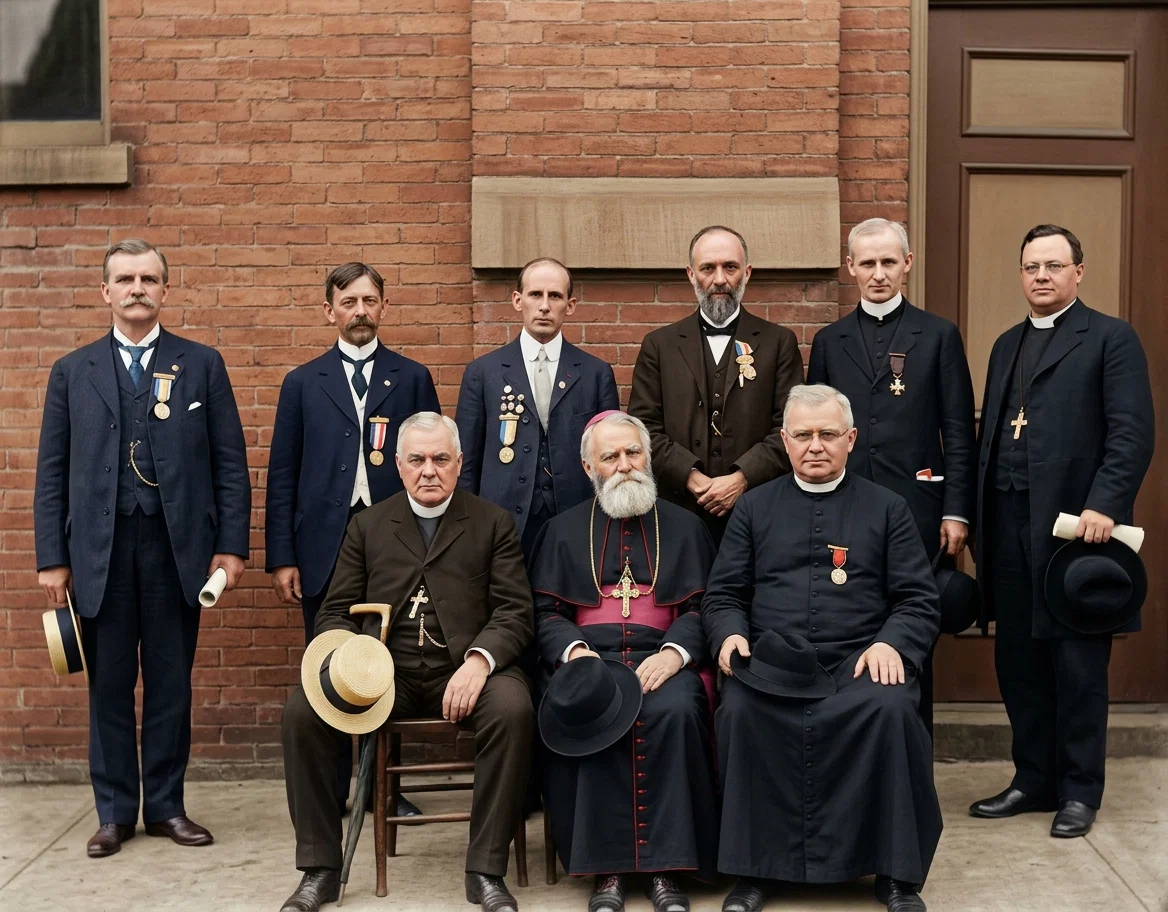
A GROUP OF DISTINGUISHED DELEGATES

Its Origin, Character, and Purpose

The American Federation of Catholic Societies is only five years old. It was founded in Cincinnati in April, 1901. Since that time it has advanced by leaps and bounds. The Knights of Saint John were active in promoting it, and it is said that the original suggestion of union came from them. At the very outset such leading church prelates as Archbishop Messmer and Bishop McFaul gave it their combined strength and influence, working indefatigably for the extension of its principles and its power, realizing beyond doubt that it was destined to play an important rôle for the church in the “game of politics.” The federation and its purposes have received the unqualified indorsement of the pope. Its motto is, “Unity for the common good,” words used by the late Pope Leo XIII. The movement is backed by eleven State, four hundred county, and fourteen national organizations; in short, by the Catholic laity of the United States and her possessions. In this convention the powerful Catholic organization known as the Ancient Order of Hibernians was admitted to membership.
The cosmopolitan character of the federation is indicated by the fact that two Indian chiefs and a Porto Rican were among the many delegates of various nationalities. Altogether, one million five hundred thousand members of the federated societies were represented by the hundreds of delegates present. Leading prelates and priests lent dignity and influence to the convention, among whom were Archbishop Messmer of Milwaukee, Bishop McFaul of Trenton, and the far-famed Bishop Colton of the diocese of Buffalo.
In a trenchant editorial, the Union says: “With the blessings of the Holy Father, the voyage has commenced: may the federation be the triumph the successor of St. Peter desires it, and may it meet our trust in its prowess. The federation has no fear, and it asks no favors. Catholics are not apologists for their presence in America. They are the true leaven of the body politic.”

Its Political Influence

Catholic federation disclaims any intention upon its part to enter the domain of partizan politics, and strenuously opposes the charge that it will yet wield a political influence. Perhaps not partizan politics, but that it will wield its influence in the sphere of the political is as apparent as anything can be. From the proceedings of the fourth national convention we may read: “The Catholic Church in this country will never be ina position to exercise an influence commensurate with her strength until she becomes thoroughly American in her social, political, and patriotic life.” Archbishop Messmer, at the foundation of the federation, said: “Our object is not political, . . . yet we can not and shall not keep away from politics altogether. . . . While, therefore, in the very nature of the case, this federation is to be, at certain times or under certain conditions, forced to exert a political influence, yet it will never do so for mere temporal, material, or purely political purposes. . . . Any one who looks over our program must see at a glance the many points of contact where Catholics can work together with Protestants toward a happy solution of the burning social questions.”
From the fact that presidents and political parties were lauded and applauded, and measures were discussed in this convention that relatively belong to the sphere of political action, and the civil, and the candid admission was made that the state must be made to secure and maintain for the church (Catholic Church) her rights and privileges, we can come to only the one conclusion: that Catholic federation is, after all, in its truest sense political! In other words, the Catholic federation is to become a great fighting machine in the political world, to demand and to secure for the church all that she desires! There is the plainest contradiction of terms, surely, in the organic utterance of federation that “it is not for political purposes,” and in the multiplied utterances of its representative men in its congress assembled that “it is for political purposes.” In this connection it would be well to ponder the Union’s statement that “they [the Catholics] are the true leaven of the body politic.”
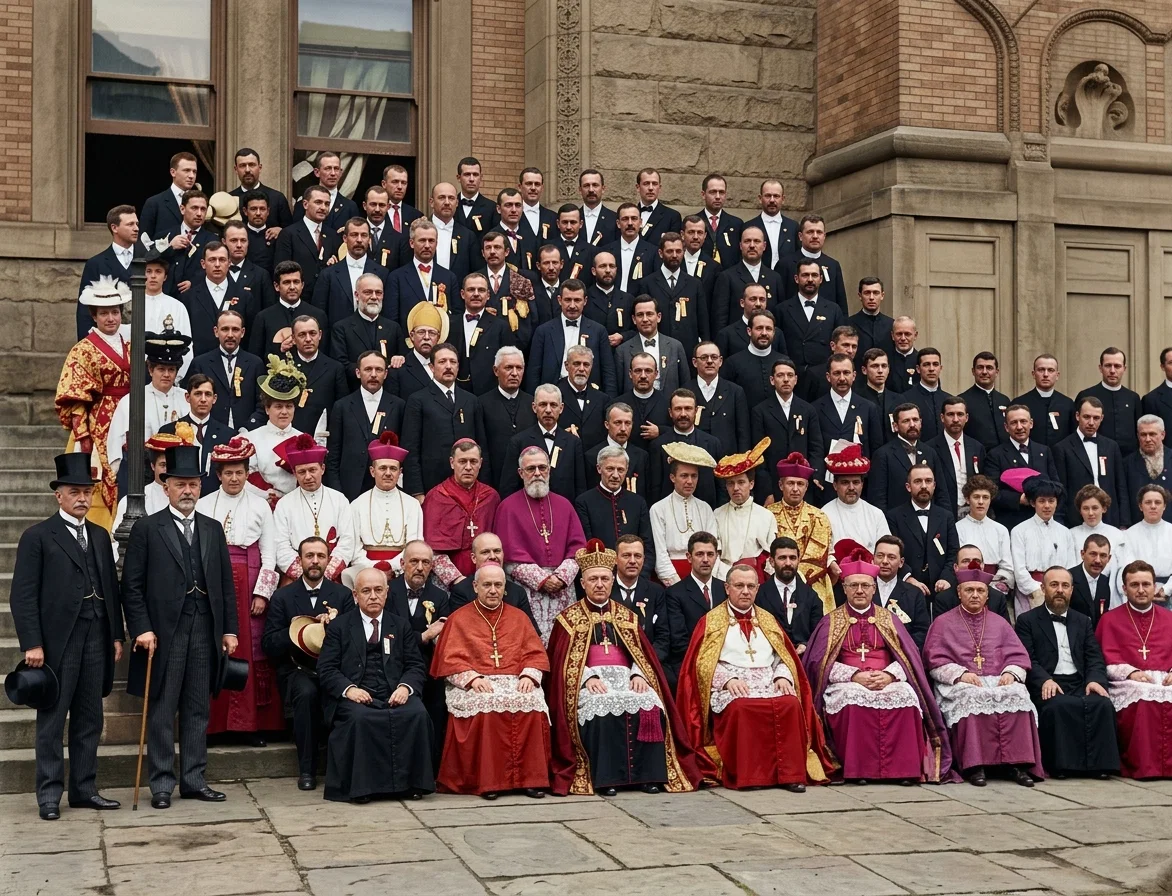
A GROUP OF PRELATES AND DELEGATES
In Cardinal Merry de Val’s letter from the Vatican conveying the pope’s blessing upon the convention, it is said: “How much joy all this”—the “endeavor to renovate public and private life in conformity with the teachings of Jesus Christ”—“gives to the sovereign pontiff can be more easily imagined than described. For you are aware that he has federation of this very kind at heart because of the abundant blessings that accrue from them to civil society.” With all this, can any one doubt that Catholic federation is, in fact, a factor that will exert a powerful influence in the political sphere?
It was President Roosevelt who expressed “his highest sympathy with the movement” of a Protestant federation of churches, and it was President Roosevelt who addressed Catholic federation, at Detroit, in these words: “I believe most heartily in the work you are doing in your American Federation of Catholic Societies.” Rulers and politicians are quick to see the mighty influence these vast bodies are ultimately bound to wield in politics and to exert upon society, and that they must be reckoned with, and taken into consideration, and yielded to, so far as public sentiment will permit, by those who would secure and continue to hold official positions in government. How sad to contemplate that under these conditions might is bound to take the place of right, and individual sovereignty to disappear like the mist before the rising sun!

Opening of the Convention

Convention Hall was bountifully draped with the American flag and bunting, interspersed with the flag of the Vatican here and there—the papal colors side by side with Old Glory! The sessions were opened with a great mass-meeting, immediately following the celebration of high mass for the delegates in St. Joseph’s Cathedral, on Sunday afternoon, over which Bishop Colton presided. Mayor Adam, of national distinction as Buffalo’s “reform mayor,” in an address welcomed the delegates to the city and its hospitality, and he, in turn, received an ovation and most enthusiastic reception upon the part of the convention. It was a scene to be remembered, church and civic officials meeting almost upon common ground. Thousands of persons attended this afternoon, and the evening mass-meeting, which was addressed by the Rev. Father Kelley upon the “Dream of Equality.”
The greater part of the time of the sessions was devoted to the discussion of socialism and the divorce question, while home virtue and sobriety and the American sabbath came in for a goodly share of attention. Resolutions were adopted denouncing the French government for its attitude in the separation of the church and the state, against all forms of divorce, against the doctrines of socialism, providing for the distribution of Catholic literature, strongly condemning the disregard of the sanctity of the Lord’s day, and for the admission of parish societies and individuals upon the Volksverein plan of membership. This last was a genuine stroke of policy upon the part of ardent federationists—and did not pass until after a lively, spirited debate that became acrimonious at times—who sincerely hope and believe that the membership of the federation will, within one year, reach the vast number of fifteen million. From one million five hundred thousand to fifteen million! Think of the power and scope of such an organization, wielded—as it certainly will be—in the political arena, for the interest and the aims of the Catholic Church! Then, too, it should be remembered that there is a genuine desire upon the part of both Protestants and Catholics to unite and co-operate upon the main proposition of civic righteousness—the betterment of the nation and its peoples through the realm of law.

Righteousness by Federation

It was Bishop Canevin, of Pittsburg, who stated: “Never in the history of this country was there a better opportunity for Catholic laymen to prove the value and power of religion in citizenship, and to show how religion alone can conserve the majesty of law and the stability of the state.” Need the writer state that, in the view-point of the speaker and of every other speaker and delegate to this representative gathering of Catholics, it is the Roman Catholic religion, and the Roman Catholic religion alone, that can “conserve the majesty of law and the stability of the state”? The speakers were absolutely united upon the one pivotal point that to remedy the existing evils of the day and in the nation, Christian order of society was necessary, “to restore all things in Christ.”
Justice Daniel J. Kenefick, of the Supreme Court of New York, and a Romanist, gave a very learned and interesting address, from a judicial standpoint, upon divorce and the existing evils resulting from a bad system of civil statutes regulating the question. Hegave all credit to the canon of the church, from which all good civil statutes must have proceeded, and stated that the urgent exigency of a truly bad situation demanded uniform legislation upon the subject. I think it must be generally conceded that his address was the finest and most sensible production of the convention.
Bishop Canevin, in a truly masterful sermon to the delegates, declared that “federation properly worked out, would bring righteousness to the nation.” So we observe an exact unanimity of opinion upon the part of the National Reformers, the Inter-Church Conference, and the Catholic Federation in the matter of bringing civic righteousness into the nation. It may be well at this time to weigh all these utterances in the scales of comparison with the avowed purpose and object of the National Reform Association as expressed in its constitution: “To secure such an amendment to the Constitution of the United States as will declare the nation’s allegiance to Jesus Christ, and its acceptance of the moral laws of the Christian religion, and so indicate that this is a Christian nation, and place all the Christian laws, institutions, and usages of our government on an undeniable legal basis in the fundamental law of the land.”
Touching the Sabbath the bishop said: “The disregard of the Lord’s day is one of the signs of the materialistic spirit and godlessness of our times. It is a subject worthy of serious consideration. Thousands of Catholic men employed in iron and steel mills, in mines and factories, on railroads, street-cars, docks, and wharves, in different departments of city governments, on many large contracts, have no opportunity, I will not say to rest, but even to worship God for one hour by attending mass on Sundays. If they have a day or a half day of rest during the week, it is usually on Saturday. Work and pleasure and material progress are made of supreme importance, and the mad sacrifice to mammon proceeds on Sundays as if laboring men had no Sabbath, no public worship to offer, no souls to save. Against this unnecessary labor, this atheistic profanation of the Lord’s day, this paganizing and brutalizing of the laboring man, and shutting out from his life all religious light and grace, this federation should resolutely use its power in civic, as well as in social and private life.”
It is worthy to note here that Bishop Colton, in a sermon, publicly said: “It is the spirit of the Catholic Church to keep the Lord’s day for rest and spiritual observance, and anything that would be against the religious observance of the day is something that the Catholic Church in this country would be opposed to.” A week later, Dr. Hunter, of the Presbyterian Church, publicly replied to this: “The words uttered by Bishop Colton last Sunday were strong and patriotic. This is a common danger to public welfare, and it is one against which Roman Catholics and Protestants should join hands in fighting. The bishop is right. I would like to see the Catholics and Protestants unite on this proposition.”

The Union of Federations

We see that the federations are willing to unite—“Catholic and non-Catholic”—to join hands in the overthrow of prevailing and national evils, chief of which will at last be found to be Sabbath (Sunday) breaking! National Reformers, Catholic Federation, and Inter-Church Federation stand shoulder to shoulder in the promulgation of the un-American doctrine that there must be compulsory Sunday observance, and the individual who shall assert his right to labor on that day, and to rest upon some other day of the week or not as he may choose, as is his right in a government where it is fundamentally acknowledged to be the right and privilege of all “to worship God according to the dictates of his own conscience,” will find himself face to face with a vast confederated power. Giant federation face to face with sovereign individual!
In this connection, I trust it is not an unpardonable digression to refer to a statement of the spirit of prophecy, as true to-day as in the hour in which it was written:— “The Protestants of the United States will be foremost in stretching their hands across the gulf to grasp the hand of spiritualism: they will reach over the abyss to clasp hands with the Roman power; and under the influence of this threefold union, this country will follow in the steps of Rome in trampling on the rights of conscience.”
How will such a startling change as this be brought about? Again, from Great Controversy, page 592, we quote:— “Political corruption is destroying love of justice and regard for truth; and even in free America, rulers and legislators, in order to secure public favor, will yield to the popular demand for a law enforcing Sunday observance.”
A federation of churches, with its combined influence, is what, when actually brought to bear, will cause legislators, corrupt and cringing, to bend to the unholy work of enforcing upon a free people a religious institution—a Sabbath day! Thus liberty of conscience will no longer be respected, or lines of justice and rules of equality adhered to. It has been well said, “Great combinations are always dangerous, and especially so when religious.”

The Real Object of Church Federation

The particular object of church federation, both Catholic and Protestant, is to conquer the civic, to dominate the state and to compel it to be subservient to its wishes and to work out its unjust purposes. Nor can any one fail to see, unless a bigot, that church federation is a veritable “church trust,” and it can not be hoped that its ways and methods will differ from the iniquitous and tortuous ways and means of ubiquitous commercial and financial combinations of our age, by which all hope of successful competition is ruthlessly crushed. The fighting program, as it is laid down by the federation, will be quietly and peaceably, by the use of the ballot, so to intimidate the political parties that they will be compelled to yield compliance to all the demands of the powerful Catholic hierarchy, first of which will be for a complete change of the public-school system.
It is interesting to note that while the federation asserts in its platform that it shall not engage in partizan politics, or the discussion thereof, yet the Socialists, the Socialist Party, their doctrines and efforts, the force and rapidly growing numbers of the party, President Roosevelt and his several appointments to offices in territory where Catholic citizens predominate, approbation and disapprobation expressed concerning this or that piece of legislation, was freely introduced and discussed in this convention, notwithstanding its disclaimer to any intention to be concerned with partizan politics. Bishop McFaul said, “I am a Democrat.” Bishop Messmer declared, “I am a Republican.”

Statements by Prominent Catholics

Following are some of the striking utterances made during the convention:—
Bishop McFaul: “I say to you that if Catholics and Protestants should unite to do something, there is no great wrong in this country that we can not right.”
J. T. Smith, chairman of Erie Co., Ex. Com.: “Much may and must be expected from a movement among Catholics that has for its principal object the moral elevation of all standards of Catholicity and the consequent respect and civic recognition that such standards justify and demand.”
Rev. Kelley: “If we were more intolerant, this would be a better country. We want intolerance of the right kind.”
Bishop Canevin: “To carry out the purpose of this association, every force of religious activity, pastors and people, bishops, priests, and laymen, must be solidly united with one voice and act with one will for God and our country.”
Bishop McFaul: “It has been an epoch-making congress. We feel now that we have got this federation on a basis that will eventually reach out to every Catholic in the United States.”
Bishop Colton: “The federation has accomplished much already, and it will accomplish still more as time goes on.”
These are sufficient to show the trend of federation. It is a mighty power indeed, a power that is to be exercised in the public life and civic affairs of the whole people, and even of the whole world; for, that Catholic federation will clasp hands with Protestant federation, and they, in turn, with the Buddhist, Hindu, and heathen religions of the East, is as certain as that night follows day; and in this way “all the world” will be led to follow “after the beast.” The great pendulum of historic time will swing back from religious liberty and human rights to religious bigotry and inhuman intolerance, and the indicator upon the dial of progress again mark the hour of midnight. And instead of fornational good, federation will have been found to be for national evil and to have accomplished national ruin!

A World Federation

There is already a plan on foot to unite the Catholics of the world. Correspondence is proceeding between the American Federation and Catholic societies in France, Italy, and Germany with a view to consummate this ideal. American federation is an accomplished fact. The federation of the world is in the future—the near future!
August 1, the convention, after electing new officers, adjourned to meet one year hence in the city of Indianapolis.
Perhaps it would be fitting, inasmuch as we are attempting to show the universality of opinion and practical working out of church federation, to close this comparatively brief report with an editorial from the Buffalo Morning Courier of July 31:—
“One of the most powerful organized bodies in this country is now in session in Buffalo. The American Federation of Catholic Societies represents a membership of a million and a half, united chiefly to oppose socialism, anarchy, perversion of marriage, divorce, dishonesty in business, and corruption in politics. Next to the Catholic Church itself this Federation of Catholic Societies is the greatest organized conservative force in the United States, actively at work in opposition to movements and influences antagonistic to the principles of American institutions. It is a matter of supreme importance that this organization should continue to grow in strength and effectiveness; and it is entitled to encouragement and hearty good will of all intelligent, law-abiding, patriotic American citizens.”
JOHN S. WIGHTMAN.
Buffalo, N. Y., Aug. 7, 1906.