A Letter From California

5%

Review and Herald Publishing Association · Takoma Park Station, Washington, D. C. · Aug 9, 1906

FromReview and Herald, Vol. 83, No. 32.

Read the full edition

A Letter From California

Another Account of the Burning of the Pacific Press Printing Plant
[The following is the greater part of a letter from Brother E. R. Palmer, addressed to the officers of the General Conference. It gives a vivid report of the experiences in connection with the recent fire at Mountain View.—ED.]
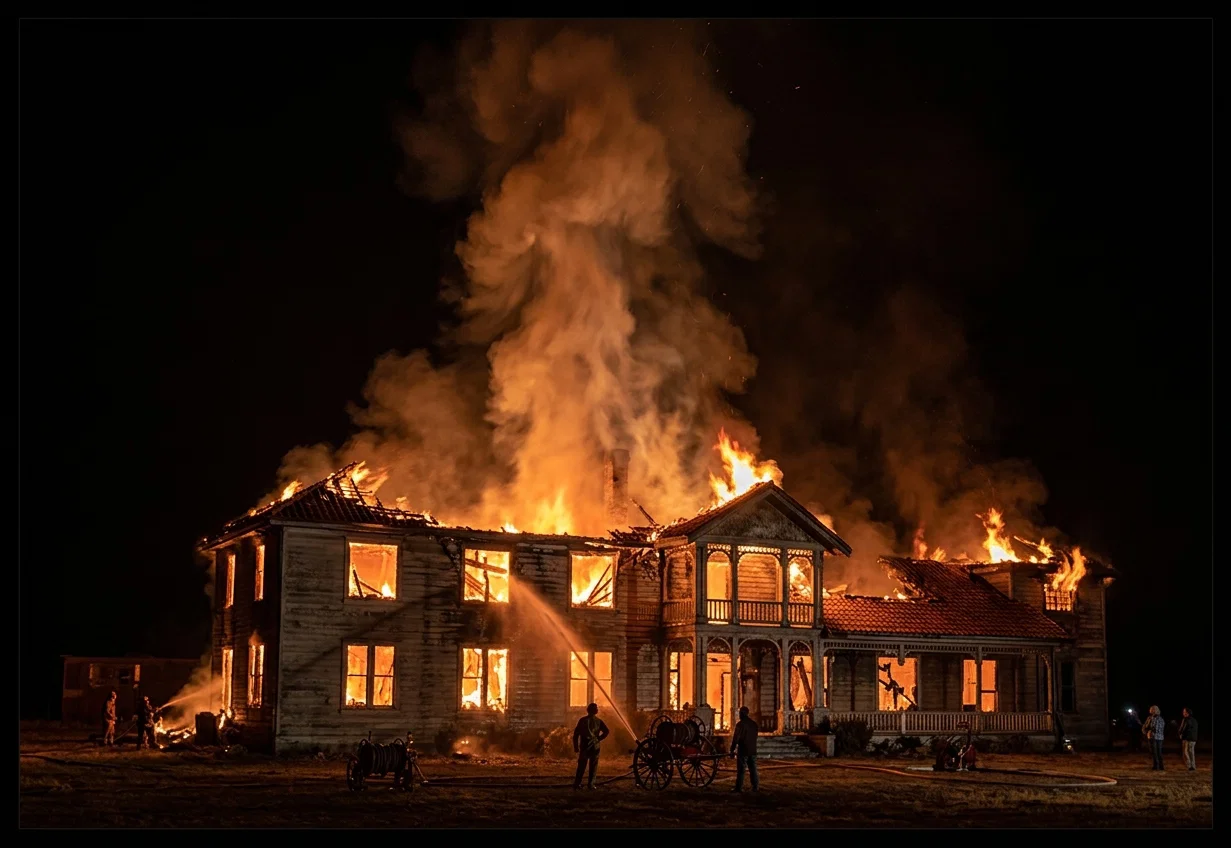
At fifteen minutes of twelve we were aroused by a man's rushing down our street toward the Pacific Press, crying “fire.” As far as known, he was the first person who saw the flames. From our front veranda we saw at a glance that the entire plant was doomed to destruction. The flames already had fast hold upon the photo-engraving department, where they doubtless started, and were mounting through the roof into the heavens. The fire was terrific, and spread rapidly through the entire plant. We rushed back to our room to partially dress, and on returning, perhaps three minutes later, and possibly less, the flames had already spread along the runway to the engine-house, and from the engine-house had caught in the tank-house. In the other directions they had spread through the entire factory, which was stacked high all through with the many large jobs in progress. Although we live only two blocks away, by the time we could reach the building, the flames had nearly destroyed the roof of the front part, which was the last portion of the plant to be reached; and great angry flames were bursting through the doors into the circulating department and into the front hall from the factory.
FRONT VIEW OF THE BURNING BUILDING
Nothing could be done except to save a few articles from the lower floor, and the men did this at the risk of their lives. The typewriters, I think, were all saved from the circulating department, although when Brother Bourdeau's machine was snatched up, the cover of it was on fire.
Brother Gage and several others were in the counting-room and got out the most of the old records. The legal papers, cash, and current account-books were in the safe, and it will probably be several days before we shall know whether they are destroyed.
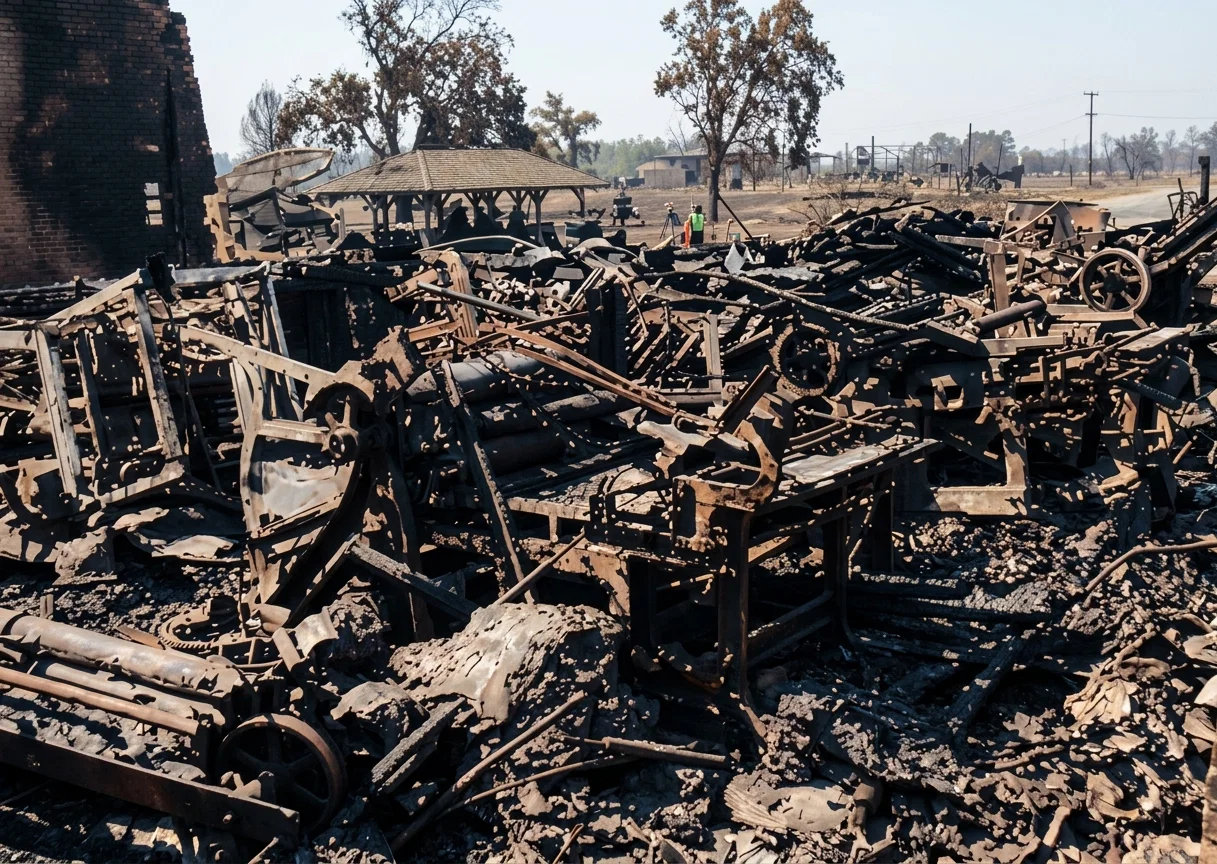
The entire plant was swept clean with the exception of the boarding hall, the horse shed, and the bicycle shed. The brick walls of the power-house are still standing. The lower story of the tank-house and a small piece of the front wall of the main building still stand. I never saw flames sweep through a building so quickly, except in the Review and Herald Office fire. Practically nothing could be saved. The large editorial library,
which Elder Wilcox had been collecting for many years, was entirely destroyed, with the exception of four small books which I had borrowed from him a few days before. Besides this, a large part of his personal library had been transferred from his own house, and went with the rest.
It is unnecessary for me to recount the items of loss. There are thousands of photographs, original drawings, and valuable files of the Signs and other papers which can never be replaced. It is not yet known whether the Signs and Little Friend lists are saved. The copies used in the circulating department were destroyed.
An up-to-date copy was kept in the vault, and a portion of the valuables stored there will be saved. Unfortunately, the vault was somewhat defective, and was probably cracked at the time of the earthquake, though no one was aware of it, and the fire got inside, but burned very little. They tried their best to keep the fire down around it, but it was heated so that it finally gave way and the top fell in. The fire was put out, and kept away from much of the stuff, but considerable has been either damaged or destroyed.
The plant was insured for one hundred thousand dollars. This was held by six or seven good companies, though these companies have been put under such a terrible strain by the disasters in San Francisco that they are likely to cut down the insurance or repudiate it altogether on almost any possible technicality. We earnestly hope that the Lord will overrule in this matter and enable the Press to secure the amount in full.
THE PRESSROOM AFTER THE FIRE
The difficulties of the present situation can hardly be conceived. It is much worse even than in the case of the Review and Herald. Never in the history of the Pacific Press was there a larger amount of work in progress, which made the loss unusually heavy. The great stock of books was entirely destroyed, there being only a conservative stock at Kansas City and Portland to fall back upon, while, on the other hand, the canvassers are having greater success than for many years. Fortunately, nearly all the agents had just made their first delivery. Others can postpone their deliveries, and it is thought that books can be supplied in six weeks. Fortunately efforts have been concentrated upon two books. Nearly all the agents are working for “Great Controversy” and “Heralds of the Morning.” Orders will at once be placed for “Great Controversy” with the Review and Herald at Washington, and a man will be sent East with the responsibility of bringing out a large edition of “Heralds of the Morning” in the shortest possible time.
In the lower room of the tank-house there was stored a large font of small pica type. The employees will set up the Signs and Little Friend, and take them to San Jose or Santa Clara to be printed. Several firms have offered assistance, and by furnishing them with additional help from the Pacific Press force, the most urgent work can be done.
Sabbath afternoon at three o'clock the members of the church met in front of the boarding hall and enjoyed a very precious meeting. There was a strong spirit of consecration and union. The occasion was a very touching one. There seems to be a universal desire to interpret the meaning of the catastrophe aright and learn well the lessons taught by it. The leading sentiment expressed in the meeting was that the Pacific Press Publishing Company does not consist primarily of buildings or facilities, but rather of faithful, devoted men and women; that the church of God is a temple not made with hands, a spiritual building which can not be destroyed, and that the work of God, although shorn of some of its strongest facilities, will go on still stronger than in the past. From this thought many who feel deeply afflicted and heavily chastised are receiving consolation.
It is too early to forecast what will be done. Much depends upon the ability of the Press to collect the insurance money. It seems probable that a smaller plant for our denominational work only will soon be erected on the old foundation. Among the employees there are many good mechanics, and it is believed that the work can be largely done by the office force, thus giving employment to many now thrown out of work.
It is needless to say that the leading men of the Pacific Press feel greatly afflicted. They suffered great loss from the move from Oakland to Mountain View. Then came the earthquake which shook down the brick walls. They rebuilt with wood, and now the whole is burned, and yet above all, the spirit of these devoted men seems to stand triumphant in the confidence that God has permitted this affliction in love, and that through it he will teach lessons in unity and reliance upon him and in separation from the world with all its commercialism, which will be worth more to the cause of God as a whole than the plant itself could have been.
Our Publishing Department and Relief Bureau have also suffered. Ten days before the fire we had moved into the Pacific Press building. The room where we were was too hot for the summer weather, and the Pacific Press very kindly gave us office room which was very comfortable and commodious. It was the large square room next to the editorial rooms, facing the south. Everything we had was destroyed,—our typewriter, our files, minutes, accounts, everything,—and we have to begin all over again. However, our accounts were with publishing houses and others who kept accurate accounts, and we shall be able from them to receive itemized statements and reports which will enable us to make up our records quite completely. It will take considerable time to get in working order again, and of course our loss will amount to quite a little, though it is trifling compared with the loss of the Press.
We most earnestly desire the prayers of all God's people that wisdom and strength may be given to the men upon whom these almost crushing burdens and sorrows are now resting. At the same time, I am confident that I express the sentiment of the Board when I say that none are wholly discouraged or cast down. Confidence in God in a time like this is proving an anchor to the soul, both sure and steadfast.