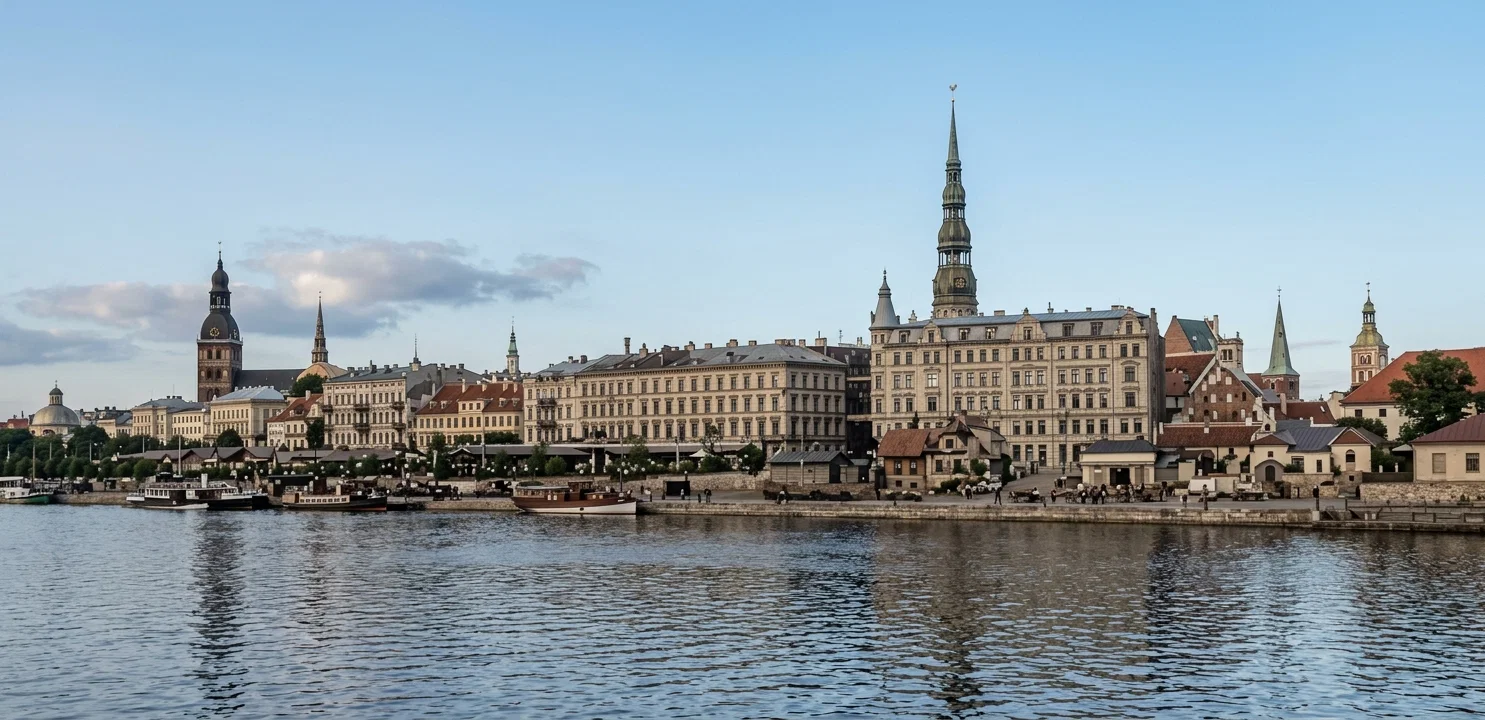
The North Russian meeting was held in Riga, October 6-10. This city was formerly numbered among the Hausa cities, and in appearance is really more German than Russian. It contains about three hundred thousand inhabitants, and for a long time was a haven for the oppressed and persecuted. We have ever regarded it as one of the freest cities in all Russia.
CITY OF RIGA
However, the Sabbath previous to our arrival the officers came into our church there, found preaching in German and Russian in progress, called for the passports of our Russian worker, Brother Juricksen, and the superintendent of the mission, Brother Gaede, took down the names and addresses of the twenty-two members present, and went to Brother Gaede’s house, searched it, and carried off his letters, reports, books, and papers, and took the passports from him and another of our ministers, and forbade their preaching until their cases were finally settled.
This action was not entirely a surprise, as there had lately appeared in the Lettish and Russian papers some very censorious articles against our work, and the very name of the street where our meetings were held had been given. Untrue members—backslidden members—are supposed to be the informers. Perils among false brethren are more to be dreaded in this land than are the efforts of our avowed enemies.
The charges against us are (1) collecting tithes; (2) having Russians in our meeting; (3) criticising other churches. Of these, of course the most serious is that of having native Russians (Greek Catholics) in our meeting.
Friday, the 9th, the case was to be handed over to the higher court, and Sabbath, the 10th, search was made to see whether the brethren were again assembled. While this interfered some with the order of the day, yet it did not entirely break up the meetings. The brethren met in two different companies, and God was present with them.
Thus the outlook for a general meeting was not the brightest when we arrived Tuesday morning. But the appointment had been given, and brethren for hundreds of miles around had come to hear the word, and have their souls refreshed. The way had been remarkably opened at a very late date for our place of meeting to be changed to an entirely opposite section of the city, and thirty or more from the other two churches and the ten companies of the North Russian Mission, with about an equal number of the Riga church, met behind closed doors in the mornings, and all but one of the evenings, to enjoy a feast of good things brought forth from the Scriptures, and to transact the necessary business of the mission.
In spite of all the difficulties that our workers must encounter here, this field shows a good growth. When it was organized two years ago, its membership was one hundred and eighty; now it is three hundred and eighty. One new church and five new companies were received into the mission at this meeting. The German, the Lettonian, the Esthonian, and the Polish nationalities are represented in the field. To insure greater safety to these nationalities, the native Russian brethren have been separated into a mission known as the Middle Russian Mission.
So expeditiously was all the business transacted, that by Friday afternoon all was out of the way. The ordination of Brother O. Wildgrube to the gospel ministry took place that morning, and that night two were baptized.
The Committee on Resolutions offered these recommendations, which were heartily adopted:—
“1. We would thank the Lord for the blessings, protection, and growth that have attended our work, and we feel grateful to the Mission Board and the German Union Conference for the financial assistance they have given us.
“2. In view of the need of more laborers, we would urge our brethren to be more faithful in the payment of their tithe.
“3. That we may assist our young people to attend the Friedensau school, we would advise that greater efforts be put forth to sell ‘Christ’s Object Lessons,’ and collect the required amount on the Material Fund.
“4. We recommend that our First-day offerings be dedicated to the German East African Mission, and urge our people to be as liberal as possible in supporting this fund.”
Ministerial licenses were given to D. P. Gaede and O. Wildgrube; the licentiates are J. Juricksen and K. Rempfert; the Bible workers, J. Sprohge, A. Rauk, and G. Lobsack.
The officers for the coming year are as follows: Director, D. P. Gaede; Secretary, J. Sprohge; Treasurer, A. Langholt; Tract and Missionary Secretary, K. Laubhan; Advisory Committee, D. P. Gaede, O. Wildgrube, K. Rempfert, F. Sander, J. Eberhardt.
The funds received during the year 1902 were as follows: tithe, $1,015.03; Sabbath-school offerings, $158.57; First-day offerings, $11.71; annual offerings, $25.42; book sales, $455.14.
We do not look upon the trials as an evidence of God’s displeasure, but we remember that our kind Father gives us the privilege of sharing in the sufferings of his Son, that we may hereafter be partakers of his glory. O that our Lord may find each of us faithful in finishing the work he has given us to do! Remember the eighteen million people of this field in your prayers and offerings. Don’t forget to ask God’s protection over our workers here; for they labor under constant danger from persecution and imprisonment.