Central Cuba

7%

Review and Herald Publishing Association · Washington, D.C. · Aug 27, 1903

FromReview and Herald, Vol. 80, No. 34.

Read the full edition

Central Cuba

W. A. SPICER
FORMERLY the eastern and western provinces of Cuba were far apart, so far as communication was concerned. New York was really nearer Havana than Santiago was. The new railway system now runs the entire length of the island, and three passenger trains each week ply between Santiago and the capital. It is a three days’ journey, however; for the trains run only by day, stopping over each night in the capitals of the two central provinces, the passengers finding hotels.
The Santiago division was only just completed at the time of my visit. The roadbed was so rough that passengers very quickly lost all regrets that we were not to make progress by night travel. The railway is of American construction, not greatly differing in style from our own systems. The fare, second class, for the entire journey, is twelve dollars, just half the first-class fare. The tourists in the first have upholstered seats; but in the second, one not only saves money, but sees the people of the soil as they crowd on and off at the way stations.
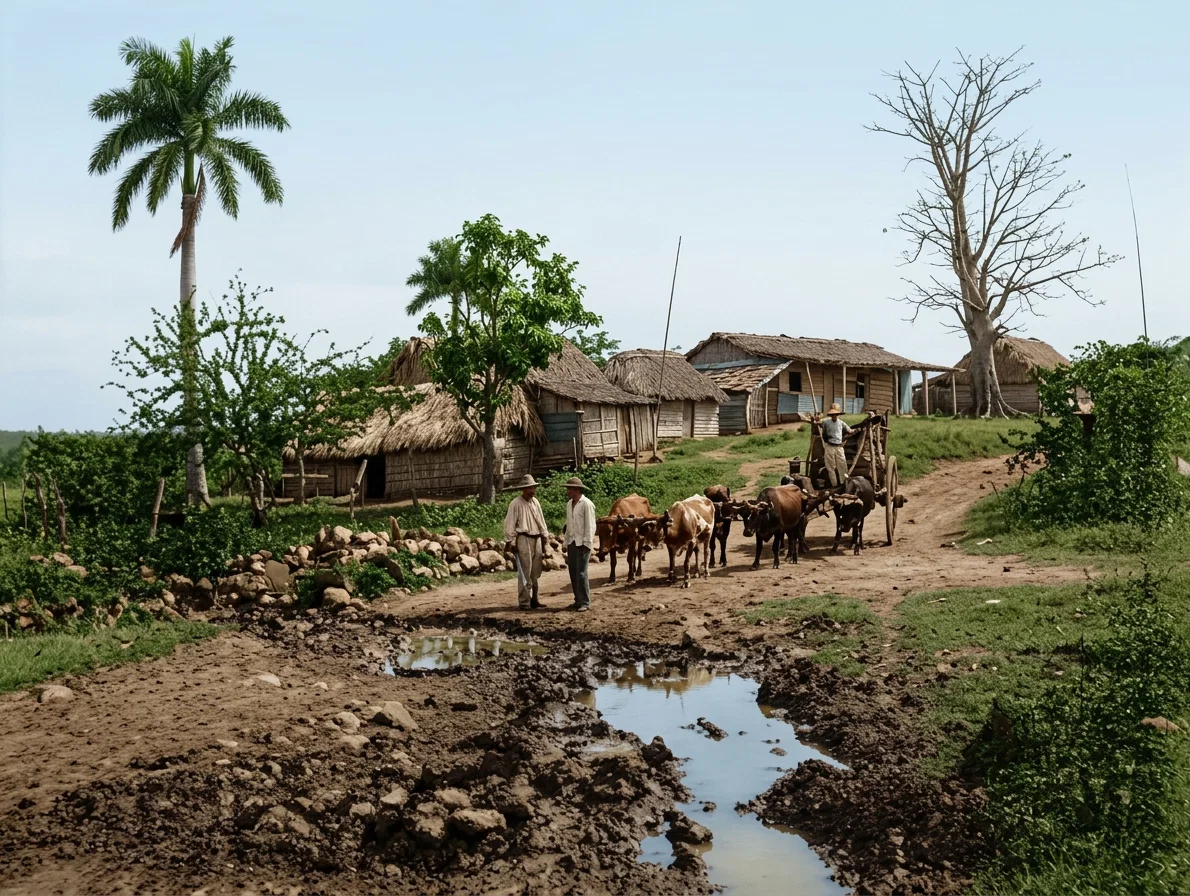
CUBAN LANDSCAPE
CUBAN LANDSCAPE
The loose blouse and battered felt hat predominate in the male costume. The long machete hangs at the belt of many of the men. This sword-like knife is not to be misinterpreted in time of peace. It is the farmer’s pocket knife in all the West Indies, his handiest tool in corn or cane fields, or in the jungle. Much of the country is new along the line between Santiago and Puerto Principe. But peasant cottages are springing up in the clearings, and women and children gather to see the train go by. The houses might be called huts if one did not know that they are often neat inside. The roof is generally thatched with palm, while the sides are patched into protecting walls by the help of boards and sheets of tin, or most often, perhaps, the dried slabs of palm fiber, stripped off the royal palm, which rears its head over all the Cuban plains.
The farmers may get three crops of corn a year in this district, I was told. There are no frosts, and gardens bring forth the year round. It is better, however, even here not to crowd the seasons. We passed through many a mile of some of the finest grazing land in the world. The guinea grass, on which the cattle fatten, grows tall and tender. The stock of Cuban cattle was almost annihilated during the war, and even now the pastures are poorly supplied.
Our first night out was spent in the city of Puerto Principe, capital of the province. I found an aged New York man keeping a simple hotel for work-a-day Americans, of whom there were many in this province. My friend said that many Americans were buying land in the district for stock raising and corn and fruit growing. Land could be had for from three to five dollars an acre. In clearing, the timber land yields a profit on the large trees, and the small growth is loosely rooted and is easily burned out. One of the finest reputed sections in all Cuba is that about Nuevitas, on the northern shore of this province; and I was told that a considerable American colony is growing up in the region. It was in the beautiful Nuevitas Bay that the real glories of the new world first burst upon Columbus, as his ships rode in after leaving the little island of San Salvador. Then he found over a million natives, gentle, mild-mannered, and so hospitable that he declared them the best race of people on earth. Ere many generations the last of the natives had perished, slaughtered under the auspices of the church that has smothered and stifled the souls of men in all the long Cuban history since that day. Now, ere the Lord comes, the full gospel of his kingdom must be carried through this fair island.
Puerto Principe is a town of twenty-five thousand inhabitants. These Cuban towns are much alike. The low dwellings, joined house to house, line the streets in solid wall of whitened plaster and cement, pierced by the wide doors and windows. Through these the people who do not walk the plaza and pavements in the evenings may watch those who do. There is little religious enterprise here. The Baptists have one small church. If the city people keep late hours, they are early awakened by the clanging bells of the several Catholic churches. I saw no signs of anybody going to early mass, however.
At eight in the morning our train moved on westward. We stopped for dinner at Ciego de Avila, a town on the famous “trocha,” or line of block houses, barbed wire, and military railway, stretched across Cuba from north to south by the Spanish forces, in the vain effort to confine the insurgents to the eastern provinces. While the passengers ate at the Chinese restaurant, I strolled along the hedgerows, and gathered over thirty varieties of flowers within a few yards of the station. Now, the journey westward took us through well-cultivated lands. The soil is dark. Fields of corn are planted with pumpkins between the rows. Cane and tobacco fields abound, and bananas and beans are favorite garden crops.
Evening brought us to Santa Clara, capital of the next province, where again we sought hotels. Here I found a Methodist general meeting in session, with Bishop Candler and several visiting brethren from America present. Nearly twenty Methodist workers were gathered. The Methodist mission is a corner store and dwelling, neatly fitted up, nearly opposite the chief Catholic church. The sign, “Mission Metodista,” is hung out prominently, and our Methodist friends are evidently making progress. One of the workers told me they now number seven hundred in all Cuba, over three hundred members having been gained this year. They hold services in halls and the open air, in clubs and private houses, and sell Bibles and literature. They take in members who might not be received in America as well-grounded Christians; but they get them within the influence of the church, and labor for their upbuilding in the faith.
A young Cuban spoke in Spanish at the evening meeting. About one hundred and fifty people were present. The sermon was followed by a consecration service. Another young worker, a Cuban trained in the States, I believe, earnestly exhorted the people, while the choir sang in Spanish the same gospel hymns withwhich we are familiar. Many of the people went forward and shook hands with one of the several ministers on the platform, an act which evidently was intended to signify consecration to service. Some, I must say, seemed to act in a light and formal manner, but many were evidently serious and devoted in taking the step. It means much to these simple Cubans to stand out publicly for a new and Protestant movement. Even though few of the people are held to the Romish Church by any positive convictions, to join the Protestants is to lay one’s self liable to petty persecutions and social ostracism.
In Santa Clara I found a bookstore, with a dozen or two books on the shelf. I asked our American railway conductor with whom I stood watching the evening crowd in the plaza, why it was that so few seemed ever to sit down and quietly read and study. He himself is a smoker, but he told me: ‘These people are cigarette and tobacco slaves. They smoke so much—men and women—that their nerves are unstrung, and they must be doing something. So they are forever on the move, and disinclined to sit and read.’
It is a ripe field for the message of the coming of the Lord with its reformation on the principles of health. One must admire these active, emotional peoples, and the truth as it is in Jesus will surely work wondrously for many of them. But we have not a soul in the field to tell it.