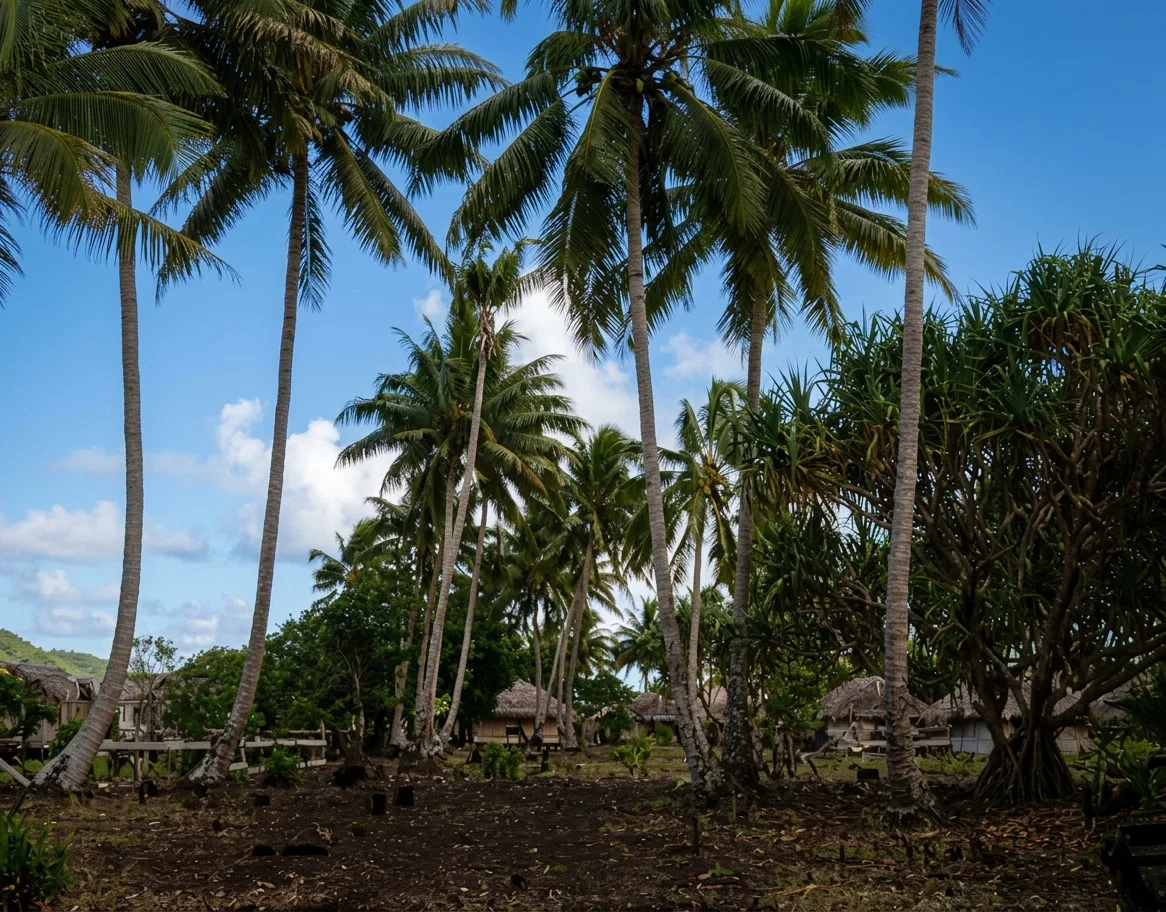
HERE in the Society Islands, the people have long rested in security, feeling that they were safe from the calamities and disturbances of nature which have been multiplying so rapidly in distant parts of the world. But we know that in these last days the Lord will send to every place signs which foretell that his coming is near. And now they have come so near to us that we have been made to sense the “troublous times” as we could not when they were farther away.
SCENE IN THE TUAMOTU ISLANDS
A few weeks ago a hurricane visited the vicinity of the Tuamotu Islands, and worked havoc among the settlers there. These are adjacent to the Society Group, and quite a number of the Society islanders were living there, and lost their lives at this time.
It was in the midst of the diving season, and many from the other islands were gathered at Hikuera, where the diving for pearl shells was in progress. On this island, out of twelve hundred people about four hundred persons were drowned, and every building was washed away, besides many of the cocoanut trees. The highest points of most of these islands are only four or five feet above the sea level, and yet the people have always felt that there was no danger from the sea. But at this time the sea, being agitated by the wind, arose and flooded the island, and those who survived had to stand for hours in water up to their waists, or cling to cocoanut trees, with only scant clothing to protect them from the fierce wind and rain. They suffered much with cold, and it was indeed a terrible experience.
One by one the cocoanut trees were uprooted or broken off, and many who sought refuge in them were killed. I have been told by those who were there that they felt their helplessness and the power of the sea as never before.
But after about twelve hours the wind subsided, and the sea went back to its proper bounds, leaving about eight hundred people on a lone island with nothing to eat or drink but a few cocoanuts (the water in the nuts is used for drink). It was seven days before any relief came, and they suffered terribly with hunger and thirst, and with the heat by day, and the cold at night.
Their native foods are simply cocoanuts and fish, as the soil is so thin that other trees and vegetables can not be grown. But as they made good wages diving, they were able to buy tinned meats, rice, and bread from the stores. At this time the stores with their contents were all gone, and also most of the cocoanuts had been blown down and washed away. There are no bubbling springs on the island, only a few pools, and these were now full of salt water. They had been dependent on rain water, which was kept in tanks, but now they did not have this, so there was no fresh water, only what was found in the nuts, and that lasted only two days.
To add to the trouble, the many dead bodies washing up on shore could not be properly buried, only a thin layer of sand covering the coral rock, and the stench soon became most unpleasant.
As soon as the disaster became known in Tahiti, as many steamers as were at hand were immediately loaded with food and tanks of water, and sent to relieve the sufferers.
Other islands of that group were also devastated, but we have not heard so much from them. The people of this group are nearly all Roman Catholics or Mormons.
But though these islands are so desolated, they are not to be deserted. The merchants are again putting up buildings for goods and for storing shells, and the people have again begun to dive. The same thing is not liable to happen again, they say. But in these days, how uncertain is everything about this old world! We can depend upon nothing but the Lord and his sure word. These we know will abide forever.