The week which begins with Palm Sunday and ends with Easter, is, by far, the most important time in the year for the Roman Catholic Church. The multitudinous ceremonies of this week we shall not attempt to describe; we will notice but a few of the more prominent features of this time.
The service of Palm Sunday at St. Peter’s church was carried on much the same as this service is celebrated in Catholic churches everywhere, with the exception that a cardinal officiates here. The cardinal, with the aid of a large number of prelates and bishops, blessed the palms and scattered them out to the people, who grasped them with eager hands.
On Wednesday afternoon the doleful service of the Tenebrae, which word means darkness, was begun, and this service was repeated each day, for the three days of Wednesday, Thursday, and Friday. In this service a candlestick containing fifteen candles was given a prominent place at the altar, and at the end of each psalm one candle was extinguished, until at the end of two hours of tedious and unintelligible service the candles were all finally extinguished, except one, which, while still burning, was removed from the candlestick.
After this service of the Tenebrae on Thursday at St. Peter’s church, the traditional washing of the papal altar took place, which is performed in this church only. Five canons, passing around the altar, from which the altar-cloths had previously been removed, each in turn poured wine and oil from flasks over the stone slab. Then with the aspergillum, a kind of brush which each carried, they performed the washing of the altar. After the five canons had completed their office, all the members of the officiating company, beginning with the cardinal, walked around the altar, passing over it the aspergillum which each carried in his hand. This part of the ceremony completed, the five canons concluded the service by wiping up the oil and the wine with sponges.
At the close of this ceremony the relics of the church were displayed from the gallery of St. Veronica. They were purported to be the veil of St. Veronica, the spear with which Christ was pierced, and a large piece of the “true” cross. When the people saw the piece of “the true cross,” they fell on their knees, and a marked silence prevailed. They did not know how many pieces of this so-called true cross there are in the world. A leading professor in history has said that if all the wood purported by the Catholic Church to be the true cross could be collected, it would fill a large ship. Paul wished to banish from our minds any such ideas as adoring relics when he said, “Yea, though we have known Christ after the flesh, yet now henceforth know we him no more.”
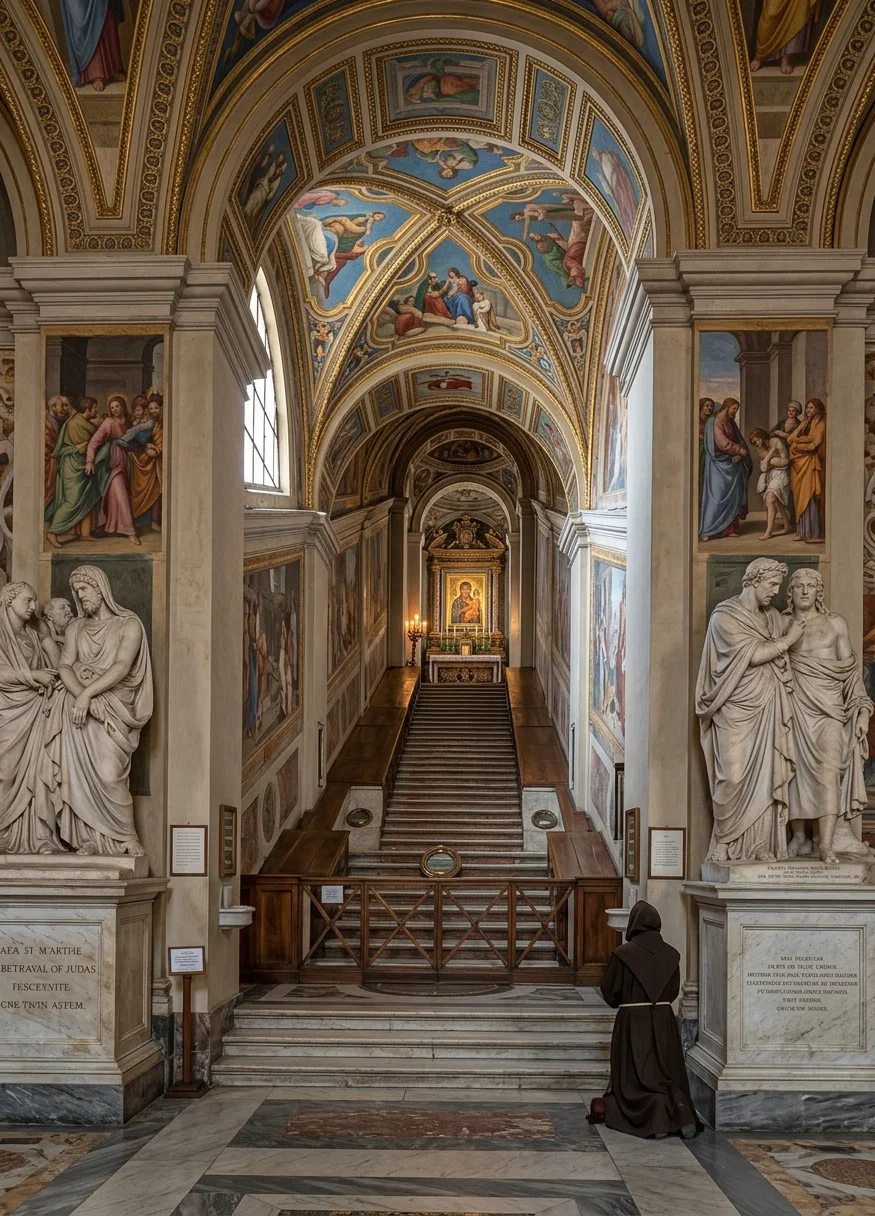
SCALA SANTA
Adoring pieces of the cross, or even worshiping a dead Saviour, will not bring salvation. But we are to look to a Jesus who says, “I am he that liveth, and was dead; and, behold, I am alive for evermore.” A morbid religion has been the result of dwelling on such pictures as Ecce Homo, on crucifixes and pieces of the cross. What we need to behold is the One who has all power in heaven and in earth.
On Thursday we witnessed the service of humility as it is performed by the Catholic Church, this being the day that the Romish church has ordained as the one on which the original ordinance was instituted. We saw a cardinal wash the feet of thirteen young students of the priesthood. He had two assistants, one of whom held the basin, while the other held the pitcher containing the water. All the utensils were of silver. The cardinal washed only one foot of each individual. He was girded with a towel. The one assistant poured the water over the foot, while the other held the basin under it to receive the water. The cardinal then wiped the foot and kissed it. This service he performed for each of the thirteen students. The ceremony was extremely formal, and there was no washing of “each other’s feet,” as only these students’ feet were washed. That completed the service. There was none of that deep moving of the Spirit that I have witnessed at the celebration of this solemn service when it was performed from the heart. With much difficulty the students suppressed their smiles, and the cardinal seemed somewhat ashamed of his work.
On Good Friday we visited the Scala Santa. This is a flight of twenty-eight stairs, said to be the flight of stairs that Christ ascended to Pilate’s judgment hall, and they were transferred hither centuries ago. It was while ascending these stairs that Martin Luther heard the voice, saying, “The just shall live by faith,” and immediately arose from his knees and went forth a determined apostle of the Reformation. No one is allowed to ascend the stairs except on his knees. Good Friday is the time when most people ascend these stairs; for on this particular day there is an image representing the dead Christ at the head of the stairs. The stairs were so crowded by those who were ascending, that a large number climbed up the sides, which are used ordinarily for the descent. As each one reached the top, he, still on his knees, came to the image of Christ, and kissed it over and over again. On each stair the one ascending is supposed to say a prayer. As we saw them climbing up the stairs and kissing the image, it would not have taken much of a stretch of the imagination to believe that we were in the temple of some idol in the midst of heathendom. We thought that instead of bowing at the image of a dead Christ, how much this people needed to know the power of a living Redeemer.
Nowhere in the history of the early church do we find the Christians making pictures of the cross or using crucifixes, or employing any of these outward forms to aid them in devotion. They dwelt not so much under the shadow of the cross, but in the presence of a Christ that “ever liveth to make intercession for them.” Truly they valued his death, and rejoiced that he had won a complete victory. But they gloried most in the fact that their Jesus had all power in heaven and in earth, and that this Jesus was with them alway, even to the end of the world. Our Saviour is not in Joseph’s new tomb, but on the right hand of his Father in glory.