Produce, Markets, and Communication of Santa Catharina, Brazil
By F. W. Spies
F. W. SPIES
The chief crops grown in Santa Catharina are corn, sugar-cane, mandioca, and tobacco. Corn is the staff of life for man and beast. From it the planter bakes his bread and feeds his stock; hence it might be regarded as the leading crop of the province. Next to corn comes sugar-cane, from which sugar and cachasse (rum) are manufactured. From the mandioca root is made a product called “farina,” which is first grated and then roasted.
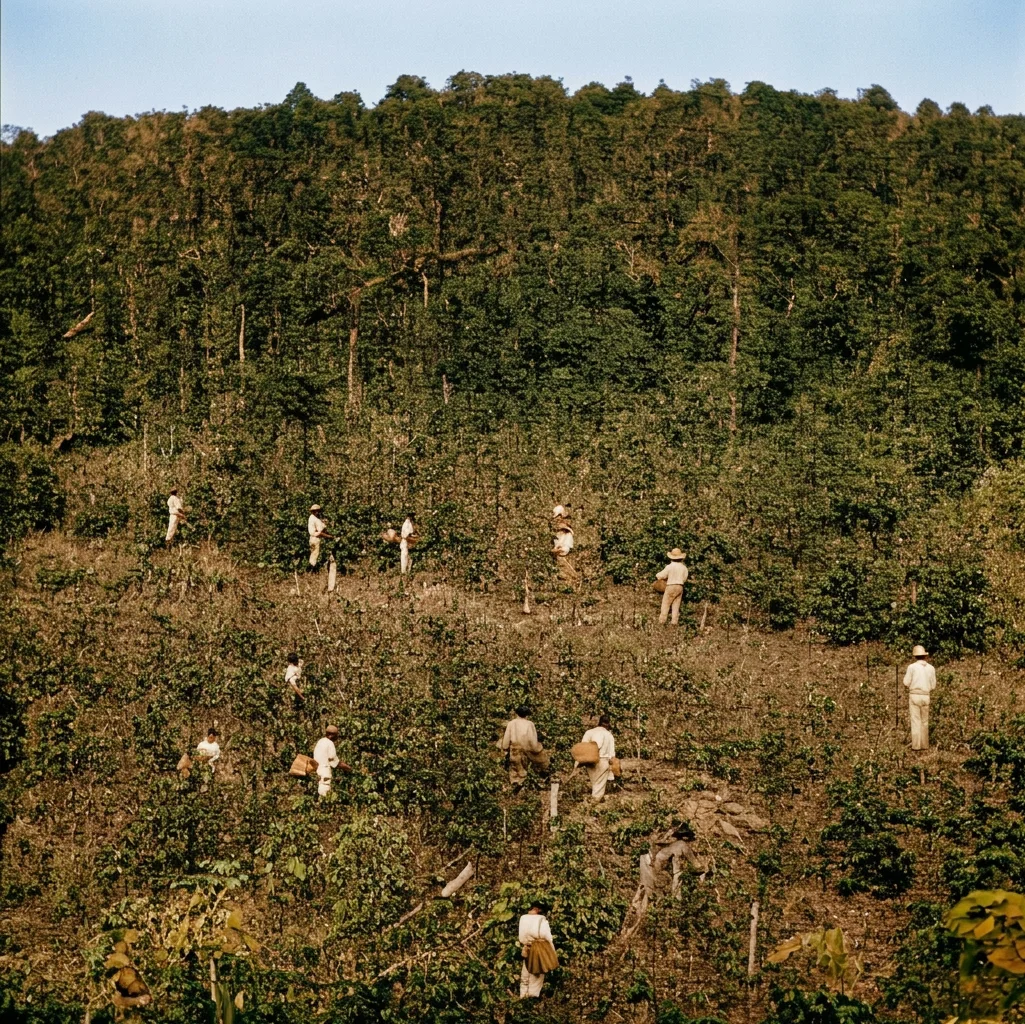
COFFEE PICKING IN BRAZIL
This farina, perhaps, ranks next to corn as a food, it being used largely by the natives. Butter and lard are also produced to considerable extent, and on the table-land the raising of cattle, horses, and mules is the chief occupation, and furnishes hides and dried meat for exportation. There is also a limited trade in lumber, but by far the largest amount of the excellent timber felled each year is consigned to the flames, and what they do not destroy is left to rot on the land, and is a hindrance to the planter as long as it exists.
The chief reasons why the excellent timber here can not be more fully utilized are, first, the lack of proper roads for transporting the same; and, second, even at those places where there is sufficient water, the timber can not be floated, as almost all varieties are so heavy that they sink in the water like a stone.
In general, the means of communication are very poor, and this makes it difficult for the planter to market the small portion of produce which he has to sell, it often being impossible to get certain things to market without the transportation amounting to almost as much as the thing is worth, or perhaps more.
Even traveling, which must be done as a rule on mule-back, is often interrupted for days, and even for weeks, on account of the overflowing rivers in the rainy season. Bridges across streams are seldom found. Thus Brazil is, in fact, a country of “paciencia” (patience), for to get along here one must have patience, and also perseverance.
There is only one railroad in the province, and that is probably not more than seventy-five miles in length, and even this is operated in one of the most thinly populated districts of the province.
For a short distance from the seacoast, communication is kept up on some of the rivers by small steamers and other boats, but the rivers of Santa Catharina are, as a rule, so full of rapids and waterfalls that they are not navigable for any great distance; and the mountainous condition of the country makes it very difficult to construct roads without great expense, and the constant and heavy rains have a ruinous effect upon them after they have been constructed. I have traveled on roads that had cost many thousands of dollars, and they were in places almost impassable. Thus it will be seen that communication in the interior of the province is very deficient, and the communication with other provinces by water is not much better.
These conditions naturally affect our work materially, and it often takes us as long as two weeks of hard, wearing travel on mule-back over mountains and across streams to make a distance which in the United States, with a well-equipped train, could be covered in about eight hours. Yet despite all these disadvantages, the work is onward.
Concerning the markets there is not much to be said. Tobacco is the only article exported to Europe. All other articles produced in the province are simply a matter of interstate commerce, and the most important of these are sugar, cachasse, farina, butter, lard, carne secca (dried meat), and hides.
This produce is usually bought up by the merchants, who keep for themselves such a large commission, and charge such high prices for their merchandise sold to the planters, that most of the latter never get out of debt, while in a short time the merchant usually acquires considerable wealth. In fact, in some sections the business between merchant and planter is simply an exchange of the produce of the one for the merchandise of the other.
Thus we have portrayed some of the conditions as they obtain here; but as a people whom the Lord has called to make known to the world the last message of mercy, we should not be influenced by either advantages or disadvantages, but should work faithfully to gather souls into the heavenly fold; for soon he who shall come will come, and will not tarry.