Trip to Dutch Guiana

6%

Seventh-day Adventist Publishing Association · Battle Creek, Mich. · Mar 17, 1903

FromReview and Herald, Vol. 80, No. 11.

Read the full edition

Trip to Dutch Guiana

D. C. BABCOCK
It was my privilege recently to make quite a trip through portions of Dutch Guiana. The territory of Dutch Guiana comprises about forty-six thousand square miles. This country was discovered by Vincent Yanez Pinzon, one of the lieutenants of Columbus, in 1499. The colony was first established in 1581, when the Dutch settled on the banks of the Demerara River, and opened up trade with the natives. The Spanish were the discoverers of this country, and the Dutch the first settlers. In 1674 the Dutch acquired the perpetual title to the territory from England, in exchange for the colony now occupied by New York.
There is a population of about ninety-one thousand. The principal products of the colony are sugar, rum, molasses, coffee, cocoa, cotton, yams, and precious woods. Rice is raised in the interior by the bush negroes, to whom I will refer hereafter.
The principal missionary efforts have been undertaken by the Moravians, who have hazarded their lives for the cause of God. Owing to climatic influence, hundreds of these noble missionarieshave laid down their lives for the Master's sake, along the streams of this colony. And only the day of judgment will reveal the amount of good that has been accomplished by these soldiers of Christ in going forth into the wilds of these colonies to bring the message of truth to perishing humanity. As fast as one missionary fell, another would offer himself to the service of God, and now we find the Moravian missions established in different parts of the colony.
On arriving at Paramaribo, the capital, it was my privilege to call on the bishop of the Moravian church, F. Stahelin by name. Although we had some difficulty in understanding each other, he speaking the German and Dutch languages, and I the English, yet by the assistance of his kind wife, who spoke English a little, and by my use of what German I knew, we got along nicely in our visit together. He gave me much information concerning the mission work throughout the colony, which will assist us greatly in our future labors there.
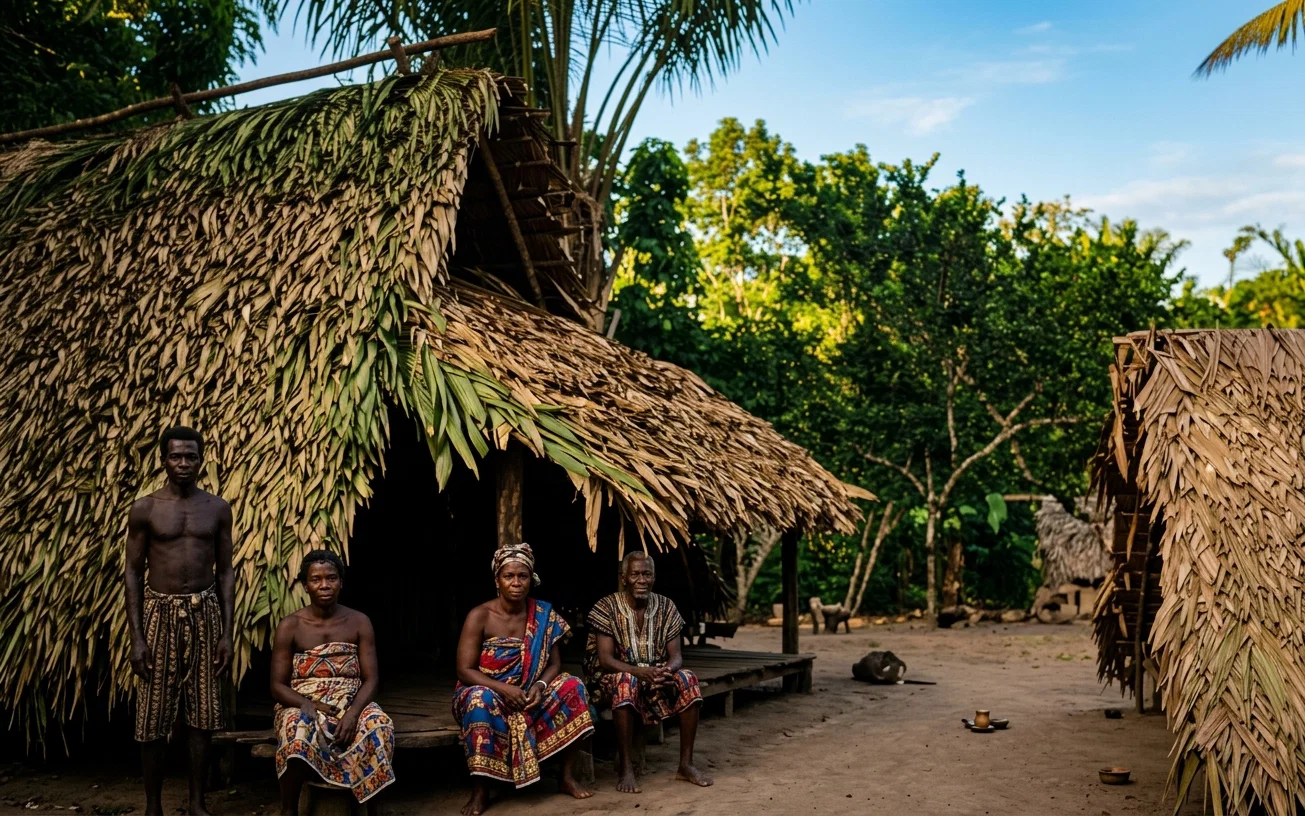
BUSH NEGRO VILLAGE
BUSH NEGRO VILLAGE
They have a well-established mission in the city of Paramaribo, carrying on all kinds of trade and manufacture that are found there. As I visited each department with the bishop, I could see that they were all attended with prosperity. They seem to be an earnest, sincere people, sacrificing talents and means for the advancement of the kingdom of God.
I also visited several other ministers, and a number of prominent business men in the city, and, strange to say, the majority of them gave us a hearty invitation to open up our work in that colony. About two years ago I formed the acquaintance of Dr. Bradley, from the United States, a manager of one of the gold placers. The third day I was there, I hunted him up, and was gladly received by him. He urged me to come there and begin our work, and offered to take me on their steam launch into the interior, and provide me a comfortable place to stay and do missionary work while I remained in that section in which they were working. These gold placers are largely worked by the bush negroes.
These negroes are a wild people, numbering from twelve to fifteen thousand, and living wholly in the interior. They were formerly slaves brought to this colony by the Portuguese; but when their tax gatherers went along the coast gathering taxes, the Portuguese sent their slaves into the interior until the tax gatherers had passed, expecting them to return when they were called upon. But finding suitable localities in the interior, the slaves decided to remain there. When the emancipation proclamation was issued by the British government, some joined them from Barbados, and others from the near West Indies, so that now they are a strong and independent nation of themselves. They are not subject to the government of Dutch Guiana, but maintain a government of their own. They have all the original customs and habits of the Congo nation, and speak the original tongue. They also use a little Dutch and French mixed.
I visited a company of these people, and through an interpreter laid before them, to some extent, our plans of labor. It seemed indeed strange to stand before a people of whom I had read much in the life of David Livingstone, and see them in their natural African element, tattooed over the greater part of their bodies and faces, with brass bands around their arms and legs. Physically, they are the strongest nation I have ever met. There is a longing desire in their hearts to have their children educated; and they made an earnest appeal to me to send a teacher among them. My heart almost melted within me as I realized our lack of facilities for carrying the last message of mercy to this people. And when I contemplate the situation of affairs in this colony, with so many different peoples to whom the message must be carried, I can only ask the Lord to help us to reveal to them the mystery of godliness. There are Japanese, Javanese, Chinese, Assyrians, Germans, Italians, etc. Representatives of almost every nation may be seen walking up and down the streets of this city. It seemed marvelous to me, as I met the different nationalities, how the Lord opened the way for me to converse with many of them; and I explained to them, to some extent at least, the message that God has given us for the world. There was a friendly disposition manifested by all, and it seems to me that there never was a time when the message of truth could be carried to this people with more success than at the present time. One gentleman, a native of the place, who had traveled extensively in the United States, and had returned and located a cocoa plantation up the Surinam River, gave me an urgent invitation to send workers there soon.
There are tribes of Indians living in the interior of Dutch and French Guiana, that are not found near the Venezuelan territory. Their habits of life are somewhat different from those of the Indians found along the coast of British Guiana. They are wild in their nature, and savage in their disposition; yet they are becoming more and more susceptible to the influences of the white race, and it is to be hoped that the gospel of Christ may soon be carried to them.
While visiting the wild bush negroes, I had the opportunity of seeing them in their morning worship. When I came upon them, they were offering sacrifice to their god. A little pole was inserted in the ground, and upon it hung a white flag. Beneath this flag was a small vessel, into which they poured rum until it was full, the priest all the time going through a ceremony. He then took the vessel, and poured out its contents upon the ground. Again he would fill it, and go through the same ceremony, until all the rum was used. He then told the worshipers that if they would take the sand upon which the rum was poured, and make a cross upon the top of their feet, and rub it on the soles of their feet, it would protect them in walking, and they would never slip when crossing the falls. It seemed indeed sad to see them come so solemnly to perform the ceremony, and then go away muttering something to their god.
What a different state of affairs our laborers have to meet in the United States, where but few deny the existence of the Son of God! When the worship was finished, I stepped forward and offered my hand to the priest, and through an interpreter entered into conversation with him. He seemed willing to listen to me, and after a short conversation, I desired to have his company stand where I could get a picture of them. He readily consented; but when I got them in the proper position and opened up the camera, the captain himself became frightened, and soon the people were going in every direction. I again ventured to go among them, and engaged in conversation with them; and after talking a while, two of them desired baptism. I presented to them the necessity of fully accepting Christ before they could be baptized, and showed them that a change of life, by the giving up of rum and their forms of worship, was essential before baptism. We have a brother in Dutch Guiana who speaks their language, and he has kindly offered to go with me to the homes of this people in the forest and labor with them for a time. It is considered by many as dangerous, as many who go among them never return. But I believe that if careful labor is done for them, God will openthe way, and many will be brought to the light of his truth.
Paramaribo is beautifully situated on the left bank of the Surinam River, just above the mouth of the Saramacca. The city is laid out in squares, with the markets well arranged. Although the streets are not so well kept, there was one feature that greatly pleased me, and that was the cleanliness about the dwellings. Even the small huts in which the negroes live were cleanly kept. The houses are all painted white, and with tropical plants of every description, set in many different forms, present a beautiful appearance. The population of the city is about forty thousand. The ground gradually rises from the sea-coast to the city. The government buildings are so situated that to one going up the river to the port they present a striking appearance. The river's edge is lined with the almond tree, which, with the beautiful green grass, closely cut, and the white buildings standing a little distance from the shore, presents a feature that will ever be remembered by one visiting the capital of Surinam. The people generally enjoy good health, except when such epidemics as yellow fever and smallpox visit them.
We now have one laborer in this field, canvassing for our books. My prayer is that God will open the way for some one who can speak the Dutch language to enter this city and publicly present the truth to the people, that they may hear the message for this time.
Georgetown, British Guiana.