Ripe to the Harvest

8%

Seventh-day Adventist Publishing Association · Battle Creek, Mich. · Feb 24, 1903

FromReview and Herald, Vol. 80, No. 8.

Read the full edition

Ripe to the Harvest

A. G. BODWELL
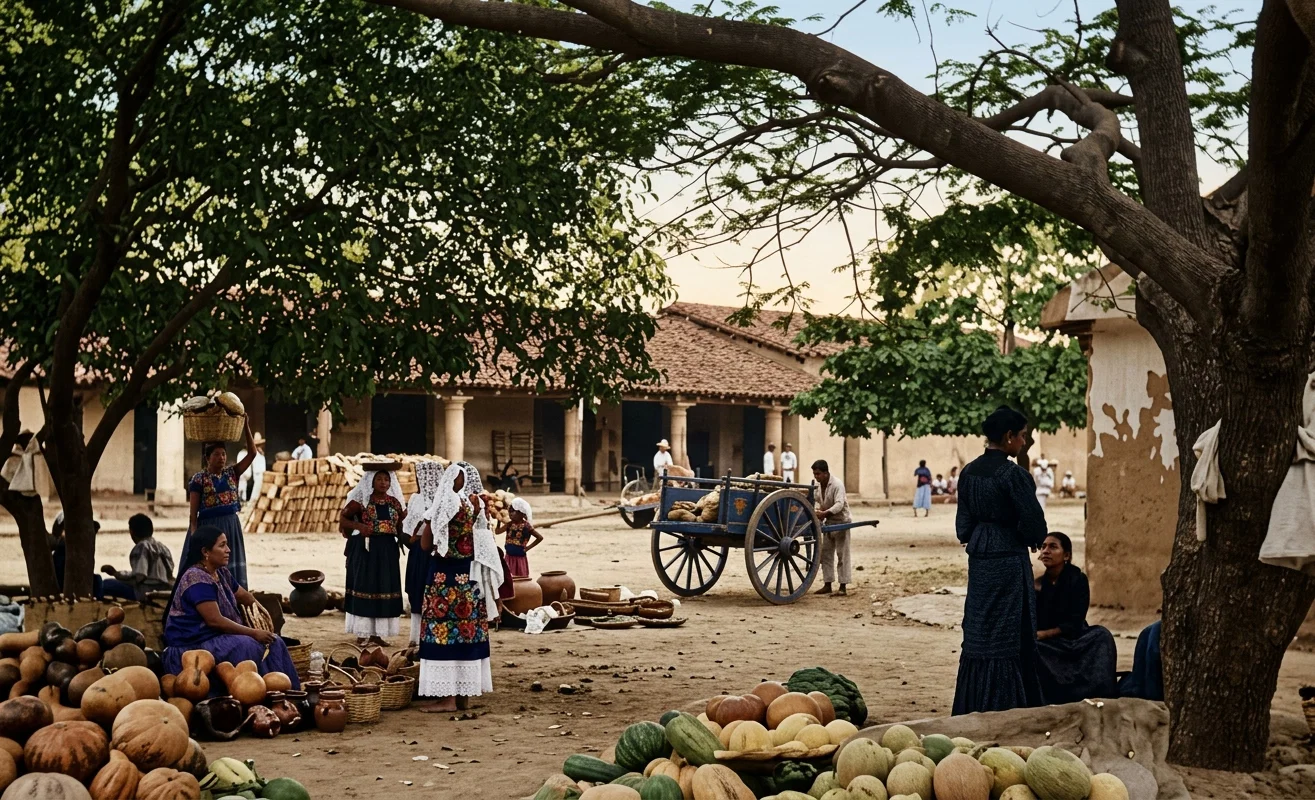
THE city of Tehuantepec is situated on a beautiful river. It contains about thirty or thirty-five thousand inhabitants, most of whom are Zapotecan Indians. They are above the average natives, and are very intelligent and thrifty. The fine physique which many of them have impressed me. I think that due largely to the kind of bread they eat, and to their habits of cleanliness. Most of them bathe in the river once or twice a day, and some of them oftener than this.
OUTSIDE THE MARKET HOUSE, TEHUANTEPEC
Their bread is toasted tortillas. These are made differently from the tortillas of any other part of the republic. The Indians take shelled corn and boil it until it is soft and tender. It is then placed upon a metate (a kind of granite stone, upon which they grind their corn). A rolling-pin of the same material is used, and the corn is rolled over and over on this stone until it is ground into a very fine dough. The tortillas are then rolled out, resembling pancakes in appearance. For cooking these a large earthen vessel is sunk in the ground, and a fire is built in it. When there is a good live bed of coals, the tortillas are placed upon them, the top of the vessel is closed, and they are left until cooked thoroughly. When taken out, they are well browned all the way through, and are quite crisp. They are very delicious and nutritive.
Many of these people live in the towns and the country between Tehuantepec and Oaxaca on the north, and between Tehuantepec and Tonala on the south. A man who has been a Bible colporteur in Mexico for twelve years, and has traveled all over the republic, told me that this was the ripest field of which he knew anywhere in the republic. About two or three years ago he was in Tehuantepec, and almost literally sowed it with Bibles and Testaments. And they have done a good work; for the power of the priests has been broken, to a large extent. The people seem to be very anxious to know what is truth. Most of those living in Tehuantepec speak the Spanish language, but in some of the smaller towns the women do not speak anything but the Zapotecan.
Persons coming here to labor will find drawbacks, as well as in other places. But if the right ones come, success will attend their labors; for if we are led by the Spirit of God, there is no such thing as failure, because the Lord does not fail.
Sometimes there is yellow fever in Tehuantepec. But I think that no one who lives in harmony with the laws of health need fear the fever. During the sickly season those who prefer to do so could live in one of the small towns near by where there is no fever.
There is a beautiful strip of well-watered country between Tehuantepec and Tonala, and land can be bought for from one dollar an acre up. In one of these little towns the judge offered me the building that corresponds to the county court-house in the States, in which to hold meetings. In this same town I met an Indian woman who had procured a Bible from some one passing through the country about eight years before. I tried to obtain her subscription for our paper, but she said that she had no time to read anything but the Bible, and that she kept it near her so that when she stopped to rest, she could read it. She further said that as far as she knew how, she tried to live according to its teaching. It was wonderful to see the truths that she had learned from the Bible, especially in regard to the second coming of Christ. I told her that she needed the paper to explain the Bible to her; but she said that was not necessary, as one part of the Bible explained the other. I gave her a Bible reading upon the Sabbath question, which she seemed to drink in with delight. I also gave her some tracts, and showed her how to study them in connection with her Bible.
I think that meetings could be held in Tehuantepec with perfect freedom. In the few days that I was there, I obtained forty-four paid subscriptions for our paper, sold one hundred and eighty-eight papers, thirty copies of “Steps to Christ,” eighteen of “Christ Our Saviour,” one of “Patriarchs and Prophets,” twenty-four Bibles, and ten Testaments. The last full day that I worked I received $30.56 from cash sales and subscriptions. The town was barely touched, as far as canvassing goes.
A person could obtain enough English pupils to earn a good living, I think. But it is no place for those who are not willing to do hard work. The thing that each one should know for himself is where the Lord would have him labor. And if the Lord directs to a certain field, he need have no fear in going to that field to labor; for the Lord will never leave those who trust in him.
I met a man here who had a Bible, and sold him “Patriarchs and Prophets,” “Christ’s Object Lessons,” and “Steps to Christ,” and took his subscription for the paper. Before leaving him, he said: “Will you send some one to teach my people the gospel? If you will, I will teach him my language, so that he can teach the gospel to my people.” He tried to get me to promise to send some one, but I told him I could not, but that I would tell my people of his request. These people must have the message, and who will give it to them remains to be seen. That God may impress some one to come to this needy field without delay, is the sincere desire of my heart.
Mexico City.