That he might become more fully acquainted with the lay of the country, I accompanied Elder Wakeham to Upper Egypt, November 12. Our first stop was at Assiut, the leading city of Upper Egypt, with a population of about fifty thousand, where the American Presbyterian Mission had its headquarters. Their work is chiefly among the Copts, for whom they have labored many years. In this field they now have one hundred stations, twenty-six churches, and ninety-seven schools. We were very kindly received by Dr. Alexander, formerly of Ohio, who is at the head of their school. There are several hundred students attending their large college here. We visited some of the classes, many of which are taught by American teachers.
PRESBYTERIAN MISSION COLLEGE BUILDING, ASSIUT
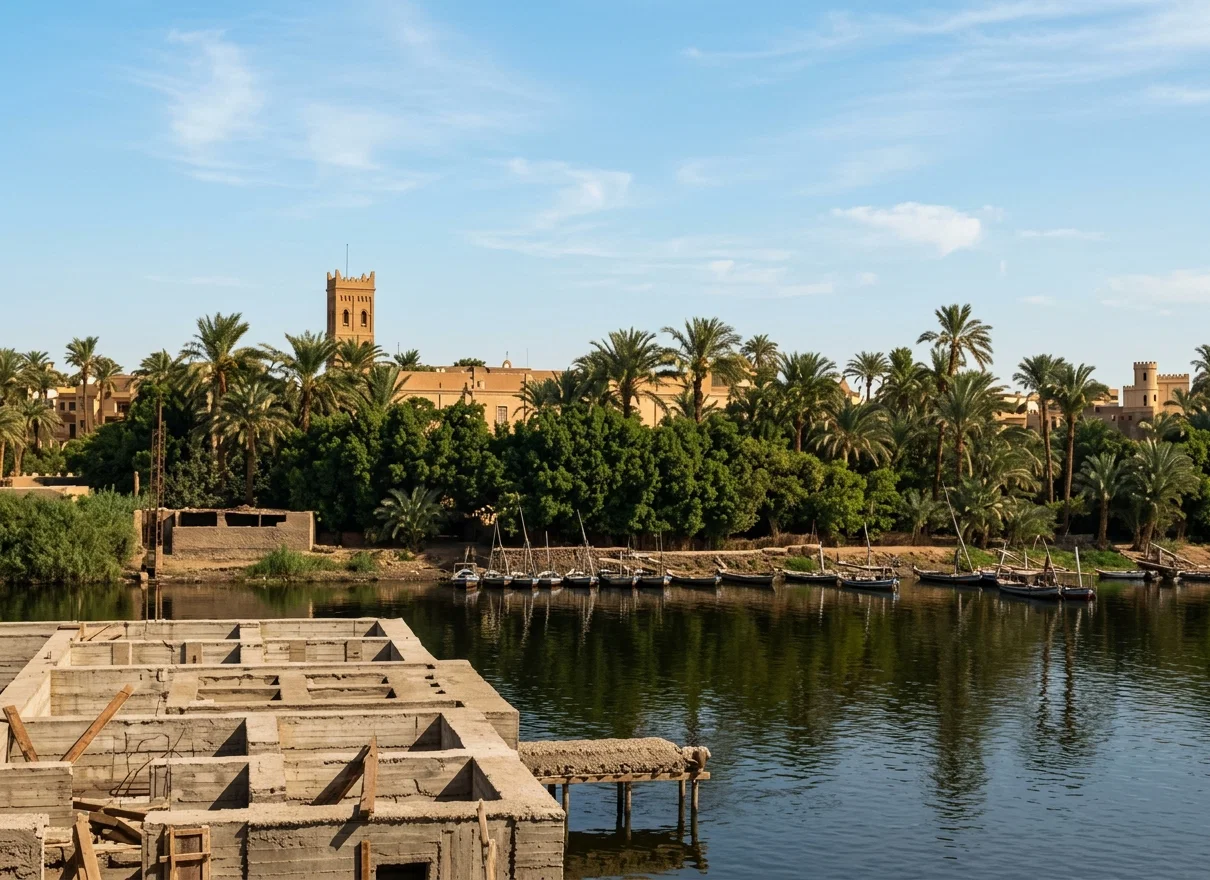
The accompanying illustration is made from a view taken across the channel of the Nile. Among the palm trees may be seen the main college building; it can be identified by the tower rising above the surrounding villas. The building in the process of construction, in front, was begun by a wealthy gentleman, but after spending thousands of dollars in excavating, and laying the foundation, he died, and the building stands unfinished, much to the satisfaction of the hospital authorities, who are thus spared an unpleasant neighbor. We visited the hospital, and were cordially received by the matron, Sister Dorcas, an American lady who had been with the institution from the very beginning.
She related to us many interesting and valuable facts about their work. At the time, their head physician was ill, but we formed the acquaintance of two young American doctors connected with the institution. We found one of them very busy in the free dispensary, which is open an hour or an hour and a half, daily, when he frequently treats as many as sixty cases, mostly persons suffering with sore eyes. They all seemed glad to know that we, too, contemplated doing medical missionary work, and we felt thankful that Dr. Keichline, whose traveling expenses have been furnished by the Young People's Society, and whom we had invited to come to Egypt at once, would soon be with our little band of workers in this great field, to further assist in this important branch of the message. They wished us Godspeed in our work, and we, in turn, hoped that God would bless their efforts to help their fellow men.
From here we went to the new dam across the Nile. It consists of eight piers, the first and the last having three arches and a lock, while the other six have nine arches. Every arch can be closed by an iron lock, so that the whole river may be dammed up, and a good part of it can be diverted into different channels to water several provinces. But a still greater work is now being dedicated at Assuan, in the neighborhood of the First Cataract of the Nile. This is the greatest dam in the world. It is constructed of solid granite blocks. It is more than 6,400 feet long, by 88 feet wide, and 100 feet high. The water can be dammed up to a depth of 65 feet. There are 180 locks in the dam, and it cost $10,000,000.
Proceeding, we visited the home of Elder Awada, in Luxor. This city contains thirteen thousand inhabitants, three thousand of whom are Copts. Luxor, with Karnak a little to the north, and Thebes across the Nile, was the scene of the grandest work of the Pharaohs; and even to this day, there is no other building in the world that will compare with it in grandeur. The Bible mentions this ancient city under the name of No Amon (Nahum 3: 8), where the attention of Nineveh is directed to the fate of this “populous” city, situated on the channels of the Nile, whose strength was Ethiopia and Egypt, and whose helpers were Put and Lubim; and “yet was she carried away, she went into captivity,” and was utterly destroyed. The mighty ruins of this city testify to the truthfulness of this prophecy, as well as to the words found in Jer. 46: 25 and Eze. 30: 14-16. God has indeed executed his judgments in No, and against its temples, which were wholly dedicated to the worship of the sun. We were glad indeed that while these ancient cities mentioned in the Word of God are in ruins, yet there are some honest ones near them, whose ears are open to present truth. Since my visit here last year, Elder Awada has had the joy of baptizing his own companion, and some of his relatives attended our Bible study there during the Sabbath.
While at Karnak, we saw the monument of victory erected by Shishak (1 Kings 14: 25) in commemoration of the defeat Rehoboam, king of Jerusalem, suffered at his hands. The monument shows Ammon, with his sword in his right hand, leading five rows of conquered cities with his left hand, typified by a ring and a prisoner, whose face very plainly reveals Israelitish features. Some of the names of the cities can still be identified. Thus these dumb stones testify to the truthfulness of the Word of God.
On Sunday we crossed the Nile to Thebes, the necropolis of ancient Egypt. Elder Awada had formerly been pastor of a company of Copts, who had united with the Presbyterian Church (there were about twenty in the company); and as we called upon them, they received us very kindly, and furnished us donkeys to go farther across the plain, up to the mountains where the elder of the company lived. They at once arranged for a meeting in the courtyard, and it was quite an interesting sight to see a number of men sitting down on the floor of the courtyard, while the women remained in the adjoining apartments, listening to the truths of the third angel's message. The old gentleman, who was glad to meet me again, charged me before I began the service, that I should present to them the Word of God, giving them his message for this time.11Elder Awada translated my words from English into Arabic. I improved a part of the forenoon and afternoon in presenting the solemn truths for our day, and all seemed grateful for the privilege of listening to them. I believe that the seed sown will spring up in the near future. We also called upon several at their homes, and enjoyed their hospitality, and at the same time visited the ruins of the temples in the neighborhood.
FREE CLINIC (PRESBYTERIAN), ASSIUT
Next morning we rode on donkeys away around the mountains, through a dreary waste of country, to see the sepulchers of the kings at Biban-el-Muluk, where the yellow-colored rocks narrow the valley down to a mere point. A terrible loneliness pervades this whole region, and it is unlike anything else in the Nile Valley. All life seems to be extinct. As we come up to the mighty rocks, we can perceive, here and there, a number of small openings . Anciently, these were closed up. These are the entrances to the sepulchers of the kings, and have been discovered within a few years. Up to date, no less than forty-one have been found. Although the Pharaohs dug hundreds of feet into the solid rock that they might secure a safe burial place for their bodies, yet it was all in vain; for robbers gained access to these tombs, and modern scientists are discovering the most hidden places; and while some rested safely for thousands of years in their dark, unknown sepulchers, laboriously cut out in the hard rock, to-day these tombs are being opened, and some of them are even lighted with electricity. These sepulchers date from the time of the Pharaohs, 1500-1100 B. C., during the rule of the eighteenth to the twentieth dynasties. On the other side of the mountains are the great temples, built in honor of the dead.
We again returned to Cairo, where we spent a few more days together.
I originally planned to visit Palestine, Syria, and Constantinople, but the latest reports in the newspapers, and letters from our brethren, were of such a nature that I felt it unwise to attempt such a journey at that time. Not only was there a ten days' quarantine against all boats from Egypt, but, as the cholera had entered Palestine, there was a state of quarantine in the different towns. For several weeks the railway connecting Joppa and Jerusalem was not in operation, and there was five days' quarantine between the two cities, so that if one entered the country, after passing a two weeks' quarantine, he might spend almost as long a time in trying to get a steamer for the outgoing voyage. The cholera had decimated the population in the ancient land of the Philistines, around Gaza, and had also made its appearance in Joppa. Brother Jespersson, of Jerusalem, wrote me that this had naturally made hard times for them. No tourists whatever were visiting Palestine, and on account of the quarantine, their supplies were cut off to a greater or less degree, so that the expense of living was rather high. On the other hand, fruit could not be transported to Egypt as usual, so it was rather high priced. These things show us the difficulties we shall have to encounter when pestilence and plagues multiply upon the earth.
Under the circumstances, we thought it best to leave Sister Weidmann at Cairo, until the quarantine would be lessened, so she could go on to Palestine; but as soon as I reached Germany again, I was informed by the brethren in Basel, that they had received a telegram stating that she was dying. A letter by Elder Wakeham, a few days later, confirmed her death. She passed away with inflammation of the bowels. Our medical missionaries in Palestine had long desired help, and we were so glad to think that it was soon to be provided. While we may not understand the dispensations of providence in removing faithful workers as they are just entering their field, yet, on the other hand, we know that when such workers pass away at their post of duty, their reward is assured them in the courts above, and that they will soon be clothed with immortal glory.