I. D. RICHARDSON

6%

Seventh-day Adventist Publishing Association · Battle Creek, Mich. · Nov 25, 1902

FromReview and Herald, Vol. 79, No. 47.

Read the full edition

I. D. RICHARDSON

Kashmir

I. D. RICHARDSON
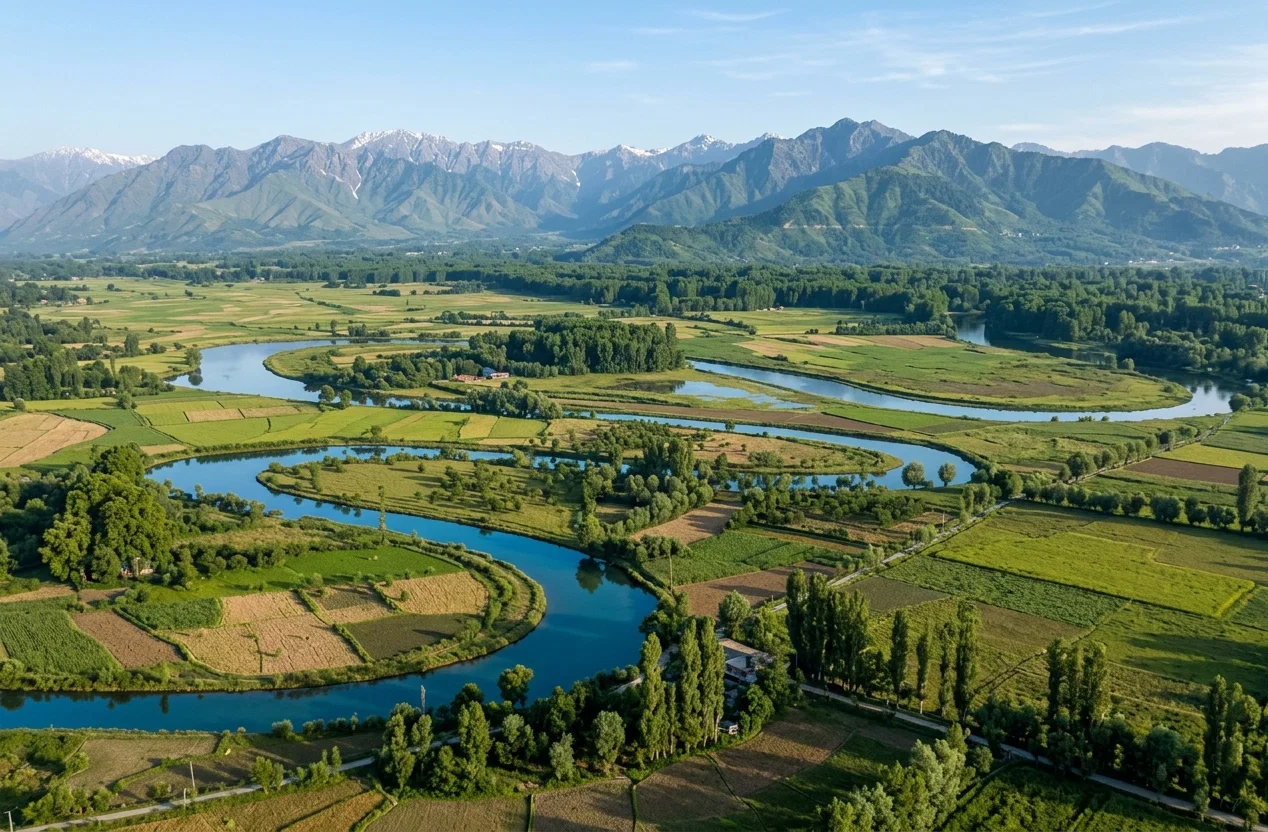
KASHMIR is a beautiful country far to the northwest of the Indian peninsula. One hundred miles beyond the Indian border is the attractive city of Srinagar, which lies at the eastern extremity of a beautiful table-land, thirty-two miles long and twenty miles wide, through which flows the Jhelam River. This table-land is five thousand feet in elevation, and surrounded by mountains from six thousand to nine thousand feet high.
To reach the plains of Kashmir we pass over a range of mountains having an altitude of nine thousand feet, down into the valley of the Jhelam River, then across the line into Kashmir; there we follow the river over the cascades toward its source, which is beyond the table-land in another range.
THE BEAUTIFUL VALE OF KASHMIR
At the entrance of the Kashmir plains we come out from behind a mountain, and a most charming scene lies before us. A row of beautiful poplar trees, tall and stately, stands horizontal to the road. Four or five trees are missing where the road passes through, which gives the appearance of entering through a wall into the country beyond. After passing this, as far as the eye can reach we see the trees on either side of the road only four or five feet apart. These extend thirty-two miles, to the city of Srinagar, which is the seat of the Kashmir government. In the city itself these trees are in perfect rows, forming avenues. There is another variety which adds greatly to the attractiveness of the place—the beautiful chinar trees. These trees very closely resemble our maple, only the leaves are much larger and the foliage more dense, while the trunk is from five to seven feet in diameter.
The dwellings in Srinagar are not numerous, as the city is located on the Jhelam River, and is surrounded by a number of beautiful lakes, so that visitors usually prefer to live in house-boats or tents rather than in houses. Each house-boat has a small rowboat, which is generally propelled by three or four men, and thus one can go about the place by water, or out on the lakes when he chooses. When a boat dweller gets tired of one place and its scenery, he can float away to another.
Goolmerg is another station, about thirty miles away, in a much higher altitude, having an elevation of eight thousand feet. To this place visitors resort when it becomes too warm in Srinagar, living in tents, and spending much of their time in hunting such wild game as is found in these mountains.
The country of Kashmir is famous for its beautiful scenery. Many of the officials of the British Indian government spend the hot months of June, July, and August in this delightful climate, to get out of the “oven,” as the plains of India are called, where, about the middle of June, the mercury often rises to one hundred and fifty degrees in the sun.
The country is governed by a maharaja (native king) and his brother, who is also a rajah, or chief. A British resident in Srinagar represents the British Indian government. Besides other visitors, those among the missionaries who can afford it, retire to this delightful place where the temperature seldom exceeds ninety degrees, to gain a little relief from the hot plains below.
Having learned that there were many Europeans in Kashmir during the hot season, as well as a few who made it their home, I thought it might be a good place in which to spend a few weeks selling our publications. So, as the hot season on the plains advanced, and my territory there was pretty well canvassed and books delivered, I secured the cheapest tonga passage, and set out for Kashmir, a distance of two hundred miles from Rawalpindi, where I was then stopping. Over the rocky steeps we rode for two long days.
The conveyance called a tonga is a two-wheeled, two-seated cart-like vehicle, with a strong canvas top, to protect from sun and rain. The seats are cushioned, and have comfortable backs, or rather, a comfortable back, as the seats are joined, one facing forward and the other backward, one back serving for both. This carries three passengers and the driver. It is drawn by two small horses, which are exchanged for a fresh team every four or six miles. In this way we travel quite rapidly all day.
Upon landing in Srinagar, I found a crowd of men awaiting the arrival of the tonga, and each one wanted me to hire his boat. After some discussion, I took a small house-boat, or donga, with four men, giving them six dollars for one month. One of the men did my cooking and looked after things in general, while the other three rowed me about wherever I wished to go. However, I did not spend much time at first looking around, as I was anxious to visit the people with the books, “Great Controversy,” “Patriarchs and Prophets,” “Ladies’ Guide,” and “Man the Masterpiece.” I soon discovered that there were fewer Europeans in the city than I had supposed, so it was not long until I had visited them all. Then, while waiting a few days for the arrival of the books for which orders had been taken, I thought it would be well to look about and see what the prospects were for doing work among the natives.
Upon inquiry I found that they were quite a sturdy class of people, firmly settled in their own religion, and desiring no other; yet occasionally one is brought to acknowledge and obey the true God as fully as he is taught by the missionary. These people are of a reflective nature, and desire a clear and complete reason that Christianity is the true religion. Who is better able to give this reason than the people who believe in the soon return of the Christian’s Prophet? There is nothing more convincing that Jesus is the true Prophet and Saviour of the world than are the prophecies of Christ relative to the things which are occurring in the world to-day. The people of this far-away land see what is taking place, and wonder what it all means. Now is the time to sow the seed in Kashmir, before the great calamity of war reaches that place, as well as other Eastern countries.
This is a good field for many all-round workers, especially medical workers, since about the only way we can reach the hearts of the people is by ministering to their physical needs. While in this place I was invited by Dr. Neaves to visit a hospital which he and his brother, also a physician, had established, solely for the natives. The hospital is quite extensive, and many hundreds have beentreated, and some converted. These physicians are Church of England missionaries, and they told me that their hospital was the only one for many miles around, and probably the only one in the country, as the people came scores of miles to receive treatment. So there is room for more workers here. The climate being very temperate, and the needs very great in this place, there surely should be some one whom God is calling to Kashmir, for the sake of those for whom Jesus died who are willing to obey when taught.
May the Lord of the harvest send forth more laborers into the far East. As God calls for volunteers, may he hear many say, “Here am I; send me.”