But little or nothing had ever been done for the aboriginal Indians of British Guiana until about the year 1843, when one John Meyer, with his faithful wife and two children, who had come from Switzerland to this colony and begun work among the black people in the year 1840, visited them, and began to work for them. He settled upon the west shore of the Demerara River, near Georgetown, and began his work among the creoles by starting a school. His efforts were quite successful, and many were truly converted to the Lord, and were taught to read and write the English language.
In visiting the Essequibo district at Taymouth Manor and other places, his attention was called to the sad condition of the aboriginal Indians of the colony. Being a man full of zeal and the Spirit of the Lord, he determined to carry the gospel of Christ to this people. His first work was to educate the youth. It is evident to one who reads the life of this man that the Lord was with him. He carried in his pocket a little pass book, in which he noted each Indian word given to him, and its meaning in English. By a determined effort on his part, he soon acquired enough of the Arawak language to be able to speak to them in their own tongue.
Learning that the Arawaks had settlements on the banks of Lake Tapicooma, he visited them, with the desire of laying before them the great plan of salvation. He found several small companies, a few of whom understood a little English, especially the chief and his sister. The chief permitted his son and another lad to return home with Meyer, in order to attend his school. Week after week he visited these companies of Indians, and soon led a number of them to accept Christ. The Lord worked mightily with him.
Ministers of other denominations, seeing that he was successful in his efforts, went among the Indians, and, as the Pharisees did concerning Christ, intimated that he was doing his work without any authority. I quote the following from “Among the Indians of British Guiana,” by Leonard Strong, referring to one of the ministers of this class:—
“The following questions were asked: ‘By whose authority does he preach? What has he yet done for you? Has he made you Christians? Are you baptized yet after all his teaching?’ and added, ‘Now, if you come to me, if you learn to repeat what I teach, you shall be baptized and made Christians; I shall then baptize your children also, and join you to your wives according to law, and you will all be good Christians.’” How sad to know that such persuasion was effected upon these poor people! Thus gradually they lost the real, living truth of Christ, and rested upon forms and ceremonies.
Becoming somewhat discouraged with his missionary effort in the Essequibo district, he decided to find other places of labor, where no one, for a time at least, could disturb him in his efforts. But Satan is ever on the track of those who are endeavoring to bring the rays of light to perishing souls; and thus the work of John Meyer was many times retarded by the great arch-deceiver. He was successful in teaching the ways of Christ to a company in the head waters of the Mahaica Creek.
Soon after this he traveled up the Demerara River, holding meetings at different places, and speaking to the natives in their own tongue. He went far above the falls, into the savannas, and there preached Christ, and thus left many who were truly converted to the Lord. The companion who accompanied him from Georgetown to the savannas soon returned, and John Meyer was left to carry out the desire of his heart—to bring the message of truth to these red men of the forest. He shortly gathered quite a company together, and after living for some time among them, decided to go through the forests, from the Demerara districts to Berbice.
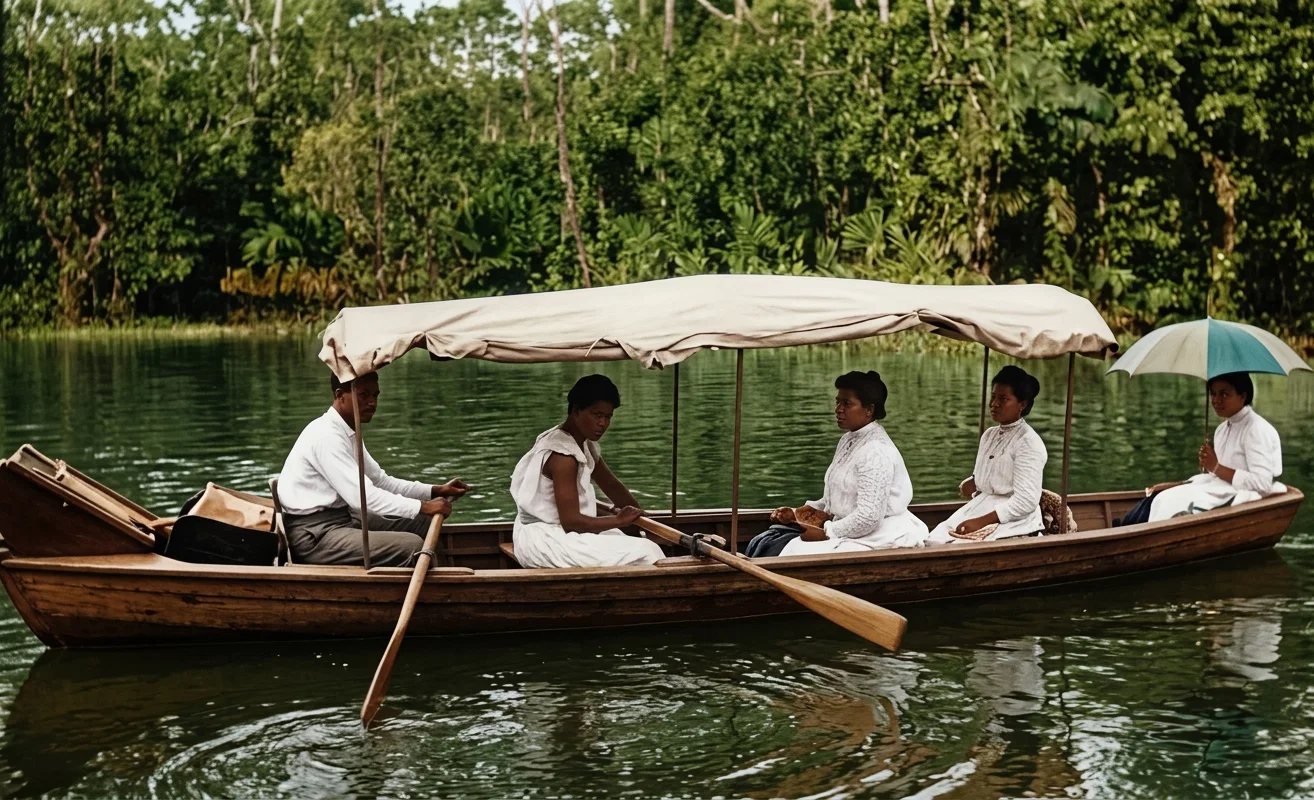
TRAVELING IN BRITISH GUIANA
The Indians accompanied him, and in three days they reached an Indian village on the Berbice River, called Kumaka, where many Indians had collected for a feast. While they remained there to take a few days’ rest after the feast was over, John Meyer made it his opportunity to preach the gospel to them. He first formed the acquaintance of the leading Indian of the village, who went among them, telling them that a white man had come with a message from the Lord. Although the Indians are a very timid people, yet it is customary for all to shake hands with a missionary. Mothers with children in their arms would take the hands of the little ones and put them into the hand of the brother, to express their thankfulness that God had sent him.
Accepting the offer of a lad who was going down the river in a batteau, he decided to return home by way of New Amsterdam. By this he was conveyed to a wood-cutting settlement, a few miles below the Kumaka village, where a white man, with many blacks and a few Indians, resided. I will again quote the words of Leonard Strong in describing a wonderful experience he had:—
“The white man showed him that if he took a batteau from thence, the river was so circuitous that, after paddling many miles, he would reach a small settlement only three miles from where he then was; he advised him therefore to walk these three miles through the forest, and there seek assistance to proceed farther down. To this Meyer agreed, and the white man, conducting him to a path which led into the wood, directed him carefully to follow it, and then left him to walk on alone. This the Indians had never done, knowing how very difficult it is for a stranger to keep the track.”
“Meyer, with his hammock and pack on his shoulders, walked on, but soon must have left the path and wandered from the right course; indeed, he acknowledged that more than once he came upon his own steps again. It is exceedingly difficult, if once you deviate from the faint break in these unfrequented forests, to recover it again, while the lofty trees so obscure the light of the sun that it is impossible to correct your course by that. He walked with little intermission the whole of that day; when the sun set, he hung up his hammock to the trees, and fell in that to sleep. At morning light he sought direction from the Lord, and pursued his journey, literally not knowing whither he went, without food or water. In the afternoon he came upon two pineapples, which he ate, as also many berries. As the shades of night closed in around him again, he swung his hammock to the trees, and commending himself to the Lord who bought him, slept till morning. At break of day he cried unto the Lord for help, and besought him not to let him die in the forest thus, if his death should discourage or stumble others and cause them to think his humble mission to the Indians had not been of him, or for his name. He then set forth again, looking to the Lord for guidance, and in the afternoon, to his great joy, lighted upon the bank of a small creek or river, where also he discovered recent traces of people, and remains of a fire.”
“Here, then, being very faint, leaves and berries his only food, he determined to remain, as, if he died here, his body was sure of being one day found, and, taking out his writing materials, he wrote down a journal of all that had happened, giving a full account of himself, with directions to whom all his papers and effects were to be conveyed. Then he hung up his hammock, and thus ended the third day, when, exceedingly happy in the Lord, though hungry and faint in body, Jesus gave his beloved sleep. The whole of the next day he lived principally on leaves, being afraid to search for berries in the wood lest he should lose his way, and his body lie concealed in the forest; for he thought it his duty to arrange if possible that his body and papers might be found, for the satisfaction of his wife and brethren. On the morning of the fifth15day he was too weak to leave his hammock or to gather leaves; persuaded that his hour was now come to die, he commended his spirit to him who had loved him and given himself for him, who had given unto him eternal life, and would raise his body at the last day; he felt that he had life in him who was risen from the dead.”
“While thus reposing his soul by faith in Jesus’ bosom, he heard the report of a gun; he listened awhile, when he heard the sound of voices on the water; raising himself in his hammock, he perceived on the creek a canoe full of Indians approaching; he then, gathering all his remaining strength, shouted and waved his hand; they came to the shore, and approached him in his hammock; he made the signs of hunger, and they brought from their canoe ready cooked fish for him to eat, from the creek also water to refresh his thirst.”
“Reviving a little, he told them his story, and how he was lost in the forest when seeking his way by the side of the river Berbice. They told him he had wandered far to the Abarry Creek, by the banks of which he then lay (this is the boundary between Demerara and Berbice counties); they then took him with all his things to their canoe, and conveyed him safely down the stream to their own village, where every attention was paid to him by their women to restore his strength, and where he remained all the next day. The following morning the Indians took him through an old canal into the Berbice River, and bringing him to a missionary station about ten miles from the town of New Amsterdam, left him with the missionary there.”
About the beginning of 1844, John Meyer moved with his family to a little village up the Berbice River by the name of Kumaka, where the Indians readily received them, and built them a home. John Meyer was a self-supporting missionary; but his arduous labors were made known to George Müller, of Bristol. He was many times assisted by this man of God. Once, when it seemed that they had eaten nearly the last morsel of bread, and starvation was about to stare them in the face, a messenger of God came to them bearing a bounty sent by George Müller. Thus he labored among these people until many of them accepted the gospel of Christ. And in after years, missionaries who have traveled through the section of country where Meyer labored find many red men who believe in the Lord and Saviour Jesus Christ.
There is a very interesting point to me in reading the record of his labors, and that is this: In the year 1844 a man, whose name is not given, went among the Indians on the savannas, far into the interior, and preached the coming of the Lord at hand. John Meyer labored against him, believing his doctrine to be fanaticism. It is evident, after reading all the connections and the manner in which this man labored, that he preached none other than the first angel’s message to these people.
Quite a number of missionary stations have been established among the Indians by the Anglicans, Methodists, and Roman Catholics. In a former article I referred to the labors of a Miss Austin, who has been very successful in teaching these people. She established the mission at Airy Hall more than forty years ago; and I find a large number of Indians scattered here and there who have been trained and taught in many respects the ways of the Lord by this woman. These people I find in most cases to be a straightforward, honest people. The Lord has surely blessed the labors of this sister; and I believe that in the kingdom of God we shall see the results of the efforts that she put forth.
We have only begun our work among this class of people, but the way is opening for us to establish missions among them; for quite often I find those keeping the Sabbath of whom I never had heard before.
May God help us to bring the precious rays of light to these benighted souls.