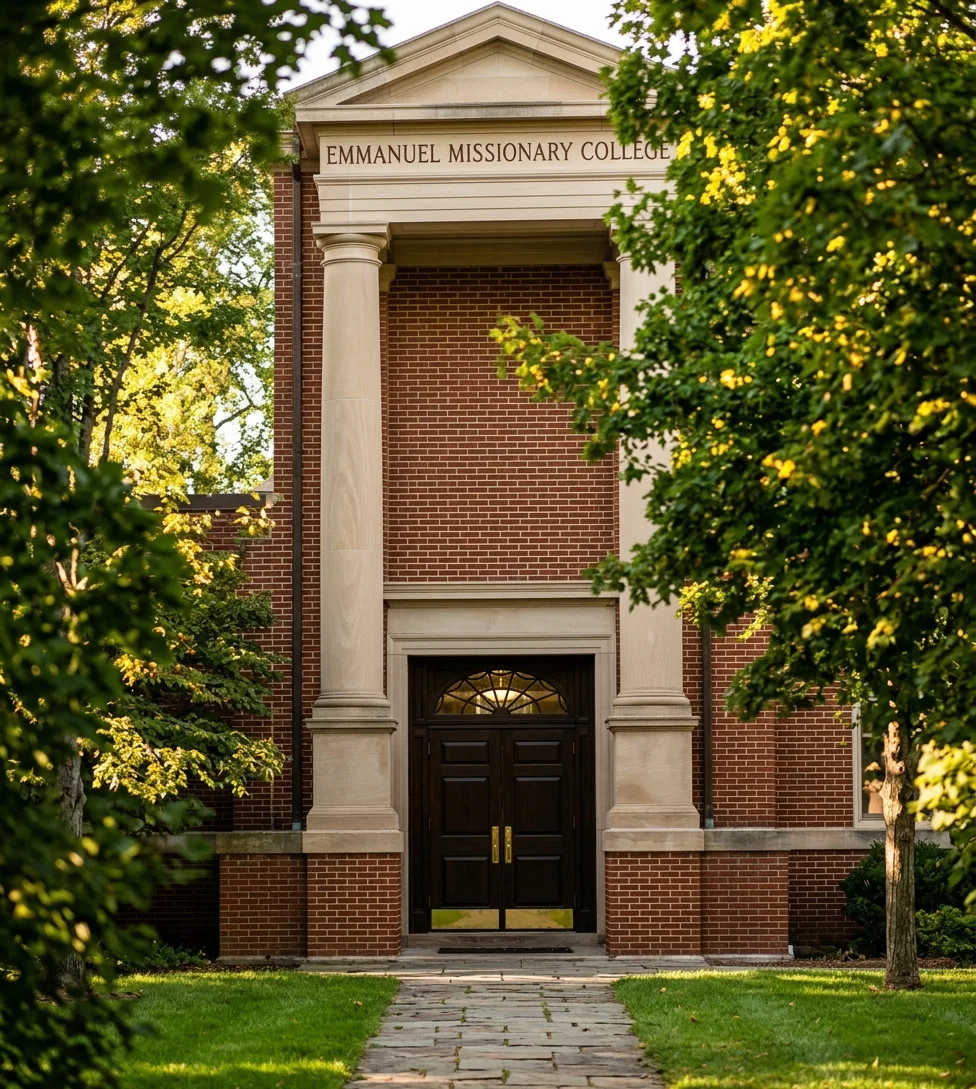
A REPORT of Emmanuel Missionary College necessarily embraces much more than the work done under the immediate supervision of the college faculty and possibly within the walls of the school buildings.
The system known as Christian education because of its breadth, includes schools of three grades,—schools where primary instruction is given to the children, intermediate industrial schools for youth, and training schools for mature students, preparing men and women for service in all departments of gospel work. The college is the center of such a system of affiliated schools, and from this center workers proceed to the other grades; the condition at this center affects materially the work done in the other schools, and a strong pulse here means healthy growth in all other parts. This is the position occupied by Emmanuel Missionary College.
Nearly thirty years ago the Seventh-day Adventist denomination founded its first school at Battle Creek, Mich. That college was established for the training of Christian workers. Owing to a combination of circumstances, that object was to a degree hidden from view. In order to return to the original plan, and more fully develop the principles of education underlying the growth of Protestantism, the location of the school was changed one year ago, and the name was changed to Emmanuel Missionary College.
The summer school for teachers held during the months of July and August, 1901, was the first work done after the changed location. As a result of that term's work, about sixty young people were added to the corps of church-school teachers.
The autumn of 1901 found the school without buildings, and it was counseled by some that it would be impracticable to attempt to conduct the class work for a year. Others, however, thought that to postpone the opening until the erection of buildings would prove disastrous to the interests of all concerned. Consequently, the fall term opened October 30, and the work of the year was carried on in rented buildings. In spite of apparent disadvantages, the attendance reached one hundred during the winter.
The plan of work was materially different from former years. It is the policy of the college to deal exclusively with mature students, who are Christians, and who desire special preparation for a definite line of evangelistic work. The fact that three intermediate industrial schools have already been established—one at Bethel, Wis., one at Sheridan, Ill., and a third at Cedar Lake, Mich.—has made it possible for the college to adhere closely to its policy concerning students. Those needing preparatory subjects are recommended to one of the intermediate schools. The consequence is that it is possible to conduct the class work of the college on the intensive plan. Students carry but one principal subject at a time. This requires vigorous application, and is a plan adapted only to mature minds. For those qualified to enter a training school, the plan has proved entirely satisfactory. The advantages over the ordinary plan are many: A subject requiring an entire year in any other school may here be finished in one term. Students unable to spend a year in school can in one term complete a definite amount of work. Teachers are able to carry on laboratory work, original research, or field work with an entire class without interfering with the class work of any other teacher. The correlation of related subjects becomes an easy problem.
In the erection of buildings, which has already begun, the principles underlying Christian education are closely followed. The spirit of consolidation and centralization so often followed in educational work is here counteracted. In place of large and costly buildings, which develop the institutional spirit, the new college buildings will be small and well scattered. The study hall will be a one-story building; the domestic arts building containing the dining hall, kitchen and serving rooms, has a second floor, which will be devoted to class work in cooking, sewing, and related subjects. The manual arts, such as carpentry, printing, agriculture, blacksmithing, etc., will receive attention equal to that shown any other class work. Suitable buildings will be erected for these departments.
The substitution of a number of small buildings, simple in construction, for a few large ones whose structure is complex, enables the management to follow the instruction given concerning the use of student labor. All buildings, from the study hall to the cottages for faculty and students, will be built by students, under the direction of competent overseers and instructors.
The Summer Assembly will this season be conducted in the fifty-acre grove on the college farm. But it is expected that at the opening of the fall term, work will begin in the new buildings.
There is a consistency about the plan and surroundings which appeals forcibly even to those unacquainted with our work. The beauty of the present location, with the variety of natural scenery presented by the river, the grove, the brook, springs, bluffs, and lowlands; the richness of the soil, and its adaptability to the purposes of an educational institution; the variety of buildings of moderate size, erected by students; the number of young men and women sent forth from the institution as active missionaries,—these things show unmistakably that God's plans of education, if followed, produce the strongest and best results.
The past year has been an eventful one; the future holds out many inducements. The college advocates universal free education, and it, with its affiliated schools, offers instruction from infancy to maturity. Its doors are open to all who are seeking a preparation for gospel work.