PRACTICAL HYDROTHERAPY

2%

Seventh-day Adventist Publishing Association · Battle Creek, Mich. · Mar 4, 1902

FromReview and Herald, Vol. 79, No. 9.

Read the full edition

PRACTICAL HYDROTHERAPY.

Lesson 3.—Some Principles of Physiology.
C. E. STEWART, M. D.
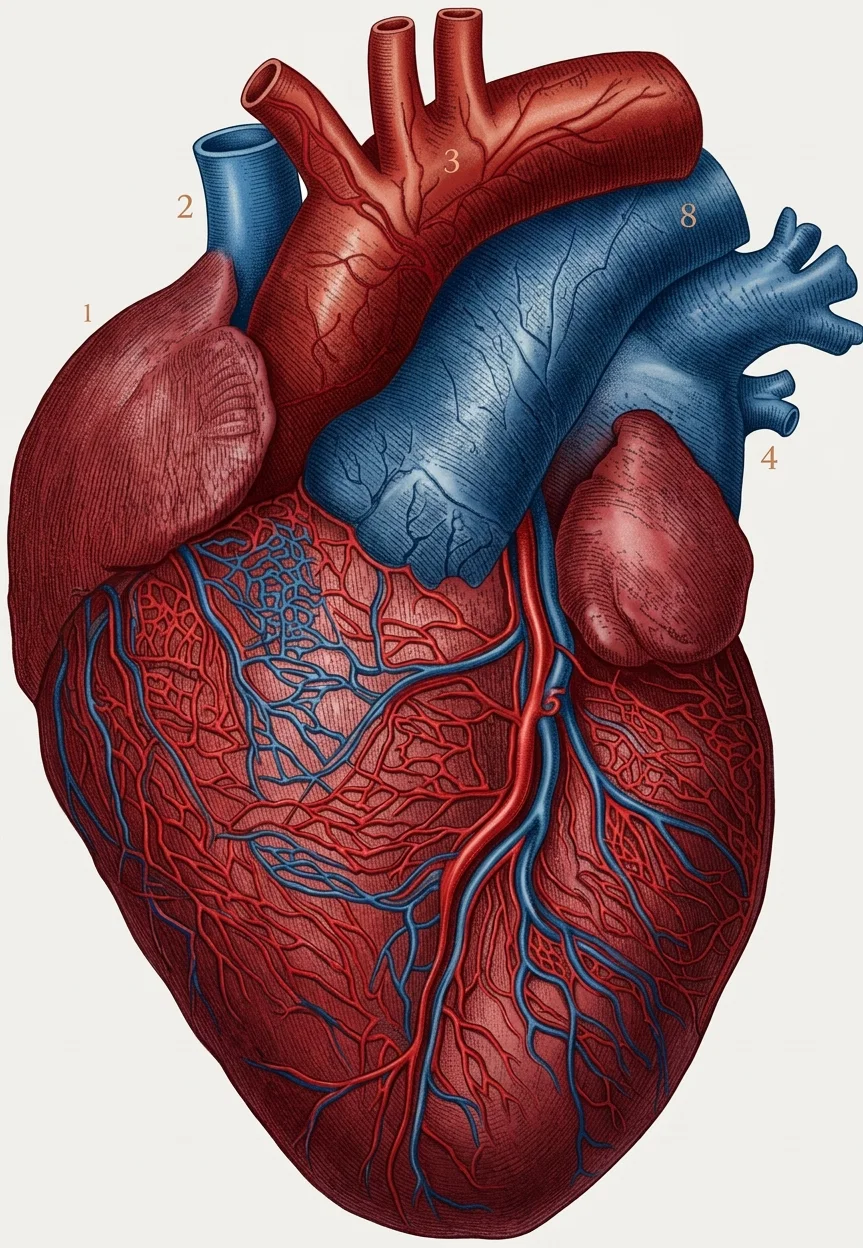
THE HEART. 1. RIGHT AURICLE. THE LEFT AURICLE IS IN THE CORRESPONDING POSITION ON THE OPPOSITE SIDE; 2. VENA CAVA; 3. AORTA; 4. PULMONARY VEINS; 8. PULMONARY ARTERY.
In this study we will consider briefly some of the principal facts pertaining to the anatomy and physiology of the circulatory systems. The circulatory system consists of a system of closed tubes through which the blood is forced by the heart is a conical-shaped, muscular organ, possessing four cavities—two auricles and two ventricles. The right auricle receives the venous, or impure, blood from the lower parts of the body, through the inferior vena cava, and from the upper parts through the superior vena cava.
While the venous blood is being collected in the right auricle, the arterial blood, which is being purified in the lungs by giving off the carbon dioxide it contains, and taking on the oxygen from the air, is being collected in the left auricle. When these two chambers are filled, they contract, and force their contents into the ventricles, the right forcing its contents through an opening between itself and its respective ventricle, the left acting in a similar manner. The openings are called the right auriculo-ventricular and the left auriculo-ventricular, and are closed by the tricuspid and mitral valves respectively. The simultaneous contraction of the auricles fills the right and left ventricles with venous and arterial blood. The right ventricle contains venous blood, and the left arterial blood. When the ventricles contract, the blood in them is prevented from escaping backward into the auricles by the closing of the valves guarding the openings.
The contraction of the ventricles forces the venous blood through a large vessel called the pulmonary artery to the lungs, to be purified, and the arterial blood through the aorta, which, by means of its many branches, carries blood to every part of the body, for its nourishment. These great vessels, which extend from the right and left ventricles of the heart, have valves at their orifices, which, by closing, prevent a return of the blood to the heart.
The blood vessels, like the heart, contain a considerable amount of involuntary muscular tissue, and in addition elastic tissue, both of which, by contracting, help to force the blood onward. The arteries become smaller and smaller as they extend farther from the heart, until they are only microscopic in size, and are so very thin that part of their contents passes through them into what is called the lymphatic circulation. Through the medium of the lymph, which is of practically the same composition as the blood, food material reaches the tissues. These very minute vessels, called capillaries, also collect the blood containing the impurities resulting from tissue activity and waste, and carry it to the veins, by means of which it is taken to the right auricle of the heart. It is impossible to tell just where the capillaries carrying arterial blood stop, and where those carrying venous blood start, because they are continuous. However, the capillary veins become larger and less numerous as they approach the heart, until finally there are but two large vessels—the superior and inferior venæ cavæ—carrying venous blood to the heart.
This whole system is under the control of the sympathetic nervous system, there being two kinds of nerves governing it; namely, the accelerator and inhibitory. When the inhibitory nerves are stimulated, the heart beats slower; when paralyzed, the heart beats faster. When the accelerator nerves are stimulated, the heart beats faster; when the accelerators are paralyzed, the heart beats slower, because the inhibitory nerves alone act. The same may be said with reference to the blood vessels: one set of nerves, the vasoconstrictors, when stimulated, cause a contraction of the vessels, and another set, the vasodilators, when stimulated, cause the vessels to dilate.
The lymphatic system, like the blood vessels, permeates all parts of the body, and is a channel through which the food material from the blood is conveyed directly to the tissues. The fluid conveyed by this system is called the lymph, which has been termed the middleman between the blood and the tissues.
In our previous studies we called attention to the close relationship existing, through the agency of the nervous system, between the skin and other parts of the body. The relationship between the skin and the circulatory system is as great, if not greater. By an intelligent understanding of this relationship, one can modify at will the amount of blood in almost any part of the body, by applying the proper stimulus to the skin.
In the treatment of disease it is the aim of the physician to regulate properly the circulation of blood. He knows that it is the blood that heals, and not himself; all he can do is to use the means which God has given him, to influence the flow of this current of life. The chief functions of the blood are to repair injury, convey food material to the tissues, and to carry waste materials away from them to the organs employed in their excretion, such as the skin, kidneys, lungs, etc. It is also a distributer of heat, and possesses the property of destroying germs and poisonous substances which may gain access to it.
What has been said with reference to the close relation between the skin and the internal organs, also applies to the mucous membrane of the alimentary canal. Through the agency of the nerves, every internal organ of the body is connected with some part of the skin, and when influences are brought to bear upon this surface, changes are produced in the organ itself. For example, the skin of the hands is related to the kidneys, and when the blood vessels of the hands are made to contract (as by cold), the activity of the kidneys is increased.
The blood vessels are so arranged that by increasing the caliber of the small vessels in the skin, less blood will reach the underlying structures; this is because the large blood vessels divide, and send branches both to the skin and to the deeper structures beneath it. Because of this wise arrangement, when a congestion of deep structures occurs, it can be relieved by producing a dilatation of the skin vessels. Blood may also be diverted from the interior of the body by dilating all the surface vessels, or may be diverted from the head by dilating the vessels of the lower extremities.
The following areas of the skin are in relationship to some internal organ, and by making the proper application to these areas the desired effects may be obtained:—
The skin of the scalp, back of neck, and face is related to the brain.
The skin of the neck is related to the nose, pharynx, and larynx.
The skin of the back, beneath the shoulders, and of the chest is related to the lungs.
The skin over the heart is related to the heart.
The skin over the lower right chest is related to the liver.
The skin over the corresponding area on the left side is related to the spleen.
The skin covering the small of the back is related to the organs contained in the pelvis, and also to the kidneys.
The skin over the lower sternum is related to the kidneys.
The skin over the stomach and the corresponding area on the back is related to the stomach.
The skin of the abdomen is related to its contents.
The skin of the feet and legs is related to the brain, lungs, bowels, and pelvic organs.
A thorough knowledge of the facts contained in this and the two preceding studies will enable one to comprehend why it is that water in its various forms, when applied intelligently, is capable of producing such marvelous results, and there is no reason why it cannot be used in the home in many cases of sickness with beneficial results.
In subsequent studies the subject of hydrotherapy proper will be taken up, but unless a thorough study has been made of this and the preceding ones, comparatively little practical benefit will be derived from them. The principles should be discussed in the family, and additional information obtained by reading Good Health, and other publications containing information on these subjects.

QUESTIONS FOR STUDY.

1. Of what does the circulatory system through which the blood flows, consist?
2. How does the food material reach the tissues?
3. Why is it that the blood vessels can be made to expand and contract?
4. What controls the capacity of the heart’s beat?
5. What controls the caliber of the blood vessels?
6. What is the difference between arterial and venous blood? Where is the venous converted into arterial, and the arterial into venous blood?
7. What is the lymph? What is its function?
8. What are the functions of the blood?
9. Why is it possible to modify the circulation of an internal organ by making an application to the skin?
10. Give an illustration.
11. If there were too much blood in the head, how could you decrease it?
12. What are the different areas of the skin which are related to internal organs? What are the related organs?