China’s Future

10%

Seventh-day Adventist Publishing Association · Battle Creek, Mich. · May 27, 1902

FromReview and Herald, Vol. 79, No. 21.

Read the full edition

China’s Future

J. N. ANDERSON
Following the Boxer uprising in 1900 and its suppression by the entrance of the allied army into Peking, the next problem confronting China and the powers was, to use a current term, reconstruction. After such a tremendous convulsion of this ancient empire, whose very existence seemed to tremble in the balance, it was only natural that the great question would be of China’s future. With the Chinese imperial court in hiding in a distant province, and the allied forces in possession of the palaces and other sacred places of the capital, the whole world waited for a great crisis. It might be the immediate, violent dismemberment of China,—the mournful fate of Poland a few decades ago,—or by a sudden, unexpected national reassertion this great nation might rise as one man, banish the hated foreigner, and slam the door in his face. Nor was this merely a fear; for some men of long experience in Chinese affairs thought it possible that, having once roused the giant (China) from his dream of four millenniums, he might, after coming to a consciousness of his strength, go forth out of his own house and ruthlessly slay his European neighbors, even as the Huns swept over the Roman empire. These were some of the gloomy forebodings of thoughtful men in 1900.
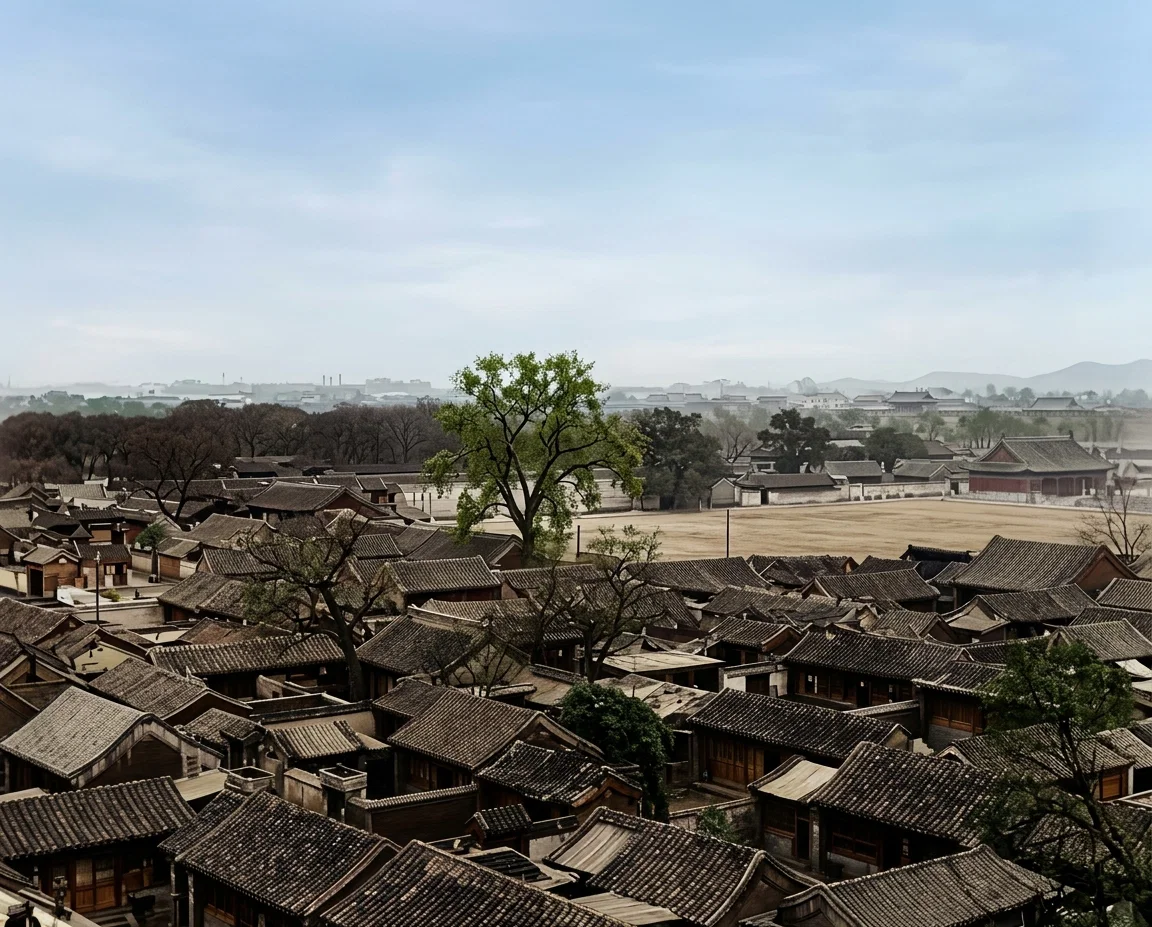
A GLIMPSE OF PEKING
A GLIMPSE OF PEKING
At the present moment the ultimate consequences of that upheaval are still problematic, but we are nevertheless permitted to review the course of events in the East during the last two years.
A few of the ringleaders in the uprising have been executed, and an indemnity of about two hundred and twenty-five million dollars has been fixed on the Chinese empire. The empress dowager with her court has returned to Peking, after an absence of about eighteen months; and contrary to all hopes and expectations, the young emperor has been seated on the throne, although his power is only nominal. During this period, if reports are to be credited, Russia has been playing a shrewd diplomatic game for territory in the north, which has caused more or less suspicion on the part of the other powers. This suspicion, whether well founded or not, has evidently taken definite, concrete form in the Anglo-Japanese alliance, which was formed last January, having for its avowed object the maintenance of the status quo in the far East, and in addition the mutual well-being, political and commercial, of the signatory powers. This last step is hailed by many, especially the friends of England and Japan, as a measure of far-reaching importance, making for peace and prosperity in the Orient.
While it is difficult to forecast the more remote results of this alliance, it seems quite likely that its immediate effect will be to promote peace, or at any rate to postpone the dismemberment of China. Both England and Japan are staggering beneath heavy national debts, and they seek only their own interests when they labor for the national integrity of China and Korea. That this alliance may provoke Russia to attack Japan is more than likely, but that only proves that it tends to curb the northern Bear.
But whatever political changes may or may not come, we cannot be in the dark about one thing,—the ultimate future of China will never be determined by politics. Statesmen and diplomats act important parts in the history of states, but the peace and destiny of China, or of any other nation, can neither be bestowed nor taken away by these personages. That China needs able and honest rulers, who both can and will introduce reforms, political, industrial, and educational, there can be no doubt. If the East is to keep pace with the West in the sense of material and worldly progress, she must by all means have the benefit of Western science and arts. China, with her almost inexhaustible but undeveloped resources, and four hundred millions of people scattered over a vast territory, needs the Western mechanical invention with which to move herself. Nor can we doubt that all these inventions and discoveries fulfill a great purpose in the plan of God.
But China’s one great need is not political reforms, Western arts and civilization, or education, but the divine life, the kingdom of God. The gospel is God’s power directed to the salvation of humanity, and this is the sole power capable of healing stricken China. Not that we may ever expect to see China as a nation receive the gospel, and so be saved as a political unit. History knows no such miracle, nor does the Bible give us promise of such results, but it does hold out to us the promise and the prediction that “this gospel of the kingdom shall be preached in all the world [οἰκουμένη, the habitable earth] for a witness unto all nations.” Jesus cast the leaven of his gospel into the entire mass of humanity, in the hope that believers will “come from the east, and from the west,” “out of every nation, and of all tribes and peoples and tongues.” And almost three thousand years ago the prophet Isaiah described this ingathering of God’s elect from the continents: “Behold, these shall come from far; and, lo, these from the north and from the west; and these from the land of Sinim [China].”
Here, then, is China’s only hope of permanent reconstruction; not by any change of external environment, but by the operation of an inward life-giving principle—“Christ in you, the hope of glory.” The key to the whole situation in China, as elsewhere, has been put into the hands of the Father’s “little flock.” “Ye are the light of the world,” and “the salt of the earth.” This gives to us, then, as individuals and as a denomination, a great opportunity, and it is equally clear that it puts upon us tremendous responsibilities. Are we ready and willing to assume them? To refuse in this critical and opportune time means our eternal loss. Now, as never before, does the message need loyal, self-sacrificing messengers. God’s truth is steadily marching onward, and this great Oriental world needs scores of our devotedyoung men and young women. Let God call you in whatever way he may choose; and when once you have heard his command to go, let nothing divert you. All things are ready, and delay on our part can bring only defeat.