Brazil — Its History

8%

Seventh-day Adventist Publishing Association · Battle Creek, Mich. · May 27, 1902

FromReview and Herald, Vol. 79, No. 21.

Read the full edition

Brazil — Its History

F. W. SPIES
Brazil was discovered in the year 1499 by Vincent Yañez Pinçon, a companion of Columbus. The next year the Portuguese navigator Pedro Alvarez Cabral had been commissioned by D. Manoel, king of Portugal, to sail to India in order to secure the commerce of that country.
He was driven by adverse winds far from his track, and having no knowledge of the existence of the ocean currents, was carried to the coast of Brazil. Cabral, supposing it was a large island, gave the newly discovered country the name “Ihla de Vera Cruz” (island of the true cross). Later this name was changed to “Terra de Santa Cruz” (land of the holy cross), and finally to Brazil, on account of the abundance of vermilion-colored wood found in it.
Although discovered in the year 1500, the Portuguese made no attempt to colonize Brazil until the time of King John III, who reigned from 1521 to 1557. The oldest city of Brazil is Bahia, formerly called San Salvador. It was the capital of the country until 1763, when the seat of government was transferred to Rio de Janeiro because of its greater strength and security from attack.
But from the first, or as soon as colonization began in Brazil, Portugal adopted a selfish colonial policy, and for three centuries Brazil was practically shut up to the outside world. During this time foreign vessels were only allowed to touch at Brazilian ports to obtain supplies or repair damages. This condition of things continued until 1808, when John the VI of Portugal was compelled with his court and family to take refuge in Brazil, in order to escape the French.
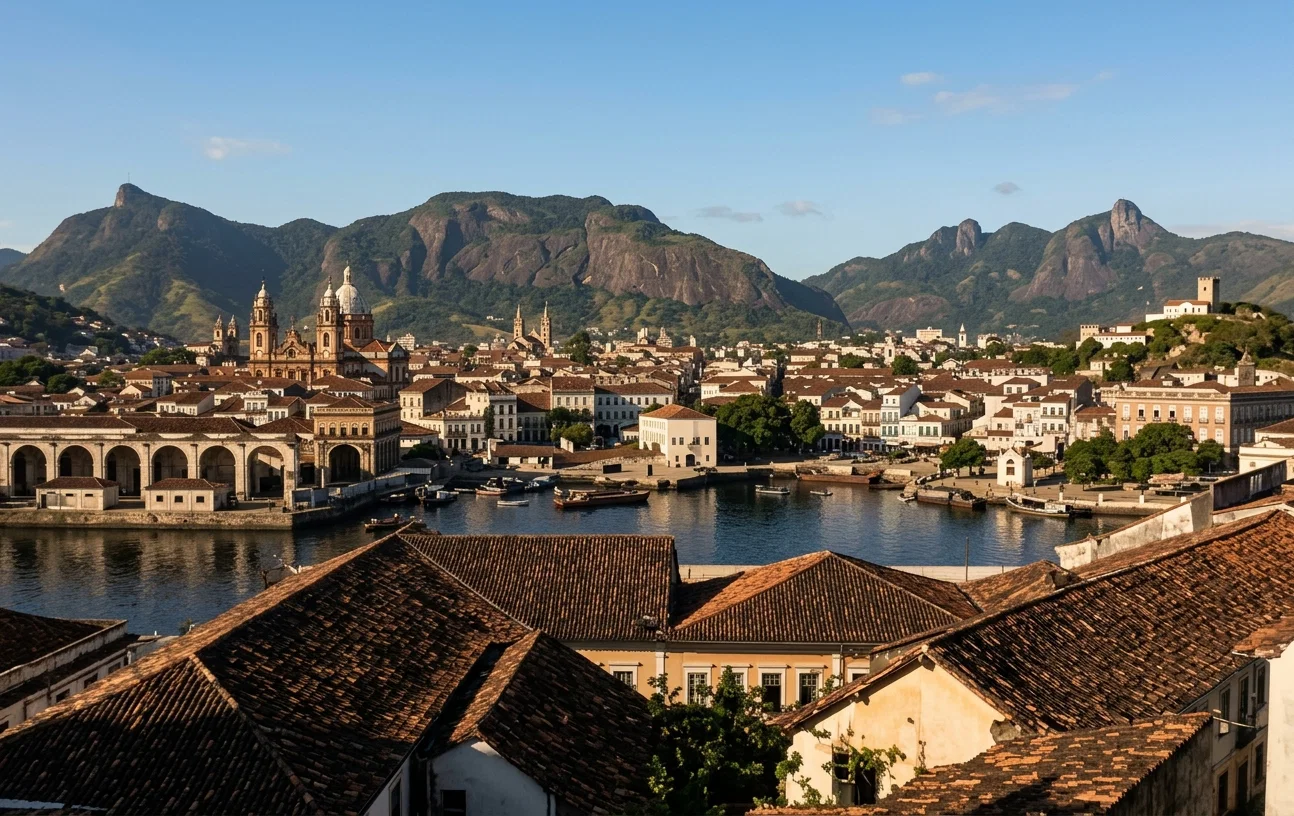
THE CITY OF RIO DE JANEIRO
From this time a new era opened for Brazil. King John VI opened Brazilian ports to foreign commerce on Jan. 28, 1808, the date of his arrival at Bahia, and he also was the first to permit the free exercise of every kind of industry to all classes of Brazilians. During the first year of his residence in Brazil, he established a royal treasury, a national bank, supreme tribunals of justice and finance, and also, for the first time, a printing office and official gazette.
The first foreigners who came to Brazil after she had opened her ports to the commerce of the world were the English. They came immediately after this event. The French did not come until 1814, but in numbers soon outstripped all others, almost all the small trades and industries falling into their hands.
On Dec. 16, 1815, Brazil was, through a royal decree, elevated from the state of colonial dependency to the dignity of a kingdom, conjointly with those of Portugal and Algarve. In 1820, a revolution breaking out in Portugal, John VI was compelled to return to that country. Upon his departure he left the administration of Brazilian affairs to his son, Dom Pedro, as prince regent, and a council of four ministers. After the departure of John VI, the Portuguese troops, aided by a large body of loyalist residents of the city of Rio de Janeiro, compelled the prince regent to swear submission to the new constitution which had been framed in Portugal; yet this did not avoid the rupture that was threatening between Brazil and Portugal. Brazil made an effort to secure her independence, but not until she threatened an appeal to arms was the independence finally granted them from Portugal, on Sept. 7, 1822, and then Dom Pedro was declared “Constitutional Emperor of Brazil” by the municipality on Oct. 12, 1822, under the name of Dom Pedro I, and his coronation took place December 1 of that same year.
The rule of Dom Pedro could scarcely be called a successful one. The financial condition of the country did not improve under his administration, and commerce and industry suffered much under the depreciated currency of the country. Further, the arbitrary temper of Dom Pedro I and the unconcealed lack of sympathy between him and his subjects also gave rise to endless controversies and reclamations, and finally led to his voluntary abdication of the throne in favor of his only son, Dom Pedro de Alcantara, at this time not six years old, and he returned to Portugal. The young prince was immediately proclaimed emperor under the title of Dom Pedro II. A regency was at once formed, to take charge of governmental affairs until Dom Pedro II had reached his fifteenth year, at which time he assumed the duties and responsibilities of government.
In 1839 steamship communication was opened along the coast; in 1850 steamship communication was also opened with Europe, and in 1865 with theUnited States. In 1871 a law was passed with the design of gradually abolishing slavery, and May 13, 1888, slavery was wholly abolished. But the abolition of slavery dissatisfied the planters, and created a dislike to the existing imperial form of government, and through a revolt of the militia under Marshall Deodoro Fonseca, on Nov. 15, 1889, the imperial form of government was abolished, and a republic proclaimed. But the existing facts show that the republic has not brought the country that prosperity that was expected, for commerce and industries are at present in a very bad condition, owing to the poor state of the country’s currency. Yet the change of government has done one thing for which it should at least receive credit. It has broken the power of the papacy in this country, and the present constitution guarantees religious liberty to all.
As the stability in temporal things diminishes the world over, the third angel’s message comes, offering to all the eternal riches. May many souls accept this rich grace so freely given, and prepare for Christ’s soon coming and eternal kingdom.