MODERN BABYLON IN PROPHECY

4%

Seventh-day Adventist Publishing Association · Battle Creek, Mich. · Aug 7, 1900

FromReview and Herald, Vol. 77, No. 32.

Read the full edition
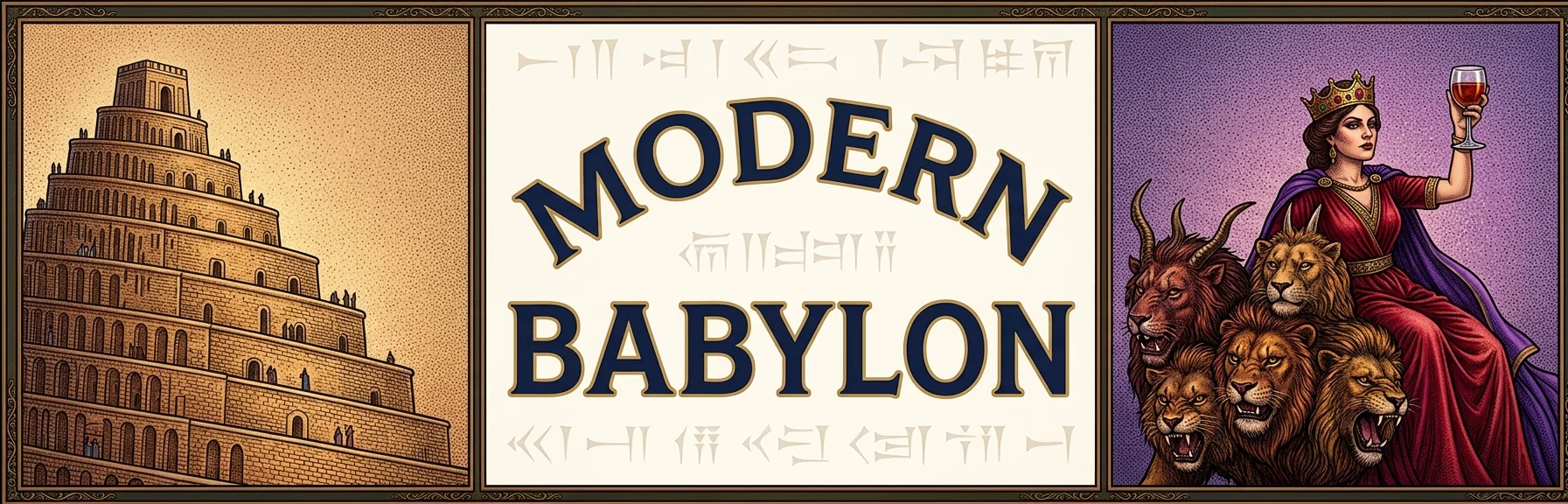
MODERN BABYLON IN PROPHECY.

The theme of what is usually called the prophetical portion of the book of Daniel is the same as that presented in the chapters already studied. The subject, though contemplating particularly Modern Babylon, is still the gospel of the kingdom. Daniel the prophet, the seer, sees the rise and fall of the successive kingdoms of the world, and the setting up of that kingdom “which shall not be destroyed.” He sees the long contest between the kingdom of heaven, the spiritual kingdom that is within men, and the kingdom of the world, the kingdom that is outward and fleshly; he sees the “dreadful and terrible” power that is exercised in the attempt to crush truth out of the earth, and to substitute a lie in its place; he sees that the union of the divine with the human, the true gospel of the kingdom, “Christ in you, the hope of glory,” brings victory in the great controversy; and he sees that a godlike character, righteousness, is the one thing that endures and gives stability. “Righteousness and judgment are the basis of his throne.” “Behold, a king shall reign in righteousness.”
And so these visions of the course of empire until “the end of the days,” simply revealed in a wider range the application, in the experience of nations and kingdoms, of those same principles that had been revealed in Babylon through the faithful testimony of Daniel, the servant of the living God. What Babylon had seen in the history of Daniel, Daniel now saw in the history of Babylon in its widest application,—that loyalty to the God of heaven, seeking first the kingdom of God and his righteousness, is the only basis of permanent prosperity. The writing of these prophecies was therefore the preaching of the gospel beforehand, and the teaching of them now “to every nation, and kindred, and tongue, and people” for what they really mean, will be the preaching of the gospel of the kingdom in all the world for a witness, “and then shall the end come.”
“In the first year of Belshazzar king of Babylon Daniel had a dream and visions of his head upon his bed: then he wrote the dream and told the sum of the matters. Daniel spake and said, I saw in my vision by night, and, behold, the four winds of the heaven brake forth upon the great sea. And four great beasts came up from the sea, diverse one from another. The first was like a lion, and had eagle’s wings: I beheld till the wings thereof were plucked, and it was lifted up from the earth and made to stand upon two feet as a man, and a man’s heart was given to it. And behold another beast, a second, like to a bear, and it was raised up on one side, and three ribs were in his mouth between his teeth; and they said thus unto it, Arise, devour much flesh. After this I beheld, and lo another, like a leopard, which had upon the back of it four wings of a fowl: the beast had also four heads; and dominion was given to it. After this I saw in the night visions, and behold a fourth beast, terrible and powerful, and strong exceedingly; and it had great iron teeth: it devoured and brake in pieces, and stamped the residue with his feet: and it was diverse from all the beasts that were before it; and it had ten horns. I considered the horns, and, behold, there came up among them another horn, a little one, before which three of the first horns were plucked up by the roots: and, behold, in this horn were eyes like the eyes of a man, and a mouth speaking great things.”
“I beheld till thrones were placed, and One that was ancient of days did sit: his raiment was white as snow, and the hair of his head like pure wool; his throne was fiery flames, and the wheels thereof burning fire. A fiery stream issued and came forth from before him: thousand thousands ministered unto him, and ten thousand times ten thousand stood before him: the judgment was set, and the books were opened. I beheld at that time because of the voice of the great words which the horn spake; I beheld even till the beast was slain, and his body destroyed, and he was given to be burned with fire. And as for the rest of the beasts, their dominion was taken away: yet their lives were prolonged for a season and a time.”
“I saw in the night visions, and, behold, there came with the clouds of heaven one like unto a son of man, and he came even to the Ancient of days, and they brought him near before him. And there was given him dominion, and glory, and a kingdom, that all the peoples, nations, and languages should serve him: his dominion is an everlasting dominion, which shall not pass away, and his kingdom that which shall not be destroyed.”
“As for me Daniel, my spirit was grieved in the midst of my body, and the visions of my head troubled me. I came near unto one of them that stood by, and asked him the truth concerning all this. So he told me, and made me know the interpretation of the things. These great beasts, which are four, are four kings, which shall arise out of the earth. But the saints of the Most High shall receive the kingdom, and possess the kingdom forever, even forever and ever.” (R. V.)
The interpretation of this vision is given on divine authority. Four successive world kingdoms occupy the whole field of history until the everlasting kingdom of God is established. The kingdoms that arise “out of the earth,” earthly kingdoms, have no permanent foundation, but the heavenly kingdom “shall not pass away.” This is individual experience applied to the nations, and it says to all, “As is the earthy, such are they also that are earthly; and as is the heavenly, such are they also that are heavenly.” “And the world passeth away, and the lust thereof; but he that doeth the will of God abideth forever.”
The simple reading of the record is sufficient to make it clear that it was not intended to be a history in detail of the four universal kingdoms that have borne rule over the earth, beginning with the Chaldean supremacy. The distinguishing characteristics of the first three kingdoms are given with brevity, and yet with a completeness sufficient to identify them beyond question.
Babylon, the head of gold of the second chapter, is here the lion, the king of beasts, and the eagle’s wings mark it as the “hasty nation, which shall march through the breadth of the land.” The plucking of the wings, and the unsteady erect position “upon two feet as a man,” tell the story of its later degeneracy.
The kingdom that was to succeed Babylon and be “inferior” to it, that of the Medes and Persians, is designated by the prophet Jeremiah as “the spoiler,” and its career of conquest and rapine is fittingly represented by the bear, to which the command was given, “Arise, devour much flesh.”
The wonderful rapidity with which Alexander with a comparatively small army covered the long distances, subdued the Oriental world, and established the third universal kingdom, Greece, is set forth by the leopard with its four wings; and the subsequent division of his kingdom toward “the four winds of heaven” is indicated by the four heads.
Then comes the fourth beast, “terrible and powerful,” to which no name is given, but which is later declared to be “the fourth kingdom upon earth,” and that is Rome. A more particular interpretation of this symbol, and the ten horns, and the little horn with eyes of a man, and a mouth speaking great things, is given later in response to the special request of the prophet.
A judgment scene is then introduced. “Thrones were placed,” and “the Judge of all the earth,” “clothed with honor and majesty” and “putting on light as a robe,” whose glory was “like devouring fire,” presided. Another seer beheld this same scene centuries later, and thus describes it: “And I saw a great white throne, and him that sat on it, from whose face the earth and the heaven fled away; and there was found no place for them. And I saw the dead, small and great, stand before God; and the books were opened: and another book was opened, which is the book of life: and the dead were judged out of those things which were written in the books, according to their works.” Rev. 20: 11, 12.
While this judgment work is in progress, the attention of the seer is attracted by “the great words which the horn spake,” and he watched the career of this power until “he was given to be burned with fire.” This last expression, taken in connection with other parallel descriptions, identifies this horn with the beast whose prophetic history is given in the thirteenth and fourteenth chapters of the book of Revelation, and whose destruction is described in verse twenty of chapter nineteen: “And the beast was taken, and with him the false prophet. . . . These both were cast alive into a lake of fire burning with brimstone.”
In the same way there is the plainest connection established between the little horn of this chapter and the woman of the seventeenth chapter of Revelation, who sat upon seven mountains (the seven-hilled city), “arrayed in purple and scarlet,” and upon whose forehead was “a name written, a mystery, BABYLON THE GREAT.” The woman who wore this title was declared to be “that great city, which reigneth over the kings of the earth.” This is the power known in human history as ecclesiastical Rome, but in the divine history as “Babylon the great, the mother of harlots and abominations of the earth.” And her end is thus described: “She shall be utterly burned with fire: for strong is the Lord God who judgeth her. And the kings of the earth, who have committed fornication and have lived deliciously with her, shall bewail her, and lament for her, when they shall see the smoke of her burning.” Rev. 18: 8, 9.
It is thus made clear that the little horn of the seventh chapter of Daniel is modern Babylon, and this is the principal subject of the prophecy. Thefour great kingdoms that are so briefly characterized in the description of the four beasts are simply so many steps leading up to, and locating, modern Babylon, “the mystery of iniquity.”
The connection between those portions of the book of Daniel usually designated as the historic and the prophetic is thus clearly shown. The prophecies of Daniel, as supplemented by the prophecies of John, recorded in the book of Revelation, and in connection with the prophecies of Jeremiah, were given to reveal the fact that the history of Babylon was to be repeated in the latter days, and to give such warnings and instruction as would enable all who are willing to separate themselves from Babylon to be saved from the everlasting destruction that awaits her.
It is thus evident that Babylon is the very incarnation of the idea of self-exaltation, in opposition to the revelation of the character of the true God as manifested in Jesus Christ, the meek and lowly One. Babylon therefore stands for man lifted up against God; for “that spirit of Antichrist,” which “confesseth not that Jesus Christ is come in the flesh;” for salvation through the works of the flesh instead of righteousness by faith; for the traditions of the church made to take the place of a plain “Thus saith the Lord;” for “the mystery of iniquity” in contrast with “the mystery of godliness;” for the papacy, and the papal idea as opposed to genuine Christianity. All this will appear with greater fullness of detail in the next study, when the special work of the little horn as described in the prophecy will be considered.
The fourth beast, little horn and all, was “destroyed;” but the rest of the beasts “had their dominion taken away: yet their lives were prolonged.” When the Babylonian monarchy “met its death at the hands of Cyrus the Great, the nationality of the Chaldees was not swept away.” The same was true in the experience of Medo-Persia and Greece. “The ruling power was transferred, but the national life continued.” All three have been combined with the fourth kingdom, and will meet their death with it.
This is also shown in the description given of the beast (identical with the little horn) in the thirteenth chapter of Revelation: “And the beast which I saw was like unto a leopard [Greece], and his feet were as the feet of a bear [Medo-Persia], and his mouth as the mouth of a lion [Babylon].” Rev. 13: 2. Thus the whole world will perish in the fall of modern Babylon, except those who heed the call to come out of her.
W. W. P.