Porto, Portugal

8%

Review and Herald Publishing Association · Takoma Park Station, Washington, D. C. · Nov 5, 1908

FromReview and Herald, Vol. 85, No. 45.

Read the full edition

Porto, Portugal

C. E. RENTFRO
Between the years 396 and 407 A. D. the barbarian tribes from the north invaded Italy. They scaled the walls of Rome, robbing it of all its riches, in a general sack. They ravaged the fields and devastated every city they found in their march. They passed into Gaul, where some remained; the rest crossed the Pyrenees, making themselves masters of Spain; they invaded Lusitania, ending their career in the extremity of the peninsula.
Until the year 585, the city of Porto belonged to the Suevic kingdom, and afterward formed part of the great Gothic kingdom. In 716 it was still in the power of the Goths; but then it was besieged and taken by the Moors commanded by the Emir Abdil-Azim. For one hundred four years the Moors were the pacific masters of this city, until 820, when D. Alfonso I of Leon (the Catholic) redeemed it from the power of the infidels. In 825 the city was destroyed by Al Mancor the Great, not one stone being left upon another. For one hundred fifty-seven years it was deserted and abandoned. In 984 the Gascons, Portuguese, and French rebuilt it.
Ferdinand Magellan, who first circumnavigated the globe, was born here. He was killed in the Philippines, April 27, 1521. In 1732, in Clergy Street, began the construction of the Clergy church, called thus because it is said to have been built by the Catholic clergy. In 1748 was begun the work on the tower of the Clerigos, which was concluded in 1763, Nicolas Maroni, an Italian, being the architect.
This tower is the highest in the kingdom, and one of the most elegant and notable of Europe, much exceeding in height those of Hamburg, Bologna, Utrecht, Riga, and Bristol. It is all masonry work of most solid construction, founded on a rock, and has resisted all storms and convulsions of the globe, except in 1834, when a strong tempest destroyed a small part of this tower, which was, a short time after, repaired. In 1862 an electric bolt threw the globe and cross to the ground. These were soon replaced. Now there is a lightning-conductor. The height of the tower, from the level of the street to the metal globe that crowns it, is two hundred forty-seven one-half feet. It can be seen from the sea thirty-seven miles distant, serving as a guide to sailors who wish to enter the port. The pulpit is all of most beautiful marble, and cost more than twenty thousand dollars.
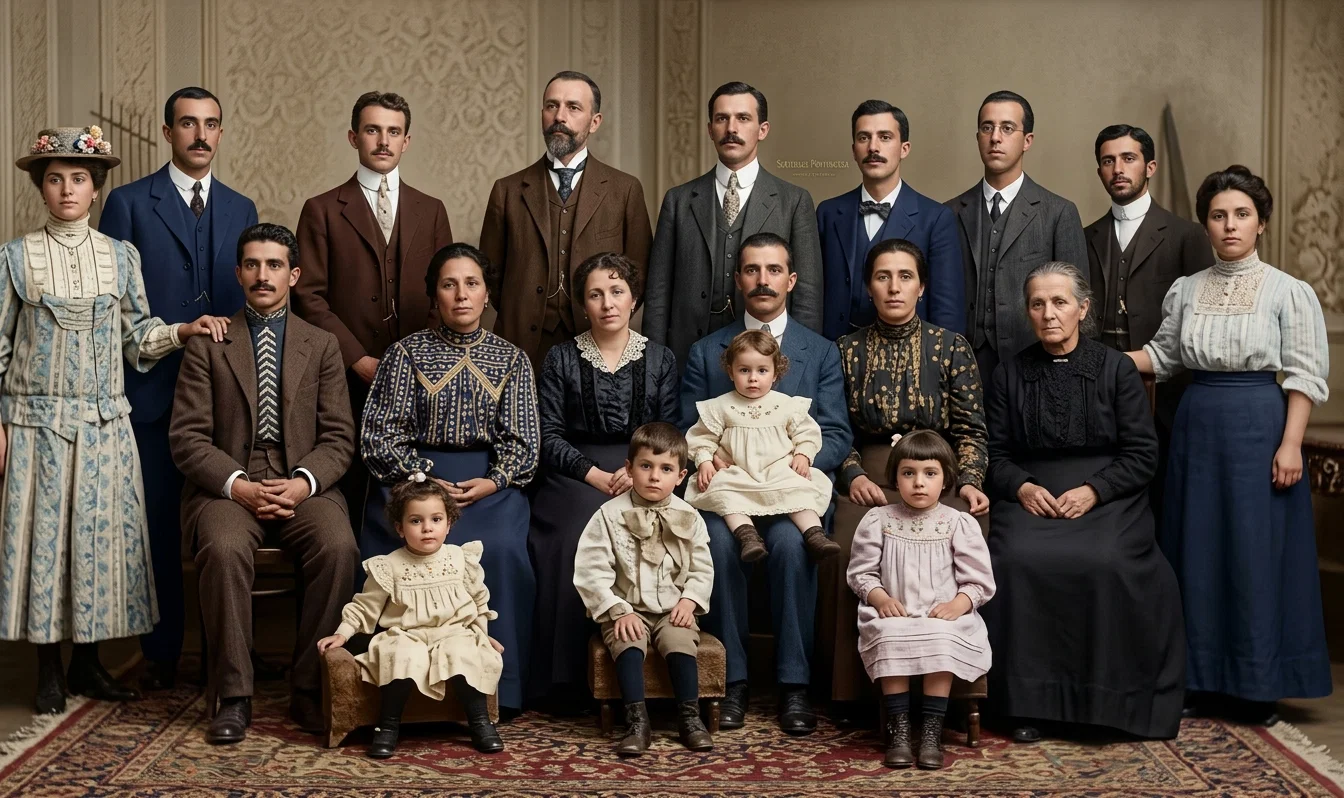
GROUP OF WORKERS AND BELIEVERS IN PORTUGAL
In 1834, at the suppression of religious orders, there were here twenty-seven churches and forty-nine public and private chapels, and nineteen convents for monks and nuns. March 25, 1877, a new Anglican Protestant temple was dedicated, the second in the city. The first was founded many years before. Of Protestant denominations, there are Methodist, Baptist, and Lutheran.
Two years ago our work was begun here by Elder Ernest Schwantes, with the help, for about one year, of two colporteurs. Visiting from house to house is not to be considered here, and only by opening a hall to the public can anything be accomplished. Out of eleven persons baptized, four went to Brazil, two moved to the frontier of Spain, one died, one moved to Lisbon, and three apostatized. A goodly number are now in great hunger for the Word. We shall do what we can from Lisbon to minister to their needs. On account of his health, Brother Schwantes was allowed to return to his home country, Brazil.
The accompanying picture shows a group of Sabbath-keepers in Portugal. In the back row, beginning at the right, is a young brother from Porto, who is now with me at Lisbon. He ought to be sent to school in Gland. The second will leave soon for Switzerland. The third is the first Portuguese Sabbath-keeper in Portugal. The writer comes next, with Brother Schwantes on his right. After him comes a German brother, who is on his way to work in the Brazilian office. The last is an interested friend, who finds it a hard thing to obtain employment where he can keep the Sabbath. Just in front of him are his wife and daughter, who are Sabbath-keepers. The next in the front row is a sister from Porto, with her child. These are escaping severe persecution by going to Brazil. The fourth from the left is the first Sabbath-keeper in Portugal. By her side are the writer's wife and children. The next three are members of the first Portuguese family to receive the truth.
I wonder if there is any one who would like to educate the young boy at the extreme right. He is seventeen years old, an orphan, having had a hard life, but, I believe, is truly converted. He is earnestly desirous of being a true child of God. We would like to call for help; but we will leave his case in God's hands. Remember our field in your prayers.
Lisbon.