FURNISHED BY HIS DAUGHTER, MRS. A. E. GURNEY, BY REQUEST.
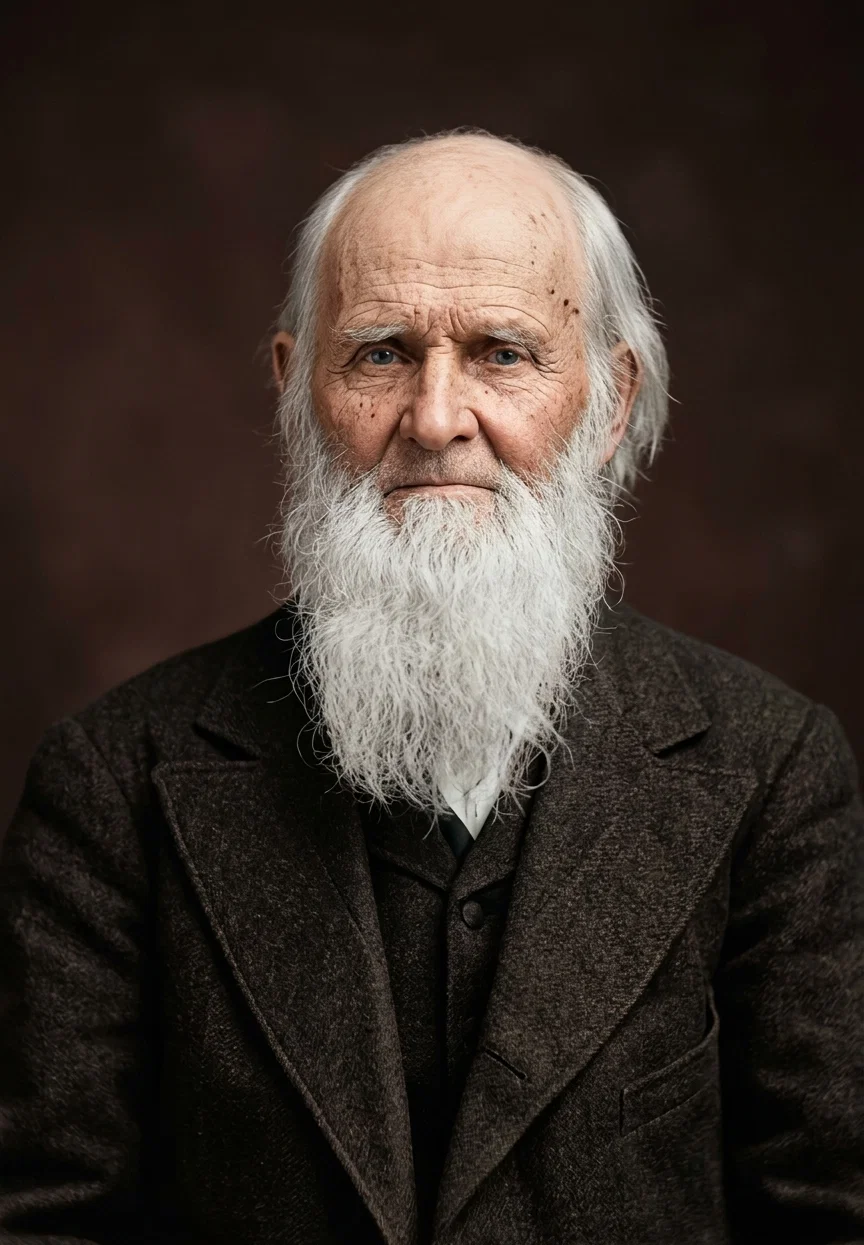
WILLIAM GIFFORD, the subject of this sketch, was born in Rochester, Plymouth Co., Mass., Sept. 22, 1798, and is consequently, at the date of the issue of this number of the REVIEW AND HERALD, one hundred and three years, three months, and twenty-two days old. The accompanying illustration is a good representation of my venerable parent, who has the remarkable experience of having lived in three centuries.
“Father Gifford,” as he is generally called, is of both English and German descent. When very young, he was left without a father; and though his mother had a large fortune, the hand of injustice wrested it from her, and she found herself alone, with a large family, and her means of support all gone. It was then thought best to put young William out at the tender age of seven years. But there he was treated so unkindly that, after a time, he ran away, and went home. His mother thinking it best not to force him to return, the young lad found employment in a cotton factory near by, thus helping to care for those younger than himself.
WILLIAM GIFFORD, BORN SEPT. 22, 1798;
PRESENT AGE, 103 YEARS.
At the age of fourteen it was decided that he should go to live with his uncle, Captain John Atsatt, and learn the pump- and block-making trade. There he faithfully toiled till of age, when came his years of freedom. He now hired out to work for his uncle, and after a time he was taken into partnership, where he remained till the year 1831, when a son of the captain came home from a whaling voyage, and bought out father's interest. He then went to Fair Haven, about six miles distant, built a shop, and started business for himself.
In 1820 William Gifford was married to Miss Mary Bowlin, daughter of Captain Josiah Bowlin. At this date he was financially prosperous, and business was thriving. My father still is, and We always was, one of those outspoken men who dare to state what they think is right, and who will sacrifice much for a principle.
Politically speaking, he was an old-time Democrat after the stiffest order, also a staunch anti-slavery advocate, and in all respects a thorough teetotaler and temperance man. From this one can readily see the outcome of so much radical truth centering in one individual, so far as business is concerned, with men of decidedly opposite sentiments. Father always kept his political flag at masthead. “No half-masts for me,” was his watchword.
At the time of the William Henry Harrison presidential campaign in 1840, father was wide awake, and constantly advocated his Democratic sentiments. The shipowners at Fair Haven were mostly of opposite politics, and the excitement ran high; and it did not take long at this period to foresee that William Gifford must either change his politics or sacrifice his business; and with him, business was but a secondary matter. He could not be bought, consequently his patronage waned.
During these exciting days, mother would sometimes say to him, “William, I hope I may be permitted to live to see you as wide awake in the cause of religion as you now are in politics,” and she did. Not long after this time the Gifford pump and block firm was sold out, and the proprietor left the business entirely.
There were many proslavery men living in Fair Haven in those days, and father could not tolerate that hated traffic, and he was very outspoken on the subject. This also injured him greatly. While in business, his grandfather encouraged him in his antislavery sentiments, and they were among those early underground railroad men who assisted the slaves in running away from bondage. At one time his grandfather brought a fugitive home, and he settled near by. Grandmother taught him to read, and later, when the Advent truth was preached, the old negro accepted it, and died in the blessed hope of soon meeting his heavenly Master. Then too, father's ardent temperance principles greatly injured his worldly business with the shipowners and sea captains.
In 1856 the writer of this sketch, with her family, moved to Jackson, Mich. Father came in the following spring. Mother died in three weeks after they had settled on a small farm at Parma, this State. So father was completely broken up again. He rented his farm, and lived with his daughter in the city of Jackson for some time. But after a while he traded his land for other property in Brookfield, and there he lived with my brother until he sold out, over twenty-five years ago. Since then he has been with me most of the time.
Father says that some of his ancestors lived to quite an advanced age. His last remaining brother died more than a year ago, at the age of ninety. He has no immediate relatives except his own family, and nephews and nieces, who are quite numerous.
He never married but once, and has now been a widower about forty-four years. My mother gave birth to eleven children, six of whom are still living. I think my father has twenty-seven grandchildren, and twenty great-grandchildren. He has one great-great-grandchild.
My father was converted and joined the old Christian Church at Mattapoisett, Mass., in 1819, when he was twenty-one years old, and remained in that connection till a short time before the Advent doctrine was preached, when he became dissatisfied with the faith and religious life of that people. He belonged to the same church of which Elder Joseph Bates was deacon. Later, he, with several others, took leave of their former church associations, and started cottage meetings in private houses. God blessed this move abundantly, and when the noted William20Miller came to the village, heralding the great second advent proclamation, they were all ready to receive the good news of the soon-coming Saviour.
Father brought up his family with the thought that he would rather pay the grocer and butcher than the doctor. Beef and pork, and all else that helped to make up a good New England table, were freely used; but he never had liquors on his table, nor elsewhere, not even as medicine. Tobacco he hated in all its forms. When the children were quite young, father used coffee at breakfast; but after a while his hands began to tremble, and he consulted the family physician, who told him that he drank too much coffee. His reply was, “Well, that puts an end to that, then.” So he would never furnish any more coffee, not even for the family. Then he took to drinking water and milk, and since then he has always used that for his drink. This experience of discontinuing the use of coffee must have taken place about the year 1836. I am now seventy years old, and do not remember that I ever saw my father drink a cup of tea or coffee, as a beverage.
He is very true to all health principles as far as he understands them. He eats no meat nor butter. Formerly when he used meat and rich foods, he frequently had sudden sick spells, but usually recovered soon. One winter he was laid up with rheumatism, and had to go to the hospital for treatment, but he has never suffered from a like attack since. After he moved to Michigan, he had a run of typhoid fever. The foregoing is all the sickness of any account that he has ever had.
He never used many drugs. His general health at present is remarkable for one of his age. Of course he has infirmities, which rather tell on his strength. He cannot get around as he used to, yet in warm weather when it is fair, he goes to church, and bears a decided testimony to those present. His mind is quite clear, and he understands what he reads. He is quite deaf, not having heard a sound for two years. His eyesight is good, though he thinks it is poor. He reads a large part of the day, not merely once in a while, but every day in the week, and no one ever hears him say that he is tired, or that his eyes ache.
In the morning, as soon as breakfast is over, he takes his Bible or the denominational paper, or both, and frequently reads until he is called to dinner. In reading he uses glasses, but for ordinary work he does not need them. He does not remember dates as well as formerly; but when he goes to church, he does not forget to tell the people what is in the church paper, and to call their attention to things of eternal interest.
His appetite is exceedingly good, and he relishes anything that is on the table. The family physician says that his healthful diet is the secret of his long life. His usual diet is oatmeal and graham bread, corn meal served in different ways, with fruit, vegetables, etc. He wants three meals each day; but with him supper is a light lunch at five o'clock. He seldom lies down in the daytime, but sometimes drops asleep while reading. He does nearly everything of a wood-work nature around the house. In summer he works in the garden and in the berry patch, and does many little jobs.
My aged parent is six feet in height. I do not know his weight, but he is in a good, healthy condition. His teeth are nearly all gone. He is some bald, indeed, he never had a heavy head of hair; but what remains is fine and silky, and is of a light-steel color. His beard is perfectly white, as may be seen in his picture.
Father Gifford accepted the Advent message in 1839, in Fair Haven, Mass., and was a full partaker of the joys of those who expected the Saviour in 1844. After the great disappointment he shared in the sorrows of those who were looking for the Lord, but he never went back on the preaching, as so many did. He was personally acquainted with many of those early lecturers upon whom God laid the burden of the great second advent proclamation. He lived in the same neighborhood with Joshua V. Himes, the co-laborer of William Miller, and was well acquainted with him in early life.
Shortly after the time passed, he accepted the Bible Sabbath, through the labors of Elder Joseph Bates; and his home was a place of common resort for those who led out in giving the Third Angel's Message. He is exceedingly well informed concerning the early labors of Elder James White and Sister White in this cause; and though he has now attained to the remarkable age of over one hundred and three years, his lamp is trimmed and burning, and the soon coming of the blessed Saviour is the joy and rejoicing of his heart.