A TRIP TO LOS ANDES

5%

Pacific Press Publishing Company · Mountain View, California · Jan 11, 1905

FromSigns of the Times, Vol. 31, No. 2.

Read the full edition

A TRIP TO LOS ANDES.
BY WILLIAM STEELE.
In company with Brother Balada I started to visit some of the brethren who live in the country beyond the beautiful city of Los Andes which is situated at the foot of the Andes mountains.
The train carried us through several beautiful valleys similar in many respects to the valleys of Oregon and Washington, with growing grain and orchards bearing fruit. The greater part of the fruit here is different from that of the States, altho grapes and peaches are very abundant.
There are three different classes of travel on the trains here, first, second, and third. The rich ride in the first class, the common people in the second, and the poor in the third. Suffice to say the third class has the most passengers, as the most of the people are poor.
As a Seventh-day Adventist mission worker is never overburdened with money, we rode third class, which is less than one-half the cost of second class, a ride of more than one hundred miles for only sixty cents, gold. The cars were crowded. In Chile all the men and the majority of the women smoke cigarettes. So if it had not been for the beautiful scenery outside, the ride would not have been a very enjoyable one.
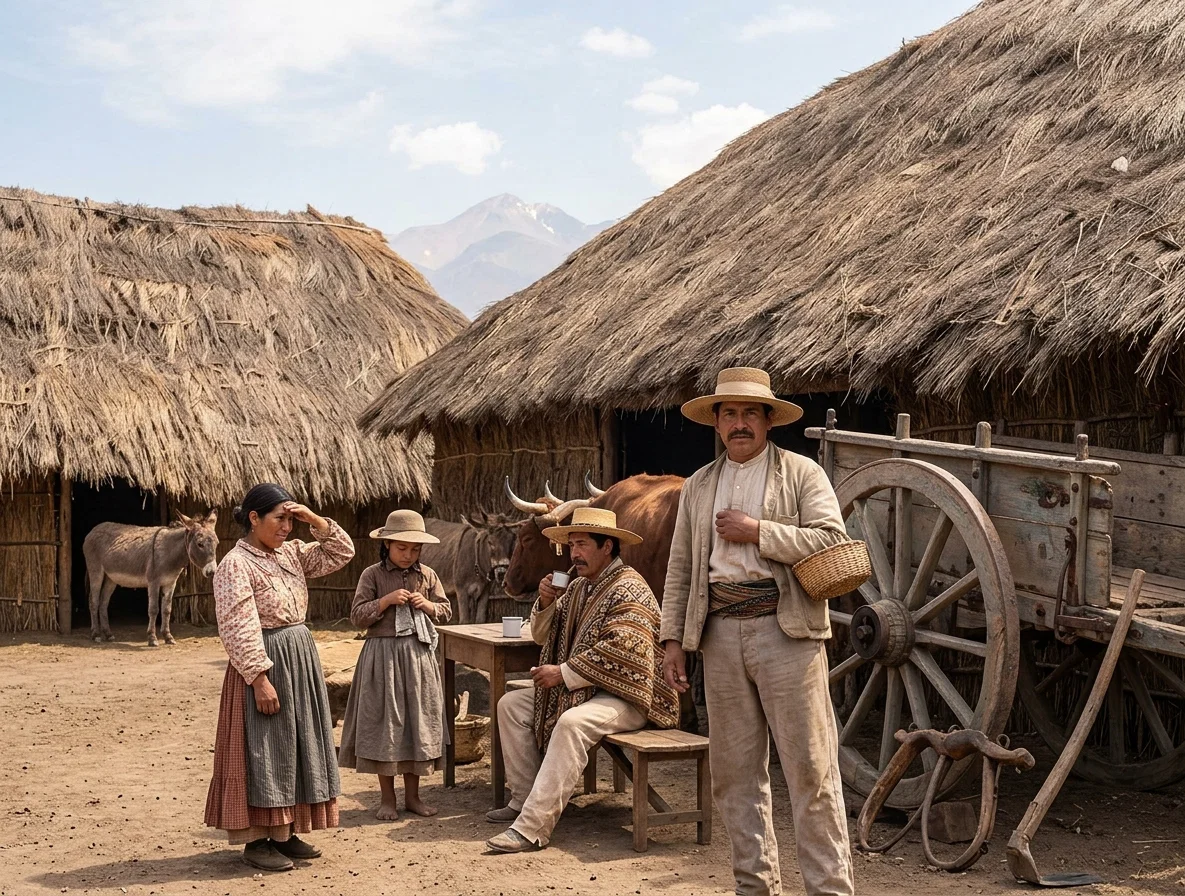
As far as I know, there is not a wagon or carriage in this country like those used in the United States. In some places they use the same kind of carts as were used in ancient Egypt. The majority of them have two very large, high wheels. Ox carts are very numerous; but many of the carts are drawn by horses, one horse being hitched in the shafts, while a second is hitched at the side by a single tug. This horse carries a saddle on which the driver usually rides. The horses all have their tails docked, as the people try to be English.
Two of the brethren met us at the station with two burros and a horse, on which we were to ride to their home, a distance of fifteen miles.
In Chile burros are used more than horses or mules for carrying burdens. It is no uncommon sight to see a little burro loaded so that about all one can see of it is its ears and tail and four small feet. One of our burros was loaded with personal effects, so only two of us could ride at one time. Five miles of the distance there was no road, simply a trail among the rocks. As it was dark when we reached this trail, I had a new experience in climbing mountains in the dark, where a single mistep might result disastrously. We arrived safely at our destination at 8.00 P.M., and found all the brethren gathered to welcome us, this being the third visit they had received since accepting the truth some four or five years ago.
A Farm House In Chile.
A Chilean supper, consisting of soup and vegetables, awaited us, and was very acceptable. After supper a short meeting was held. The next morning we had a good meeting which lasted two or three hours. In the evening the ordinances of the Lord's house were celebrated, and all seemed to be strong in the faith.
During the afternoon we spent a few hours climbing mountains and enjoying the beautiful scenery. The mountains are covered with shrubs and cactus. The people keep goats and burros which feed on the shrubbery. These animals are the principal source of income to the people.
The next morning, in company with one of the brethren, I returned to Los Andes to sell a few Las Senales de Los Tiempos (our Spanish paper) before returning to Valparaiso. After walking the entire distance, I succeeded in disposing of enough to amount to $8.50; also took a few subscriptions for the paper.
I did not see a house in the country that is as good as the sheds we keep stock in at home. The houses are made of mud with a thatch roof. They have no floors or windows, and some of the doors always stand open. The housewife has no cook stove, but cooks on a fire built in the middle of the room or on a brasero which is a kind of kettle twelve or fourteen inches in diameter, in which a fire is built. Altho the most of the native Chileans are very poor, yet in the cities can be seen people as well dressed as in any place in the world.
The wealthy people and the foreigners live in the cities. If one goes to the parks on Sunday or on a feast day, one sees the people resplendent in diamonds and expensive clothing. They think of everything but God, the Giver of every good and perfect gift. They seem so eager for pleasure, that one often wonders how they can be halted in their mad rush long enough to hear the warning message.
A short time before our visit to Los Andes, in company with the same brother, we made a trip to Quillota, a small city about an hour's ride from Valparaiso. We only remained between trains. During that time I spent about two hours in selling papers, but sold enough to amount to $4.60.
The work is onward in Valparaiso. Seven adults who have accepted the Sabbath through attending the meetings, desire to be baptized, and unite with the church. There are others who will be ready for baptism in a short time. Last Sabbath, October 29, I spoke to the people for the first time without an interpreter.
While sitting here writing this afternoon, we felt a very decided shock from an earthquake. At first the house seemed to tremble, then to shake, and then suddenly lifted up and the windows rattled. It gives one a very peculiar sensation, hard to be described—a feeling of uncertainty.
I thought, If this apparently small thing can cause these heavy, solid buildings to tremble and shake, how will it be in the great day of the Lord, when He arises to "shake terribly the earth."
There is no safety except in the Rock of Ages. In Him we have a safe and sure abiding place, a strong tower. Praise His name. We need the prayers of God's people for the success of the work in Chile.
Valparaiso, Chile.