THE MOUNT OF OLIVES

11%

Seventh-day Adventist Publishing Association · Battle Creek, Mich. · Aug 20, 1901

FromReview and Herald, Vol. 78, No. 34.

Read the full edition

THE MOUNT OF OLIVES.

F. H.
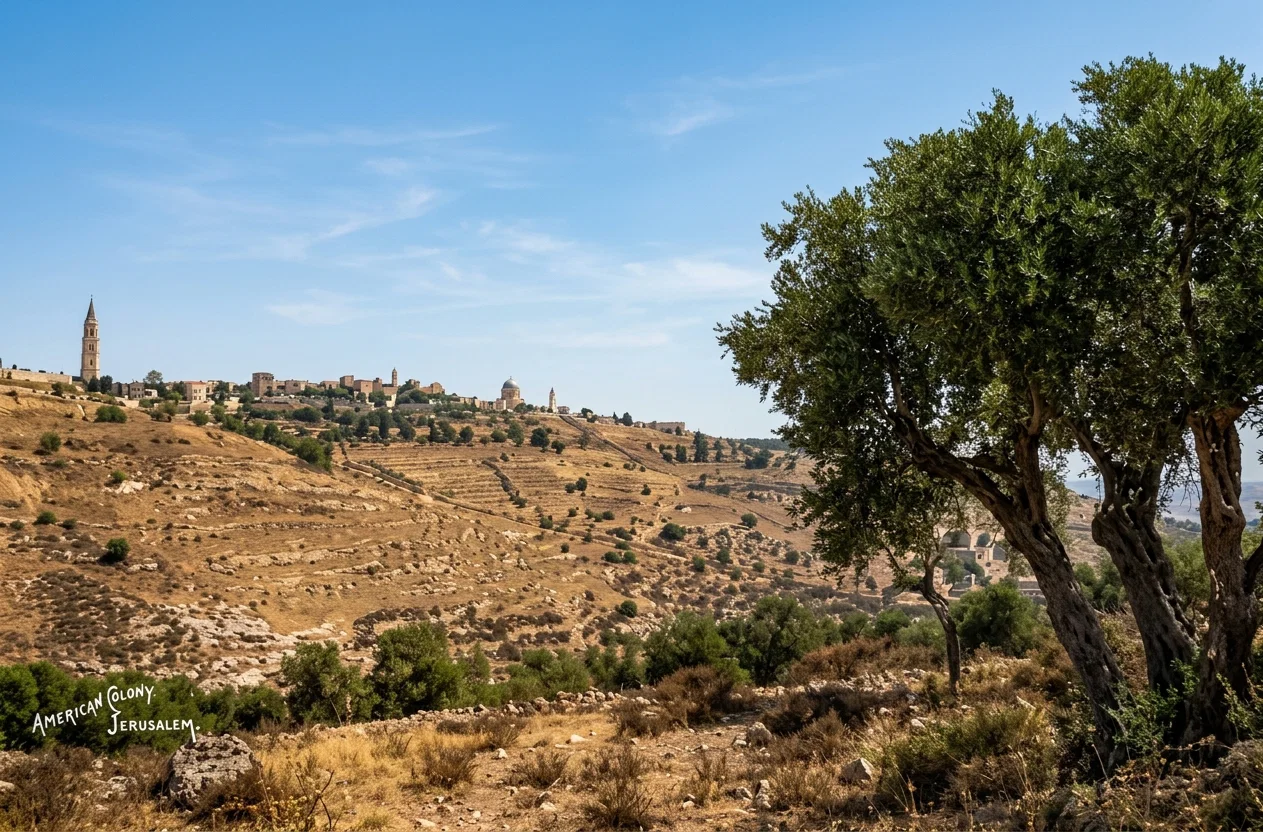
The picture represents the Mount of Olives, as we see it to-day, with but a few old olive trees on it. At the foot of the mountain we see a beautiful building on which there are several golden domes. This is near the garden of Gethsemane. On the summit of the mountain there is a high tower, with two hundred and seventy-six steps. A little to one side is another building, which ends in a large dome. This represents the so-called Ascension church. All of these last-named buildings have been erected by the Russian Greek Catholic Church. From the tower one has a beautiful view away to the mountains of Judea, to the Jordan, and to the Dead Sea.
MOUNT OF OLIVES, LOOKING EAST FROM JERUSALEM.
The Mount of Olives was the place where at one time our beloved Master, with His disciples assembled around Him, looked sorrowfully upon the city of Jerusalem, the inhabitants of which were bound with the cords of sin. This was also the place where He prophesied the destruction of Jerusalem, and, among other things, also spoke of the long time of persecution through which the followers of Jesus would pass. Here He also mentioned the signs which should indicate the nearness of the end of the world and of His second coming, as recorded in Matthew 24 and also in the Gospels of Mark and Luke.
On the road from Bethany to Jerusalem one comes to a sharp turn in the path, on the southwest declivity of the hill, at which point a view of the city of Jerusalem breaks suddenly on the beholder. This, in the days of Christ, must have been a scene of magnificence and beauty, for then the gorgeous temple of Jerusalem, the place of which is now occupied by the Mohammedan Mosque of Omar, rose grandly in the foreground. This is supposed to have been the spot at which Christ wept over Jerusalem, as recorded in Luke 19:41.
Having briefly referred to what the New Testament says about the Mount of Olives, let us see what the Old Testament says about it. If we take our Bibles and turn back to the prophecy of Zechariah, we read, in chapter 14:4, that our Saviour will, at His return, put His feet “upon the Mount of Olives, which is before Jerusalem on the east, and the Mount of Olives shall cleave in the midst thereof toward the east and toward the west, and there shall be a very great valley; and half of the mountain shall remove toward the north, and half of it toward the south. . . . And the Lord my God shall come and all the saints with thee. . . . And the Lord shall be King over all the earth; in that day there shall be one Lord, and His name one.”
It is clear that this will take place at the return of the Saviour to receive His own, as He promised His disciples before He ascended, and as the angels assured them after His ascension. Acts 1:9-12. He will return and set His foot on the same place from which He ascended—on the Mount of Olives, as is shown in this last-named reference. And the city of God will come down and occupy the plain made by the cleaving of this mountain. See Rev. 21:2, 10.
Dear reader, you may not be permitted to set your foot on the Mount of Olives on this sinful earth as it is now; but may you be privileged finally to enter in through the gates into the city, as one who has a right to the tree of life. We all may do this by overcoming through Him who saves to the uttermost.