The Annual Conferences in Germany

6%

Review and Herald Publishing Association · Takoma Park Station, Washington, D. C. · Mar 14, 1907

FromReview and Herald, Vol. 84, No. 11.

Read the full edition

The Annual Conferences in Germany

L. R. CONRADI
After having organized the Silesian Conference at Goerlitz, and the North German Conference at Harburg, we held the Rhenish Conference December 27-31, in one of the best halls in the very heart of the city of Bonn, on the Rhine—a city of eighty-two thousand inhabitants. The business sessions, and the public services in the evening, were held in the hotel “Golden Star,” on the market-place, opposite the city hall. The city of Bonn is especially noted for its university and its beautiful surroundings. The sons of the emperor complete their university course here.
The territory of the Rhenish Conference is composed of only the Prussianprovince of Rhineland, with a population of about six and one-half million. At the time of our meeting, we were able to receive six companies and churches. During the year there were two hundred and twenty-six additions in this field, bringing their membership up to six hundred and twenty-five. Their tithe was over eight thousand dollars for the last year.
The first two churches in Germany were organized in this conference, as much as thirty-five years ago; but as no one looked after them, their membership decreased, in the course of time, and finally there was but one church left—the church at Vohwinkel; but now the membership has so increased that it was found well to re-establish the Solingen church, and it was again received into the conference. Although the Rhenish Conference has been organized only four years, and had at the time of its organization only six laborers, yet it has been so blessed of God that the work has extended from the extreme north to the south, and from the east to the west of the province, good churches being established in the leading cities.
In view of its increase in membership, and the size of its territory, the Rhenish field was glad to receive Elder Behr, of the West German Conference, as one of its workers, so that now this province starts out with two ministers, four licentiates, and seven Bible workers. It was very encouraging to me to see so many brethren present at the meeting.
About one hundred and twenty-five dollars was raised toward the material fund for the German “Ministry of Healing,” and the conference voted twelve hundred dollars toward the old people's home. The book sales for the year were about nine thousand dollars.
Elder G. W. Schubert was again unanimously elected president. Brethren Luepke, Pieper, and Hoenes assisted in the meetings, and all our people went home refreshed and strengthened.
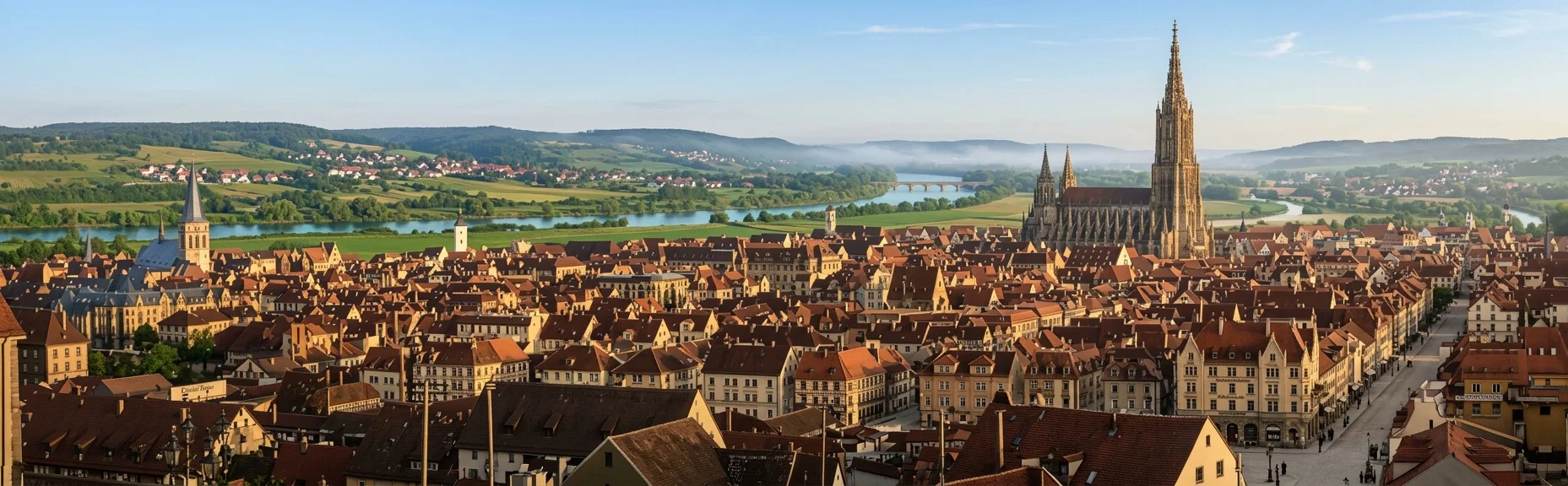
ULM, SOUTH GERMANY
Just beyond the large cathedral was held our South German Conference.
ULM, SOUTH GERMANY Just beyond the large cathedral was held our South German Conference.
From here we went to Ulm, where we held our next conference, January 2-6. The South German Conference was but a mission field in 1901, and it had the smallest population of any of our conferences in Germany; but since we now have seven different organizations in northern Germany, this South German Conference (organized in 1902) is the largest in population, containing about thirteen million inhabitants; its membership is nearly six hundred and fifty; during 1906 there were one hundred and thirty-six additions, and several new companies could now be received into the conference.
Ulm is a fortress in Würtemburg. It has a population of fifty-two thousand. Just across the River Danube from Ulm, is New Ulm, in Bavaria. It contains about ten thousand inhabitants. As the two cities are so near each other, it gives the believers in the Bavarian town an opportunity to cross the river, and worship freely with their brethren in Ulm. We were also pleased to see so many strong, promising men in this meeting. We are still suffering under the rigid laws of Bavaria; but the Lord is helping our workers to find ways and means by which the truth steadily progresses, and our membership increases, in spite of all the obstacles that men may place in our way.
Elder G. W. Schubert and Dr. Hoenes assisted in this meeting. There was an excellent outside attendance each evening. The leading Lutheran paper in Würtemburg had three full columns about this general meeting, giving our history, naming all the books and journals our canvassers circulate, and giving the address and time of our general meeting, and warning the people not to come; but this advertisement simply worked well, for it increased the curiosity of the people.
Seventeen were baptized at this meeting. Elder J. T. Boettcher was again unanimously elected president of the field. The canvassing work in southern Germany was especially blessed of the Lord in 1906, as they sold sixteen thousand five hundred dollars' worth of books and publications. Their tithe was over nine thousand dollars. The pledges here toward the material fund amounted to one hundred and fifty dollars. The people also gave liberal donations on Sabbath and Sunday, as Sabbath-school and first-day offerings. Twelve hundred dollars was voted toward the old people's home. This conference starts out for the new year with two ordained ministers, six licentiates, and eight Bible workers.
January 7 I spent at Basel, with the German-Swiss committee, auditing their conference accounts, and looking after the depository there. We still occupy the hall and business offices in the old building once owned by our people, and pay only a nominal rental of three hundred dollars a year for the room we have there. The property has already changed hands again, and the parties who secured the property seem to have a hard time to use it to good advantage. The German-Swiss Conference had also a good growth of over ninety during the year. Its population is about two and one-half million. Their membership is now four hundred and thirty-five. The eight tenths of their tithes easily covered their expenses, and with the rest of their income they were able to secure a second tent for their summer meetings. At the time of their last summer meeting, this conference voted sixteen hundred dollars toward the old people's home.
Our next meeting was held in the Lutheran town of Erfurt, January 9-13. It is now a growing industrial center of about one hundred thousand inhabitants. Here we also had secured a fine hall in the leading hotel in the heart of the city, opposite the city hall and main post-office, and our public lectures were well attended. In Erfurt we have a good church of about sixty members. It was in Erfurt that Luther was a monk in the Augustinian monastery, 1505-08. This monastery is now an orphan asylum, known as the Martin Asylum.
The West German Conference was able to receive some new companies at this meeting in Erfurt. They had two hundred and eighty-five additions during the year, making their present membership ten hundred and ninety-five, about four hundred and seventy-five of whom will, from the first of 1907, belong to the North German Conference. After the division of the field, western Germany will still retain about seven and one-half million people. During the meeting Brother Zerndt was ordained to the ministry. He had been laboring faithfully in Westphalia. Brethren G. W. Schubert, Luepke, and Dr. Hoenes assisted in the meetings. The West German Conference has three ordained ministers, two licentiates, and eleven Bible workers.
This conference voted twenty-four hundred dollars of its surplus for the Friedensau old people's home. Over one hundred dollars was raised for the material fund. During all these meetings liberal donations were made for the mission fields, and the objects of these funds were set before the people plainly. Prayer was also offered for our workers in German East Africa, and for the young men who are enduring imprisonment because of refusal to serve in the army on the Sabbath. In each meeting the deep movings of the Spirit of God were felt. Our brethren went home stronger than ever before. At the same time quite a favorable impression was left with the people in the city about our work and the principles we hold. The meetings generally began Wednesday night, and before the Sabbath came, all the conference business had been attendedto, so that we had Sabbath and Sunday for spiritual services, and for instruction and public meetings. The good attendance on the part of our people was the best testimony of the value they place on these gatherings. We were pleased to see a number of young people offer themselves for service in God's cause. Everything went off in perfect harmony, and we have every reason to be encouraged concerning the progress of the work in the different conferences, and the outlook for the future.