The Struggle for Religious Liberty in Peru
7%

Review and Herald Publishing Association · Takoma Park Station, Washington, D. C. · Feb 21, 1907

FromReview and Herald, Vol. 84, No. 8.

Read the full edition

The Struggle for Religious Liberty in Peru

EDUARDO F. FORGA
(Concluded)
LA REFORMA has published nearly fifty thousand pamphlets, and altogether, with other publications, we have distributed nearly two million pages in the last two years. The fundamental idea of our propaganda has consisted in making the people see that the Roman Catholic Church and the gospel of Jesus Christ are opposite. This idea, which compelled me to combat the former, has made me feel the necessity of defending the liberty of thought, conscience, the free circulation of the Bible, and the separation of church and state. In different numbers of La Reforma we have reproduced the most notable writings of Peruvianthinkers of the past and present generations in favor of liberty and in opposition to Rome. Some publications were especially dedicated to the radical policies of the French minister Combes, and the great conflict between church and state in France. La Reforma has also made a declaration of principles and fortified itself with strong testimony that it might be strengthened for a decisive battle.
The followers of Rome, exasperated by the flood of literature and by the unsuccessful attempt to imprison me and break the force of my pen, organized a laical religious society called “The Center of Catholic Action.” Their object was to fight, by means of the press, lectures, etc., the fearless advance of triumphant liberal unbelief and Protestant heresy, thus checking the growing animosity to the Catholic cause. The inauguration of this society was celebrated by processions in the streets, sermons in the churches, and ostentatious articles in the papers. The celebration took place at the University Hall of Arequipa, and was attended by the bishop of the diocese, who made a long speech appealing to his flock to defend the holy faith of the Roman Catholic Church, exterminate the heretics, Masons and Protestants.
In answer we published a pamphlet criticizing the actions of the clerical element in its diverse phases, and especially the lack of Christian spirit shown in the speech of the bishop. His arguments were refuted by historical, scientific, and Biblical argument, showing that the church had falsified God’s commandments and the teachings of Jesus, especially in Peru. This was a blow which powerfully represented the awakening national conscience, and brought consternation to the church in our nation.
Some time after this another misfortune overtook Romanism in the political field. It was the case where the president of the republic, Dr. José Pardo, as ordered from Lima, the capital, that the municipality of Arequipa should unite with the state government in renting a suitable building for a hospital, which the committee of physicians had delegated for that purpose, in order to prepare for the possible invasion of the bubonic plague, which was raging in Mollendo, the port of Arequipa. The silent house which was desired was in the suburbs of the city, and was church property. The bishop haughtily refused to obey the order of the government, in spite of the exigencies of the public health. Immediately the liberal element of the city gave a great anti-clerical demonstration, defending the civil power. In this meeting such opposition was made to the bishop and his church that he was compelled to submit to the government. With prestige gone, he resigned his office and left the city.
After this victory was written in the annals of the history of Peru, La Reforma threw itself more strongly into the struggle against the enemies of liberty and the republic. It appeared that the papal delegate, Bavona, a resident of Lima, came to Arequipa on his way to Bolivia, in order to investigate a scandal of a monastery, and especially to oppose the passing of a law establishing religious liberty. On that occasion there were published ten thousand leaflets showing the essential differences between Christ and the popes, and explaining that the papacy is the beast of Rev. 13:18, with the number 666. Declarations of eminent men were made against inquisitorial Rome, which has only succeeded in poisoning the source of national life by religious oppression,
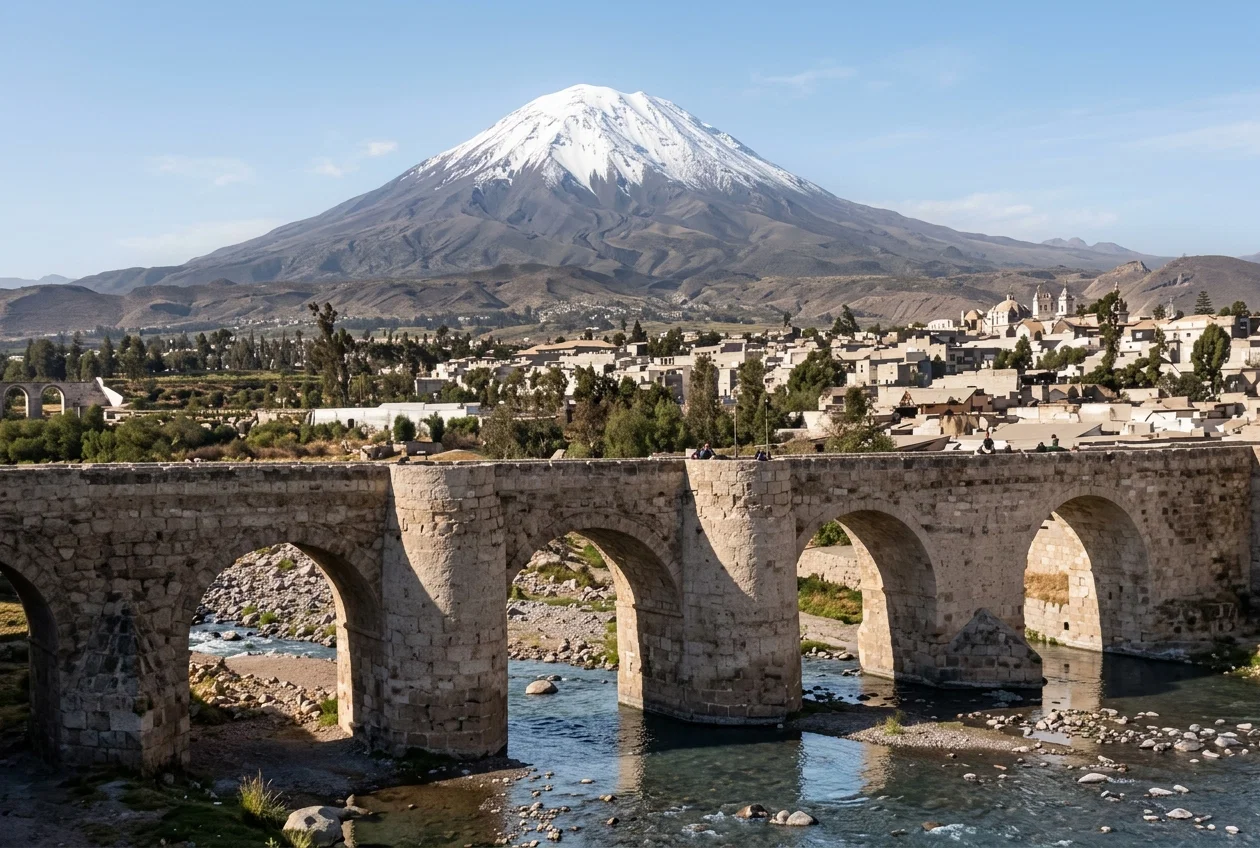
A VIEW OF AREQUIPA (PERU), SHOWING MOUNT MISTI IN THE BACKGROUND
These leaflets, having fallen into enthusiastic hands, were posted throughout the city, on the street corners, church doors, stations through which the papal delegate passed from Lima, Peru, as far as the Congress Hall in La Paz, the capital of Bolivia. The principal object of this campaign was to destroy, if possible, the stupid fear which many of the populace had of the papal officers and leaders.
Under such circumstances the clergy and Catholic press, overcome by the strength of the propaganda, chose to be silent; and if they preached or wrote, it was more of a lamentation over the unfortunate times and the prediction of a disastrous crisis for the interests of the church.
On the thirty-first of August of 1905, the year to which we have been referring, La Reforma addressed circulars to private citizens, societies, clubs, lodges, newspapers, evangelical churches, etc., asking them to send to Congress on September 20, the commemorative day on which Garibaldi’s capture of Rome took place and the pope’s temporal power fell, telegrams asking for the following laws:—
  1. Religious Liberty.
  2. Separation of Church and State.
  3. Expulsion of Religious Congregations.
  4. Prohibition of the Teaching of Religion in the Public Schools by Ecclesiastics.
The result of this movement caused very great surprise. On the day indicated, the Congress in Lima received large numbers of telegrams from all parts of Peru, asking for the passing of the four radical laws just mentioned. The Catholic clergy felt the ground moving from under their feet, and the government and men who were watching for the national welfare understood that the thorough sounding of public opinion just shown was a sign that the ship of state would be safely guided through the waters of Radical reforms, and would make a safe and sure advance.
Arequipa, Peru.