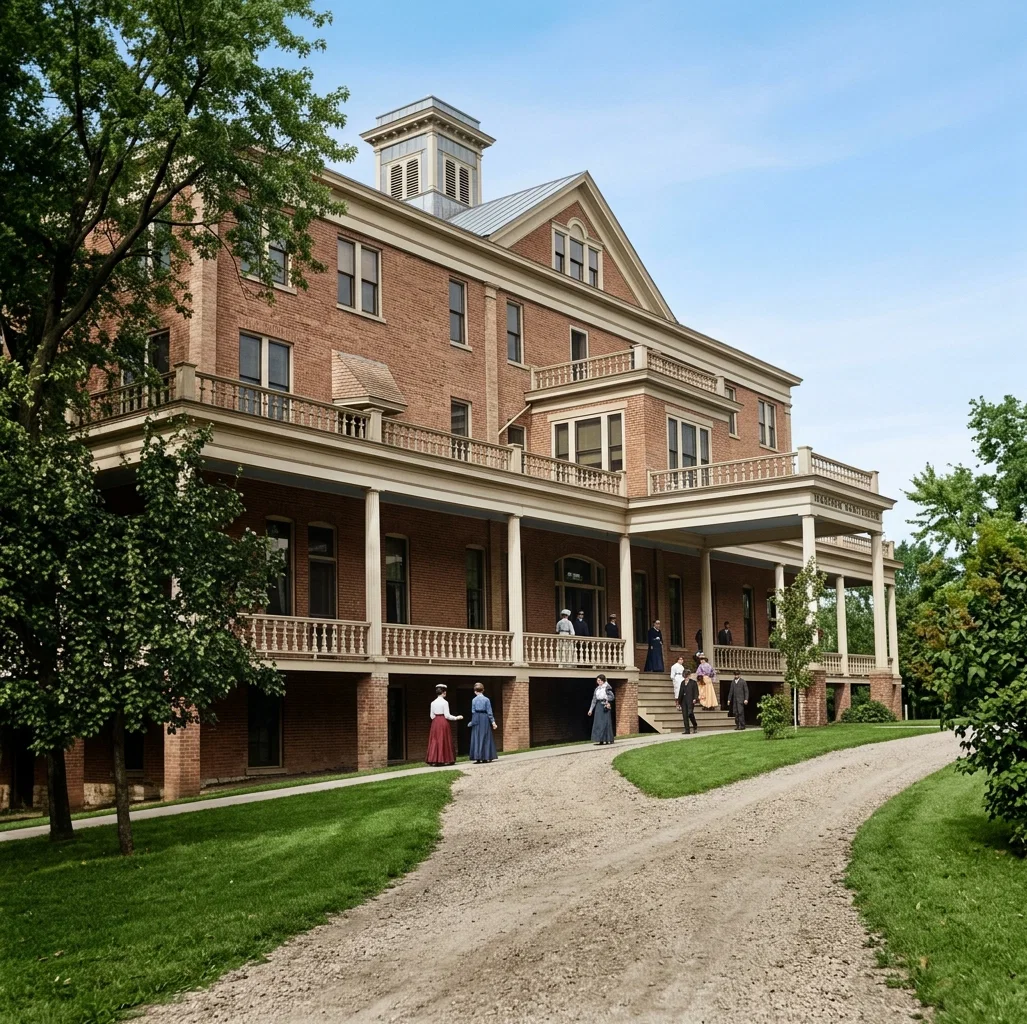
The Madison Sanitarium

6%

Review and Herald Publishing Association · Tacoma Park Station, Washington, D. C. · Feb 7, 1907

FromReview and Herald, Vol. 84, No. 6.

Read the full edition

The Madison Sanitarium

In the winter of 1899 and 1900, Sister Laura E. Neilson, and Sister Edith Miller, who is now Mrs. Dr. Law Keem of China, graduate nurses of Battle Creek, came to Madison at the earnest request of Mrs. W. D. Stillman, who had been in the truth a long time, and was an acquaintance and friend of Sister Ellen G. White and her husband.
A number of years before at the camp-meeting at Madison, Brother and Sister White had spoken very enthusiastically with reference to this city as a favorable location for a sanitarium, and had selected a piece of property for which Dr. Stillman was to negotiate. The papers were ready to be signed, and Dr. Stillman was on his way to have them executed, when he picked up a morning paper in which he saw a notice of the death of Elder White. As Elder White was interested in the proposition, Dr. Stillman decided to wait a little while before executing the papers. The matter was dropped, and until these nurses came at the request of Sister Stillman, nothing was done in the way of medical missionary work in Madison.
These nurses secured work before they had been in the city twenty-four hours, and did such excellent service that there was an immediate demand for them all over the city. About this time Brother and Sister J. H. Bramhall, also nurses from the sanitarium at Battle Creek, joined the work at this place. They secured treatment rooms at 118 Monona Avenue, in May, 1900. From the beginning, the treatment rooms were crowded.
In September Mrs. Farnsworth and I, in response to a call, came to this place to assist in taking care of the growing patronage. About this time a wealthy manufacturer of the city became interested in the work, and sent for Brother Bramhall, who was the business manager of the institution, to call on him. He proposed to give twenty thousand dollars toward building a sanitarium and hospital in the city of Madison. As there was no regular hospital here at that time, it seemed to us an opportune moment. Ten thousand dollars was promised by another citizen of Madison, and ten thousand more was promised by one of the brethren in Illinois, making, altogether, forty thousand dollars. Some serious objections were raised to starting the work on this basis. The workers were much disappointed and dropped the matter at that time. Had we who have been here during these years, had more experience at that time, we would have certainly organized the institution on the basis of all these gifts, but the opportunity passed.
Mrs. Farnsworth and I were called to take charge of the Guadalajara Sanitarium in Mexico, and Dr. Harry B. Farnsworth came to take our places here.
The work progressed satisfactorily, and a restaurant was opened on State Street for the benefit of the university students, in order to teach them the principles of health and open a missionary field among them. The Lord greatly blessed this work.
In the spring of 1902 we returned from Mexico, and again united with the work in Madison, at the request of the Wisconsin Conference, and it was soon decided to build an institution. They secured five acres of land near the Monona Assembly grounds. Plans were drawn up for the institution, and presented by the writer at the Grand Rapids camp-meeting in the summer of 1902. It was enthusiastically voted by the conference in session to established a sanitarium at Madison; but the time had gone by, it seems, for securing donations, as only twenty-two hundred dollars was secured, of which more than half was donated by the helpers of the sanitarium.
In order to prosecute the design of the conference in the institution, the Medical Missionary and Benevolent Association of Wisconsin was formed at the camp-meeting, the constituency being composed of every one in good standing in the denomination in Wisconsin.
The building was erected entirely with borrowed money, about fifty thousand dollars being required, and was dedicated June 7, 1903. There were thirteen patients and seventeen helpers at the institution at the time it was opened. Within four months the institution became self-supporting, and during the first year earned nearly ten thousand dollars more than the running expenses. It was found that it would be necessary to build a dormitory for the nurses, as they had been rooming outside of the building at great expense. This was presented to the conference in session at Oshkosh, and the decision was that if somebody could be found to donate all the money necessary, the dormitory would be built. Brother M. E. Bautelle, of Lake Mills, Wis., who had been suffering for some time with a severe form of rheumatism, made the generous gift of six thousand dollars for this dormitory, in which two rooms were to be built for him and his wife, they to make their home at the sanitarium the rest of their days. The conference accepted this donation, and the dormitory was built during the fall and winter succeeding. In all, there has been given eleven thousand five hundred dollars.
The Lord has blessed the work, and an excellent class of young people have been engaged in taking the nurses' course. A number of patients were converted in the sanitarium, twenty-two accepting the truth, and others being favorably impressed. Up to the present time, there have been about twenty-one hundred patients received in the institution. Nearly four hundred major operations have been performed, without a single death either from the operations or from disease complicating them.
Several helpers not of our faith have been admitted the past two years, among whom there have been ten conversions. Brother Joseph Scott, of Chetek, Wis., was sent here as chaplain. He has been untiring in his efforts to bring the truth before the patients, and uphold the right principles before the helpers. It was due largely to his efforts that these conversions have taken place.
During the last eighteen months the conference has been untiring in its efforts to secure workers for this place, but owing to the general depression which sanitarium work has been under the last two or three years, it was not until this fall that a large class of enthusiastic workers was secured. The institution has earned about twenty-five thousand dollars above the running expenses during the three and a half years of its activity, and in addition to this it has given away in free work an aggregate of about thirty-five thousand dollars, which, considering the size of the institution, is without parallel as far as we are able to ascertain.
These results were attained only through the faithfulness of the graduate nurses, the untiring efforts of those who are in training, and the efforts of the business manager and domestic helpers. Of eighteen graduate nurses we know of only one who is not actively engaged in medical missionary work at the present time. The reputation of the sanitarium is becoming wider and more firmly established every day, with no advertising at all. We praise the Lord for the opportunity of making this report to those who are interested in medical missionary work.
The opportunities for work are increasing in this place. At the present time every room and nearly every bed in the house is filled with patients.
The following is a list of the medical staff and workers of the Madison Sanitarium: Drs. C. P. Farnsworth, Anna Farnsworth, W. Lindsay, W. E. Bliss. Business manager, J. H. Bramhall. Graduate Nurses: Mrs. H. N. Garthofner, Misses Laura Neilson, Myrtle Smith, Mary Rathbun, Alzaide Abbott, Harriet Kathan, and Mr. William Patton. Undergraduate Nurses, third year: Christiana Christenson, Rupert Babcock, Sarah Getchel, Alyse Wirth; second year: Misses Julia Hoveland, Tomenia Nelson, Clara Holford, Lillian Watson, Ethel Thompson, Mattie Smith, Mildred Clark, Helen Peterson; first year: Misses Shanks, Gross, Snyder, Shorey, Catherine Eydle, Hazel Roe, May Melish, and Mr. Cleve Pulver.
C. P. FARNSWORTH.